Professor Dr Aage Bohr (✝︎)
Nobel Prize for Physics 1975
- Section Physics
- Location Kopenhagen, Denmark
- Election year 1981
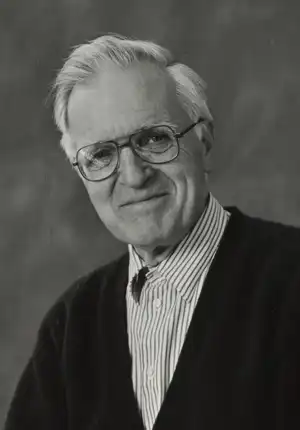
Research
Aage Niels Bohr was a Danish physicist. Together with his compatriot Ben Mottelson and the American Leo James Rainwater, he was awarded the Nobel Prize in Physics in 1975 for the discovery of the connection between collective motion and particle motion in atomic nuclei and the development of the theory of the structure of the atomic nucleus based on this connection.
Person
Aage Niels Bohr, son of Niels Bohr and his wife Margarethe, was born in Copenhagen on 19 June 1922, the same year his father Niels was awarded the Nobel Prize in Physics. The family initially lived near the Institute for Theoretical Physics, which was part of the University of Copenhagen. As a result, Aage Bohr was in contact with science from an early age, with famous physicists coming to his parents' house regularly. In his recollection, he spoke of addressing Nobel Prize winners such as Werner Heisenberg and Wolfgang Pauli simply as “Uncle Heisenberg” or “Uncle Pauli”.
In 1950, Aage Bohr married Marietta Soffer, with whom he had children Vilhelm, Tomas and Margarethe. After his wife died in 1978, Bohr married Bente Meyer in 1981. Aage Bohr's son Tomas Bohr is a professor of physics at the Technical University of Denmark.
Aage Niels Bohr passed away on 8 September 2009 in Copenhagen.
Career
Aage Niels Bohr began studying physics at the University of Copenhagen in 1940, shortly after the German occupation of Denmark. Three years later, when Hitler ordered the deportation of Danish Jews, the Bohr family fled to Sweden. He then accompanied his father, Niels Bohr, to England and the United States, where he worked on the “Manhattan Project” to develop an atomic bomb. During this time, Aage Bohr was his father's secretary and assistant at the Los Alamos laboratory in New Mexico. After the Second World War, Aage Bohr continued his studies in Copenhagen and graduated in 1946. Two years later, he went to Princeton. He spent the years 1949/50 at Columbia University.
Aage Bohr became a professor at the University of Copenhagen in 1956. After his father died in 1962, he succeeded him as director of the Institute for Theoretical Physics (Niels Bohr Institute) at the University of Copenhagen, a post he held until 1970. Between 1975 and 1981, he was also director of the Nordic Institute for Theoretical Physics (NORDITA), with which the Niels Bohr Institute cooperated closely.
Honours and Memberships
Aage Bohr was honoured with numerous other scientific prizes. These included the Dannie Heineman Prize for Mathematical Physics (1960) awarded by the American Institute of Physics and the American Physical Society, the Pope Pius XI Medal (1963), the Atoms for Peace Award (1969), which his father Niels Bohr had already received twelve years earlier, the Örsted Medal (1970) and the Ole Römer Medal (1976). He was a member of numerous scientific organisations, including the Danish, Norwegian, Croatian, Polish and Swedish Academy of Sciences and, since 1981, the German Academy of Natural Sciences Leopoldina.
Nobel Prize
Processes in the atomic nucleus, such as nuclear fission and radioactive radiation from the nucleus, could not be explained with the models available at the time. Together with Ben Mottelson and Leo Rainwater, Aage Bohr succeeded in uniting the two most significant existing models (Elsasser's shell model and Gamow's droplet model) into one common model. James Rainwater published his research in this field in April 1950. A little later, Aage Bohr described the connection between surface oscillation and the movement of individual nucleons in the nucleus. In the following years, he and Ben Mottelson succeeded in proving his theory experimentally. Their most important discovery was the realisation that the positions of the energy levels of certain nuclei could be explained with a rotation spectrum. For this achievement, Aage Bohr received the Nobel Prize in Physics in 1975, together with Ben Mottelson and Leo Rainwater.