G7 Policy Advice
The Leopoldina brings the voice of science to the G7 summits. Together with the academies of the G7 countries, it develops science-based recommendations on globally relevant topics and thus strengthens the link between science and politics.
Last edited: 14. July 2026

Publications
The annual summit meetings of the heads of state and government of the G7 countries are accompanied by the science academies of these countries. They draw up science-based statements on the topics on the summit agenda. The academy of the host country takes the lead in each case - including the Leopoldina in 2022 during the German G7 presidency.
Advising the G7 summits is an important instrument for contributing scientific expertise to political decision-making processes. The academies work together in the Science7 (S7) format. The joint recommendations are published before the summits and presented to the respective G7 presidency at a science conference.
On the occasion of the German G7 presidency in 2022, the German government mandated the Leopoldina to lead the Science7 process. The thematic priorities were ocean and climate issues, antiviral drugs and One Health. In 2015, the Leopoldina had already coordinated the statements of the G7 academies on antibiotic resistance, tropical diseases and the future of the oceans.
The G7 is made up of Canada, France, Germany, Italy, Japan, the United Kingdom and the United States. The European Union is also represented.
G7 Statements 2026
Brain Health
Neurological and mental disorders affect almost one in three people over the course of their lives. The economic impact is considerable, with global costs estimated at five trillion US dollars per year. The G7 academies therefore recommend treating brain health as an important issue throughout the life course — from early childhood to old age — and addressing it not only within health policy, but as a cross-cutting policy priority. To this end, they recommend establishing a “Brain Health Advisory Council” at G7 level — an advisory body that could formulate science-based guidance for policy measures, identify emerging innovations and ensure ethical oversight. To accelerate both scientific and clinical advances in brain research, the G7 countries are called upon to launch an investment and innovation initiative to secure funding from public resources and private capital. Medical progress will also depend on harnessing the potential of large datasets, artificial intelligence, advanced imaging and genomics. As neurological and mental disorders pose a particular challenge for low- and middle-income countries, the recommended initiatives should also be designed to extend beyond the G7. G7 Statement “Advancing Brain Health (including Mental Health)” (2026)
The Arctic as an Early Warning System
Over the past 40 years, the Arctic has warmed almost four times faster than the global average. The consequences are visible locally: sea ice and glaciers are retreating, permafrost is thawing, coastlines are eroding, wildfires are increasing and ecosystems are changing. However, these changes are not confined to the region. Thawing permafrost can release large quantities of carbon dioxide and methane. The melting of the Greenland ice sheet contributes to sea-level rise. Changes in the Arctic can also affect ocean currents, weather patterns and ecosystems far beyond the region itself. The statement therefore describes the Arctic as an early warning system. The G7 academies call on the G7 countries to uphold the Paris Agreement and to reduce greenhouse gas emissions rapidly and sustainably. They are also proposing a moratorium on geoengineering in the Arctic. At the same time, international and interdisciplinary research cooperation on Arctic change should be strengthened, and Indigenous and local knowledge should be incorporated. G7 Statement “The Global Arctic” (2026)
Large Satellite Constellations
An increasing number of satellites are being launched into low- and medium-Earth orbits. Large satellite constellations can improve internet access worldwide, enable communication in remote regions and support near-real-time Earth observation. At the same time, they pose risks: the growing number of satellites increases the danger of collisions and space debris. It also remains unclear to what extent the upper atmosphere is being affected by chemicals and dust particulates resulting from frequent rocket launches and the re-entry of satellites and rocket stages. The G7 academies recommend supporting research into the effects of space activities on the atmosphere and into the development of satellite-based communication networks, while also establishing clear rules for their sustainable use. These should include binding standards for “de-orbiting”, meaning the removal of defunct satellites from orbit, improved systems for monitoring the use of Earth’s orbital environment, and robust assessments of how many objects particular orbits can safely accommodate over the long term. G7 Statement “Large Satellite Constellations” (2026)
Impressions
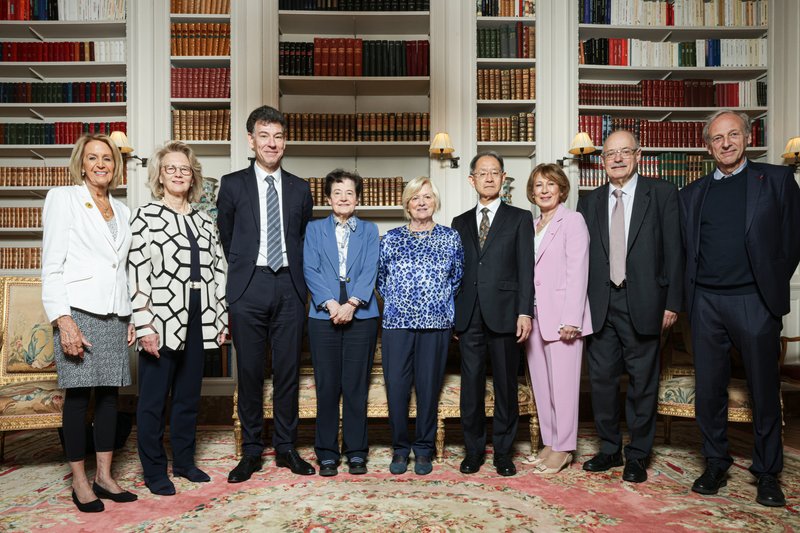
Group photo of the representatives of the G7 academies with Philippe Baptiste, French Minister for Higher Education, Research and Space, at the Science7 Summit 2026, hosted by the French National Academy of Sciences (Académie des sciences), Paris, France.
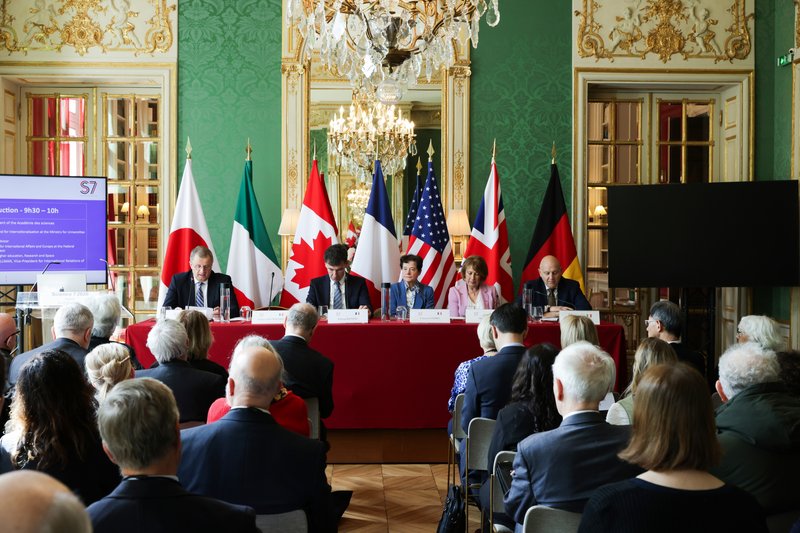
Opening session at the Science7 Summit 2026, hosted by the French National Academy of Sciences (Académie des sciences), Paris, France
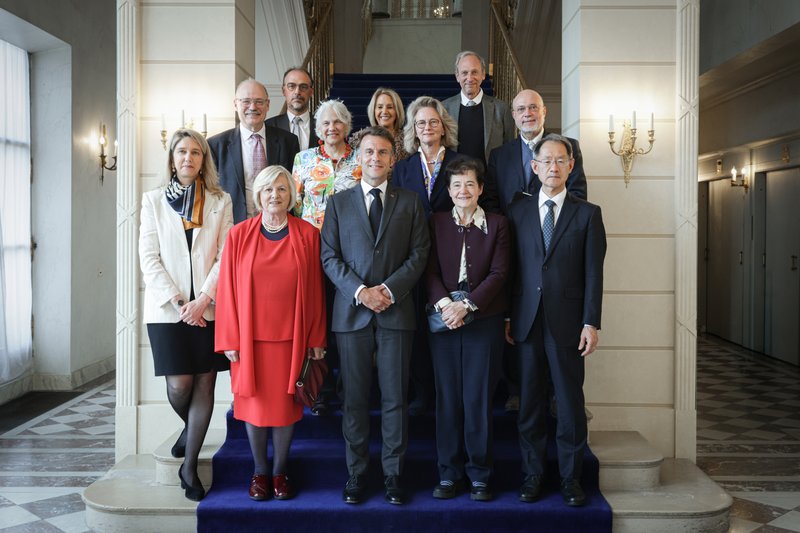
Group photo of the representatives of the G7 academies with Emmanuel Macron, President of the French Republic, 19 May 2026, Science7 Summit 2026, Paris, France

Presentation of the Science7 statements to Wolfgang Schmidt, Head of the German Federal Chancellery, Science7 Dialogue Forum 2022, Berlin.

Keynote by Wolfgang Schmidt, Federal Minister for Special Affairs and Head of the German Federal Chancellery, Science7 Dialogue Forum 2022, Berlin

2025 Summit of the S7 academies, hosted by the Royal Society of Canada (RSC), Ottawa, Canada

Drafting meeting of the G7 academies, chaired by the Leopoldina, 2022, Halle

Presentation of the Science7 statements, 2023, Tokyo, Japan

Presentation of the Science7 statements to Sergio Mattarella, President of the Italian Republic, 2024, Rome, Italy

Presentation of the Science7 statements, 2025, Ottawa, Canada
-
Kontakt Dr. Ruth Narmann
Head of International Relations Department
-
Kontakt Christian Weidlich
Deputy Head of International Relations Department