Infrastructure modernisation and CO₂ pricing
Infrastructure modernisation, grid expansion and monitoring
Major public and private investment is needed to restructure the energy system's infrastructure. Close Europe-wide coordination is required for electricity transmission grids, hydrogen infrastructure, charging stations for e-mobility and digital infrastructures in order to create a standardised European energy system. Renewable electricity must be transported and distributed with as few bottlenecks as possible. This requires efficient transmission and distribution grids as well as energy storage systems that take into account the fluctuating nature of renewable energy generation. Investments in energy efficiency are also important, as they reduce the overall demand for energy.
In order to assess the effectiveness of European energy and climate policy promptly and precisely and to be able to make adjustments if necessary, the EU should also set up a comprehensive monitoring system. The absolute quantity of annual greenhouse gas emissions is a suitable central target and measurement parameter.
CO₂ price as a key instrument of climate policy
General CO₂ pricing creates an economically efficient, stable and long-term framework for the transformation of the energy system. The CO₂ price should therefore be established as a guiding instrument of European and international climate policy. A standardised price should be sought for all greenhouse gases across sectors, regions, actors and technologies. Whether this CO₂ pricing is implemented on a quantity-based (certificate trading) or price-based (tax/levy) basis is of secondary importance from an economic perspective.
Questions and answers
Question
Why do we need a CO₂ price?
Answer
A CO₂ price makes the consumption of fossil fuels financially unattractive, as the CO₂ emissions generated during the production or consumption of a product have to be paid for. The CO₂ price can therefore change the behaviour of consumers, companies and investors and create incentives to switch to climate-friendly alternatives for electricity supply, heating or mobility. In addition, a carbon price can trigger technological innovations and generate revenue that can be used in the interests of European climate policy. Although carbon pricing has the potential to defossilise the global economy, only around a fifth of global emissions have been covered by pricing systems to date. The global average price (in $ per tonne) is only in the single digits. However, a global carbon price in the high double-digit or even triple-digit range would be necessary to reduce emissions sufficiently to keep global warming below 2°C. It should be noted that non-price measures also incur costs, which - converted into corresponding (shadow) prices per tonne avoided - typically lead to far higher burdens.
In order to compensate for the social hardship of a high CO₂ price, a significant proportion of the revenue should be paid back to households, for example in the form of a "climate dividend". Relative to their income, low-income households in particular should be favoured. This can contribute to social acceptance. Climate-friendly behaviour could then even lead to a financial gain for consumers, especially among lower income groups.
Audioplayer
Prof Dr Christoph M. Schmidt on the strength of CO₂ pricing
Economist

With the EU Emissions Trading Scheme (EU ETS), a functional instrument has been established for the energy sector, industry and intra-European aviation, which already covers around 45 per cent of the EU's greenhouse gas emissions. This instrument must be further expanded and improved. For example, the climate protection target of EU-wide greenhouse gas neutrality by 2050 should be made binding for all member states in the EU Climate Law. A consistent reduction in the permitted volume of emissions reliably ensures an effective CO₂ price path that creates planning security and provides lasting incentives for sustainable climate protection investments.
How does emissions trading work?
The following graphics show step by step how certificates are allocated, traded, and reduced—and how this makes climate protection effective in a market economy.

The Emissions Trading System (ETS or EU-ETS) was introduced by the European Union in 2005 and is an important climate protection instrument. It is primarily aimed at industries with a high energy requirement, such as power plants or aviation companies. The system applies in all EU countries, as well as in Iceland, Norway, and Liechtenstein. Emissions trading intends to create financial incentives for companies to reduce their greenhouse gas emissions and to invest in climate-friendly technologies. How many emissions a company is permitted to produce depends on how many emission certificates it has. These can either be purchased or are directly assigned. The German Emissions Trading Office at the German Environment Agency (DEHSt) is responsible for the implementation of German emissions trading and awarding the certificates. Almost all revenue from emissions trading is put into the climate and transformation funds.

EU Emissions Trading works according to the “cap and trade” principle. The EU Commission decides how many greenhouse gases can be released by all companies in total (cap). A certificate is awarded for every permissible tonne of CO₂. Industrial plants receive a certain quota of free emission rights according to fixed regulations, and the rest is assigned as a result of auctions on a European stock exchange. After this, emissions rights can be freely traded and companies can purchase emission rights from other companies. The prices for these certificates are based on the supply and demand principle and thus created through trade. Every year there are fewer certificates in circulation, while the market price for emissions rights increases. The incentive for companies to avoid emissions and to invest in climate-friendly or more environmentally friendly technology grows.
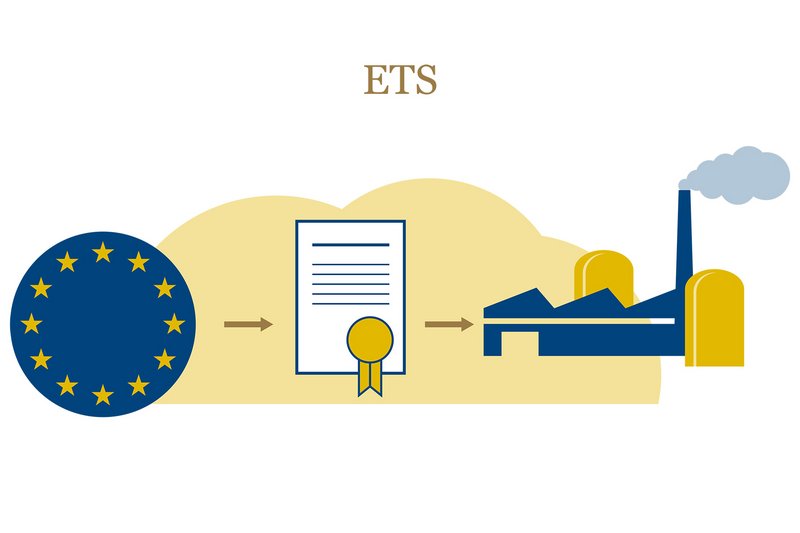
The Emissions Trading System offers the possibility to trade with certificates. If companies exceed their certificate quota (i.e. release more CO₂ than covered by their emissions rights) they have to acquire more emissions rights at the relevant market price. Companies with an excess of emission certificates benefit from this, as they have successfully reduced CO₂ and thus saved energy. Example: Company A has 100,000 permissions to emit CO2 but annually they emit 150,000 tonnes CO₂. Company A must therefore purchase an additional 50,000 permissions. Company B also purchased 100,000 permissions but only used 60,000 of them. Company B can now trade with their excess of 40,000 permissions and sell them to Company A, for example.

EU-ETS should also apply to shipping, road transport, buildings, and fuels in future. As soon as emissions trading applies to buildings and transport, certificate trade would have a direct influence on petrol and heating costs, and thus on consumers. Prices would be more likely to rise rather than drop. However, there should be a price brake, and a climate social fund in the amount of 87 billion should be set up to reduce the burden on households and small companies.
Carbon cycle management
There is a natural carbon cycle on earth. Plants absorb carbon from the air or water and bind it in biomass. This removes the carbon from the atmosphere and water for a certain period of time. Dead plant matter is decomposed by microorganisms and the carbon is released back into the atmosphere.
Humus-rich soils, oceans and forests store large amounts of carbon and thus help to absorb CO₂ emissions. In Germany, peatlands play an important role in climate protection. In functioning (undrained) peatlands, biomass does not decompose and the carbon stored in it is permanently removed from the atmosphere and stored as peat. Due to factors such as the burning of fossil fuels and intensive land use, more and more carbon dioxide is released and ends up in the atmosphere or the ocean. How long the oceans, for example, can continue to absorb CO₂ is uncertain. It is possible that from around 2050, the oceans' ability to absorb CO₂ will be exhausted and they will become a source of CO₂. This would further intensify global warming.
Even optimistic scenarios for the development of global greenhouse gas emissions assume that fossil fuels will be used until the middle of this century. This means that more climate-relevant gases will be emitted than is permissible. In addition, there are areas in which it will be difficult to completely eliminate CO₂ emissions by 2050 (e.g. air and sea transport, cement production). In the medium term, it will therefore be necessary to permanently remove CO₂ from the atmosphere, i.e. to promote carbon cycle management.
Carbon storage: technological solutions
The technical processes of carbon storage consist of two steps: the removal of CO₂ from the atmosphere and its long-term storage or sequestration. One option is to bind CO₂ to biomass. If this is burnt to generate energy, highly concentrated CO₂ is produced. This can then be separated from the combustion gases and ultimately used to produce durable goods, such as building materials or plastics, or injected into geological formations. The filtering of CO₂ from the atmosphere, direct air capture (DAC), is a process currently under development. However, this requires a considerable amount of energy and involves a number of other chemical challenges that have not yet been well resolved.
One family of possible processes for the storage and further use of carbon dioxide is "Carbon Capture and Utilisation" (CCU for short). Here, carbon is fed into at least one further utilisation cycle and can be used, for example, in the synthesis of final energy sources in transport, industry and heat supply. Depending on the origin and utilisation of the carbon, this requires various processes that are differently energy-, resource- and environmentally-intensive. However, the CO₂ eventually returns to the atmosphere - when exactly depends on the longevity of the consumer goods.
The "Carbon Dioxide Capture and Storage" process (CCS for short) aims to remove CO₂ from the carbon cycle as permanently as possible and store it underground. To achieve this, CO₂ is stored in geological formations or on the seabed, for example. The CO₂ to be stored comes either from fossil energy supply and industrial plants or from the use of biomass to generate energy. However, this process currently requires additional energy input and increased consumption of fossil raw materials.
The family of CCU processes is suitable for processing part of the CO₂ extracted from the atmosphere (technically or with biomass) with green hydrogen into energy sources (such as e-fuels or SAF). At the same time, an equivalent proportion of the molecules are converted into elemental carbon by recovering the hydrogen they contain. This can be used as a structural material (soil improvement, building materials) or stored in imitation of nature and thus permanently removed from the atmosphere.
Carbon storage: Natural solutions
Natural or nature-based solutions are also available for the long-term removal and storage of carbon from the atmosphere: Plants incorporate carbon into biomass and store it in wood and, after they die, in organic deposits (e.g. humus or peat) in forests, wetlands, coasts and oceans. In addition to the positive effect on the climate, this also serves to preserve or restore intact ecosystems.
In addition to large areas of forest and the Earth's global permafrost belt, seagrass meadows on the coasts of the North and Baltic Seas are also among the threatened habitats. Seagrass meadows play an important role in the life cycle of fish. The sediments under the seagrass meadows store large amounts of carbon, as the biomass decomposes very slowly, similar to bogs.
Nature-based solutions also include the forced weathering of rocks, ocean fertilisation and the spreading of biochar.
Scope of carbon management
All of the methods listed together can only capture a fraction of the human CO₂ emissions generated today and are no substitute for doing without fossil fuels. A distinction must be made between two objectives in their evaluation: On the one hand, the goal of using CCU measures to keep carbon in a technological cycle that is designed to be similar to the natural cycle. The second is the goal of permanently removing carbon from the atmosphere and thus rendering it climate neutral. Such measures are needed to neutralise unavoidable technical emissions from the material use of carbon-containing minerals (cement and glass) and from the consequences of land use (e.g. forestry and agriculture). They will be required on an even larger scale in order to meet today's climate targets. In this case, the CO₂ already released into the atmosphere would have to be removed again and rendered climate neutral.
In any case, carbon management measures will require considerable amounts of additional renewable energy and infrastructure for large-scale processes. Their financing must be factored into the design of market models for sustainable energy systems today.