Locations
The Leopoldina is represented at locations in Halle (Saale) and Berlin. The Academy's headquarters, archive and library are located in Halle (Saale). In Berlin, it maintains offices and seminar rooms for contact with research communities, funding initiatives, professional associations and federal politics. Together, the two locations reflect the current work of the Leopoldina as the National Academy of Sciences and its long history as the German Academy of Sciences.
The Head Office in Halle (Saale)
Further information
In Halle (Saale), the Leopoldina is in the public eye with two building complexes: the headquarters with the office on Jägerberg and the traditional location at Emil-Abderhalden-Straße 35 to 37 and August-Bebel-Straße 50a.
The site on which the current main building stands was raised in the 16th century as a protective rampart at Moritzburg Castle. At the beginning of the 17th century, probably under the administration of Christian Wilhelm, the “Fürstliche Jägerei” (princely hunting lodge) was built on this site, giving the area its name. From 1792, the property belonged to the masonic lodge "Zu den Drei Degen", which laid the foundation stone for the lodge house here around 1820. Concerts, balls and parties were held in the two-storey building. Since then, the exterior has been remodelled and extended to resemble a neo-classical building from the early 19th century. Today it is known in Halle (Saale) as the "White House".
Under pressure from the National Socialist state, the lodge had to hand over its building to the city of Halle as a "donation" in 1937. After 1945, the Soviet Military Administration (SMAD) and the Martin Luther University Halle-Wittenberg used the building as a cultural centre and lecture hall building respectively, the latter named after the Russian philosopher and writer Nikolai G. Chernyshevsky.
Impressions from the history of the Leopoldina main building


Condition of the Leopoldina main building before the refurbishment

Staircase in the Leopoldina main building in Halle (Saale) during the refurbishment

Exterior view of the Leopoldina main building in Halle (Saale) during the refurbishment in 2011
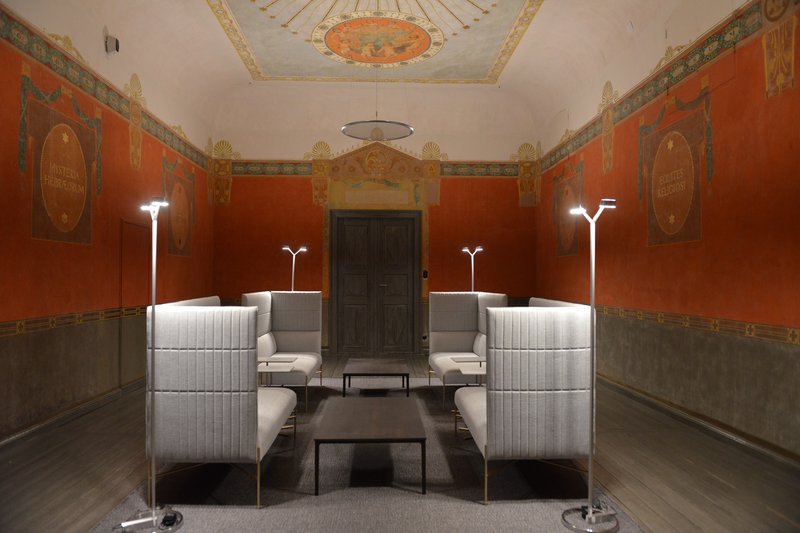
Historical ritual room of the Leopoldina

Seal of the Leopoldina on the main building in Halle (Saale)
Johann Lorenz Bausch Johann Lorenz Bausch ▸
- Election year 1652

Further information
In 2009, the Leopoldina was able to acquire the building from the non-profit Weltkugelstiftung, the legal successor to the Masonic Lodge "Zu den Drei Degen". In the course of the refurbishment between 2009 and 2011, a large number of historical artefacts were brought back to light, including the Scagliola columns and semi-columns in the ballroom and the marble relief in the lecture hall. At the same time, historical ritual rooms of the Masonic Lodge were discovered, one of which - the ritual room of the VI degree - was restored between 2015 and 2018. With its artistically valuable wall and ceiling design from 1906, it is a rarity in Germany. On the other hand, the ballroom for 380 people and the lecture hall for 170 people as well as the presidium room and the seminar rooms were created as different event rooms. Since 2012, lectures, symposia, closed meetings, science cafés, S7 and S20 working meetings, annual meetings, trade fairs, debates, academy discussions, lectures and the Long Night of the Sciences have been held in these rooms. The Jägerberg also houses the offices of the National Academy with the seat of the President, the President's Office and the General Secretariat.
Guests of the Leopoldina can also visit the park, which includes a garden as well as memorials and artistic elements: For example, the memorial stele commemorates members of the Leopoldina, including those from Jewish families, who were murdered during the National Socialist regime or died in the cruel camps. There is also a bust of Johann Laurentius Bausch, who founded the Leopoldina in Schweinfurt together with three doctors in 1652, as well as a group of sculptures on the west side of the grounds.
Impressions of the Leopoldina main building today
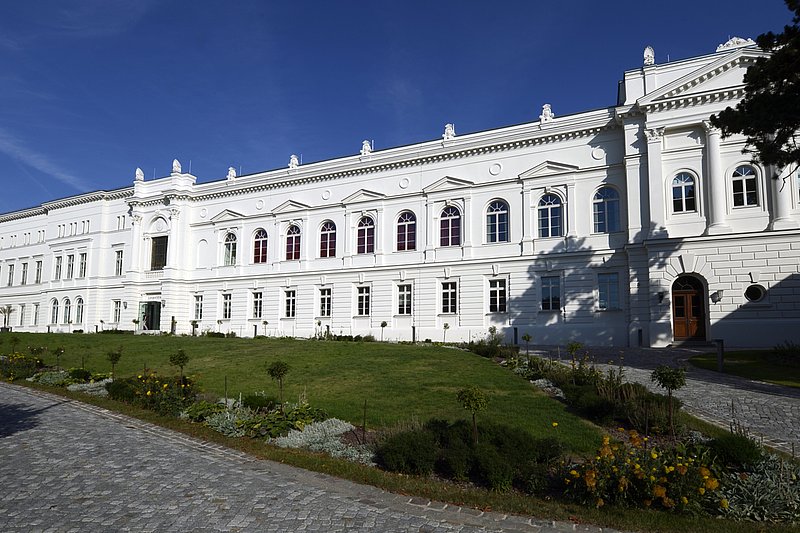
The Leopoldina main building today

Ballroom in the Leopoldina main building in Halle (Saale)
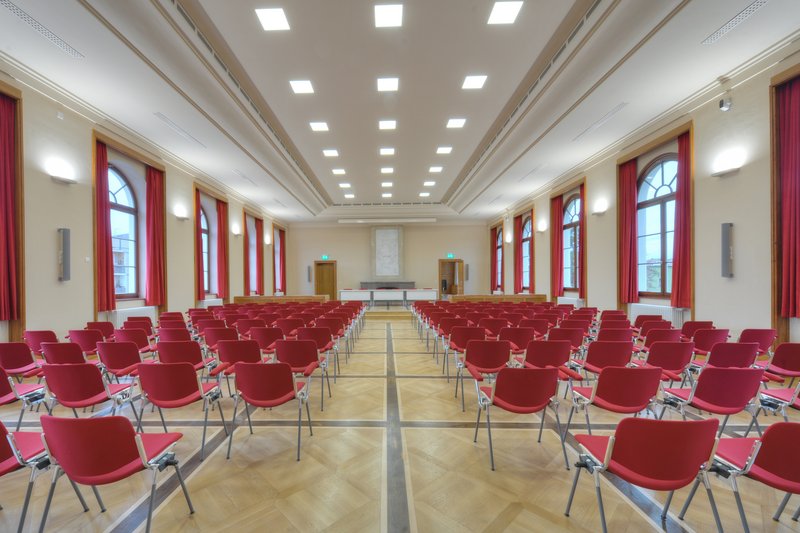
Lecture theatre in the Leopoldina main building in Halle (Saale)

Stele in memory of NS victims

Outdoor area of the Leopoldina main building in Halle (Saale)

Glass windows in the main staircase in Halle (Saale)

Details on the exterior façade of the Leopoldina main building in Halle (Saale)
In 2009, the Leopoldina was able to acquire the building from the non-profit Weltkugelstiftung, the legal successor to the Masonic Lodge "Zu den Drei Degen". In the course of the refurbishment between 2009 and 2011, a large number of historical artefacts were brought back to light, including the Scagliola columns and semi-columns in the ballroom and the marble relief in the lecture hall. At the same time, historical ritual rooms of the Masonic Lodge were discovered, one of which - the ritual room of the VI degree - was restored between 2015 and 2018. With its artistically valuable wall and ceiling design from 1906, it is a rarity in Germany. On the other hand, the ballroom for 380 people and the lecture hall for 170 people as well as the presidium room and the seminar rooms were created as different event rooms. Since 2012, lectures, symposia, closed meetings, science cafés, S7 and S20 working meetings, annual meetings, trade fairs, debates, academy discussions, lectures and the Long Night of the Sciences have been held in these rooms. The Jägerberg also houses the offices of the National Academy with the seat of the President, the President's Office and the General Secretariat.
Guests of the Leopoldina can also visit the park, which includes a garden as well as memorials and artistic elements: For example, the memorial stele commemorates members of the Leopoldina, including those from Jewish families, who were murdered during the National Socialist regime or died in the cruel camps. There is also a bust of Johann Laurentius Bausch, who founded the Leopoldina in Schweinfurt together with three doctors in 1652, as well as a group of sculptures on the west side of the grounds.
The traditional location in Halle (Saale)
Further Information
The building complex in today's Emil-Abderhalden-Straße 35 to 37 and August-Bebel-Straße 50a is considered a traditional location of the Leopoldina. It houses the archive, the library and the reading room, as well as the Centre for Science Research and the Scientific Editorial Office and the Admissions Office.
When the Academy settled permanently in the university city of Halle in 1878, the library with its 40,000 volumes also moved from Dresden to the Saale a year later. Initially, the collection - as well as the Leopoldina itself - was housed on the premises of the University Surgical Clinic on Domplatz. In May 1904, the Academy was given a completely new building of its own in Friedrichstraße, now August-Bebel-Straße 50a. This was erected within less than a year and also extended in part to a property in Wilhelmstraße, now Emil-Abderhalden-Straße 37. The steel skeleton building with its clear separation between stacks and offices was one of the most modern library buildings of its time. In addition to the library, it also housed the offices of the presidents and the chancellery, later the presidential office, general secretariat and administration, until 2012.
The library's collection was planned to grow over a period of 35 years, after which the villa on the site was to be demolished and replaced by an additional storage wing. But things turned out differently: war, the post-war period and the division of Germany characterised the subsequent history of the Leopoldina, the library building and the archive and library. Neither the planned demolition nor later renovations and extensions were ever realised.
Today, the library building is largely as it was in 1904, and the conservation and security conditions are now so critical that more than half of the holdings of around 280,000 volumes, monographs and journals from the natural sciences and medicine have had to be removed since 2021. At the same time, the Leopoldina is working on a solution to accommodate the holdings in accordance with current standards and to create new space for exhibitions and lectures.
The state of the library at the end of 2024 is now documented in a 3D visualisation. For the view of the building structure with six storage levels at the back and two at the front, a part of the building was selected that allows a detailed view over two floors.
The archive, one of the oldest academy archives in the world, was also initially housed in what is now Emil-Abderhalden-Straße 37. The core of the collection comprises the matriculation and protocol books as well as CVs, lists of publications and portraits of members as well as correspondence series and administrative documents. In addition, more than 80 estates of academics, photographs on the history of the academy and science, art objects, a medal collection and a sound archive are stored here.
The entire collection, currently totalling around 1,200 linear metres, has been housed at Emil-Abderhalden-Straße 35 since 1998. The Leopoldina acquired the Wilhelminian-style building in 1996 and converted the existing offices for archive purposes.
Impressions of the traditional location of the Leopoldina


Locations in Berlin
In the German capital Berlin, the Leopoldina is represented at two locations at Reinhardtstraße 16 and Unter den Linden 42. Both buildings are centrally located just a few minutes' walk from Friedrichstraße S-Bahn station and Brandenburger Tor S-Bahn station respectively.
Offices and meeting rooms are available at both locations, which are used for the work of the President and the Academy management in particular. In addition, contacts that the Academy maintains as part of its activities in policy advice, academic diplomacy and institutional networking are maintained from here. These include discussions, working meetings, kick-off meetings and round table talks with the Alliance of Science Organisations, research communities and funding initiatives, research-related associations and committees, federal politicians and their committees, as well as federal ministries and the Saxony-Anhalt state representation.
The offices at Reinhardtstraße 16 in the Berlin-Mitte district are part of the Hans Dietrich Genscher House complex, which comprises Reinhardtstraße 14 to 16. The Sankt Maria Viktoria Hospital was built on this site between 1908 and 1912 and was run by the Dominican Order until 1938. In the GDR, the Deutsche Bauernverlag and the Deutsche Landwirtschaftsverlag had their headquarters here. Following its acquisition and refurbishment until 1999, the FDP used the listed building as its federal office. Several floors are also rented out to third parties, and the Leopoldina has been using the premises since 2009.
The rooms at Unter den Linden 42 are located in "Haus Pietzsch", also in the Mitte district. The building was constructed between 1993 and 1995 and has a comparatively narrow façade of 15.71 metres facing the avenue Unter den Linden. Behind this façade is an atrium in which changing exhibitions are shown. The Leopoldina has been one of the tenants in the six-storey office and commercial building since 2020.