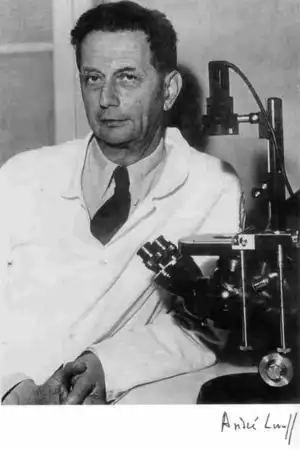
Prof. Dr. André Lwoff (✝︎)
Nobel Prize for Physiology or Medicine 1965
- Section Microbiology and Immunology
- Location Paris, France
- Election year 1970
Research
André Michel Lwoff was a French biologist and virologist. He was one of the founders of modern molecular biology, and the bacterium Acinetobacter lwoffii bears his name. Lwoff was awarded the Nobel Prize in Physiology or Medicine jointly with the French molecular biologists François Jacob and Jacques Monod for their discoveries in the area of genetic control of enzyme and virus synthesis in 1965.
Person
André Lwoff was born on 8 May 1902 as the son of the psychiatrist Solomon Lwoff and his wife Marie, a sculptor, in Ainay-le-Château near Vichy, France. His parents had previously escaped Tsarist Russia. His father was responsible for sparking André’s interest in science and research at an early age. He attended the Lycée Voltaire in Paris.
On 5 December 1925, he married the French biologist Marguerite Bourdaleix.
André Lwoff died on 30 September 1994 in Paris.
Since 2000, the Federation of European Microbiological Societies (FEMS), for which Lwoff served as President from 1974 to 1976, bestows the Lwoff Award endowed with 1,000 euros for scientific achievements in the field of microbiology.
Career
André Lwoff studied natural sciences and medicine and joined the Paris Institut Pasteur at the young age of 19. In 1927, he earned his medical degree M.D., followed by his doctorate (Dr. rer. nat.) in 1932. A scholarship from the American Rockefeller Foundation allowed him to join the Kaiser Wilhelm Institute for Medical Research in Heidelberg, Germany, where he worked in a laboratory under Otto Meyerhof (Nobel Prize in Physiology or Medicine 1922) for a year, studying the development of flagellates. In 1936, he spent seven months at the University of Cambridge, UK, – again with financial support from the Rockefeller Foundation.
In 1938, he became the director of the department of microbial physiology at the Institut Pasteur in Paris, France, where studies on bacteriophages and the poliovirus were conducted. The geneticists and molecular biologists Jacques Monod and François Jacob were part of the working group with whom Lwoff investigated how the genetic code could be decrypted and read. Thanks to their location in the building, the working group was soon nicknamed "Le Grenier”, the attic.
During the time of National Socialism, the research at Institut Pasteur was obstructed by the German occupation and eventually interrupted. Together with his colleague Jacques Monod, Lwoff worked in the French underground to fight the German occupation, for which he was made an officer of the Legion of Honour (1982). After the Second World War, the group resumed their work again, and their results were later honoured with the Nobel Prize.
From 1947, Lwoff worked as Dunham lecturer at Harvard University in Cambridge, USA. From 1959 to 1968, Lwoff served as professor for microbiology at Sorbonne University in Paris. After this, he became the director of the Institut Gustave Roussy for cancer research in Villejuif, France, and held this position until his retirement in 1972.
Honours and Memberships
For his scientific work André Lwoff received countless other awards, such as Leeuwenhoek Medal of the Royal Society (1960), the Keilin Memorial Lecture medal of the British Biochemical Society (1964) as well as the Grand Prix Charles-Léopold Mayer and the Barbier Prize of the Académie Nationale de Médecine.
He was a member of the Harvey Society (1954), the American Society of Biological Chemists (1961), the Society for General Microbiology (1962) and the German National Academy of Sciences Leopoldina (1970), as well as an Honorary Member of the New York Academy of Sciences (1955) and the American Academy of Arts and Sciences (1958). He was also an Associate of the US-American National Academy of Sciences (1955), a Corresponding Member of the Botanical Society of America (1956) as well as a Foreign Member of the Royal Society, UK (1958).
Several universities awarded him an Honorary Doctorate, such as the universities of Chicago (1959), Oxford (1959), Glasgow (1963), Leuven (1966) as well as Liège (1967), Brussels and Bucharest (both 1969).
Nobel Prize
From mid-20th century, the pace of research on genetics accelerated. Until then, the question had remained how the genetic makeup itself is controlled. Together with his colleagues at the Institut Pasteur in Paris, André Lwoff discovered a “switch” for the genetic information that made it possible to turn it on or off, as needed. Examining two genes, the three scientists found out how this switch works and how it is regulated. Jointly with his colleagues François Jacob and Jacques Monod, Lwoff was awarded the Nobel Prize in Physiology or Medicine for this work and discoveries in the area of genetic control of enzyme and virus synthesis in 1965.