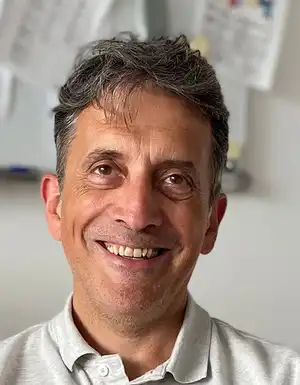
Professor Dr Andrea Musacchio

- Section Biochemistry and Biophysics
- Location Dortmund, Germany
- Election year 2023
Research
Research Priorities: Cell division, chromosomes, mitotic spindle, centromeres, kinetochores
Andrea Musacchio is an Italian structural, molecular, and cell biologist. He studies the molecular mechanisms of cell division, with important implications for the study of genetic alterations in tumors and other diseases.
Andrea Musacchio’s focus in on the processes that enable errorless distribution of the genome from a mother to its daughter cells. During mitosis, chromosomes consist of two identical, connected copies. During cell division (mitosis) the chromosomes attach themselves to a framework called the mitotic spindle. The attachment involves complex structures called kinetochores. As soon as the chromosomes are all arrayed on the spindle through such attachments, they are disconnected and redistributed towards both ends on the dividing mother cell. Thus, each daughter cell inherits the same chromosomal make-up.
Musacchio’s group focuses on the study of kinetochores. Kinetochores provide the chromosomes with points of attachment onto the mitotic spindle during cell division. In addition to that, kinetochores also govern control mechanisms that correct errors during attachment to the microtubules of the mitotic spindle and that coordinate the timing of chromosome disconnection with the achievement of alignment. These mechanisms are vital for cell viability, as their suppression would lead to mistakes during the division of chromosomes, in turn causing the daughter cells to inherit the wrong number of chromosomes. Thus, kinetochores are pivotal for the inheritance of the genome and the propagation of life.
In his research, Andrea Musacchio combines biochemical reconstructions with structural and cell biological analyses to gain insight into the function of kinetochores. His working group was able to reconstitute in vitro kinetochore particles that contain all known core subunits. Similarly, it reassembled one of the aforementioned error correction mechanisms with purified components. Using X-ray crystallography and single-particle cryo-electron microscopy, Musacchio’s group determined the structures of the kinetochore’s crucial modules and used this information to introduce precise, targeted perturbations to address function. These approaches are allowing Musacchio to elucidate fundamental unknown functional aspects of kinetochore’s biology.
Andrea Musacchio is an Italian structural, molecular, and cell biologist. He studies the molecular mechanisms of cell division, with important implications for the study of genetic alterations in tumors and other diseases.
Andrea Musacchio’s focus in on the processes that enable errorless distribution of the genome from a mother to its daughter cells. During mitosis, chromosomes consist of two identical, connected copies. During cell division (mitosis) the chromosomes attach themselves to a framework called the mitotic spindle. The attachment involves complex structures called kinetochores. As soon as the chromosomes are all arrayed on the spindle through such attachments, they are disconnected and redistributed towards both ends on the dividing mother cell. Thus, each daughter cell inherits the same chromosomal make-up.
Musacchio’s group focuses on the study of kinetochores. Kinetochores provide the chromosomes with points of attachment onto the mitotic spindle during cell division. In addition to that, kinetochores also govern control mechanisms that correct errors during attachment to the microtubules of the mitotic spindle and that coordinate the timing of chromosome disconnection with the achievement of alignment. These mechanisms are vital for cell viability, as their suppression would lead to mistakes during the division of chromosomes, in turn causing the daughter cells to inherit the wrong number of chromosomes. Thus, kinetochores are pivotal for the inheritance of the genome and the propagation of life.
In his research, Andrea Musacchio combines biochemical reconstructions with structural and cell biological analyses to gain insight into the function of kinetochores. His working group was able to reconstitute in vitro kinetochore particles that contain all known core subunits. Similarly, it reassembled one of the aforementioned error correction mechanisms with purified components. Using X-ray crystallography and single-particle cryo-electron microscopy, Musacchio’s group determined the structures of the kinetochore’s crucial modules and used this information to introduce precise, targeted perturbations to address function. These approaches are allowing Musacchio to elucidate fundamental unknown functional aspects of kinetochore’s biology.
Career
- since 2012 Honorary Full Professor, Universität Duisburg-Essen, Duisburg-Essen, Germany
- since 2011 Director, Section Mechanistic Cell Biology, Max Planck Institute for Molecular Physiology, Dortmund, Germany
- 2003-2011 Senior Group Leader, Department of Experimental Oncology, European Institute of Oncology, Milan, Italy
- 1999-2003 Junior Group Leader, Department of Experimental Oncology, European Institute of Oncology, Milan, Italy
- 1995-1998 Postdoctoral Fellow, Harvard Medical School, Boston, USA
- 1991-1995 PhD in Biochemistry, European Molecular Biology Laboratory (EMBL), Heidelberg, Germany
- 1985-1990 Studies in Biology, Tor Vergata University of Rome, Rome, Italy
Functions
- since 2023 Member, Scientific Advisory Board, Human Technopole, Milan, Italy
- 2017-2020 Senior Editor, eLife, eLife Sciences Publications, Cambridge, UK
- 2016-2018 Member, Scientific advisory Committee, Armenise-Harvard Foundation, Boston, USA
- 2015-2021 Member, Perspectives Committee, Max Planck Society, Munich, Germany
- 2015-2017 Member, Expert Advisory Board, eLife, eLife Sciences Publications, Cambridge, UK
- 2014-2020 Member, Editorial Board, Journal of Structural Biology
- 2014-2019 Speaker, Chemical and Molecular Biology, International Max Planck Research Schools (IMPRS)
- since 2012 Member, Advisory Board, Biology Open
- 2011-2017 Chair, LS1 Review Panel for ERC Starting Investigator Grants, European Research Council (ERC)
- 2011-2017 Advisory Editor, EMBO Journal
- 2009-2020 Advisory Editor, EMBO Reports
- since 2009 Member, Editorial Board, Cell Research
- since 2009 Member, Editorial Board, Journal of Cell and Molecular Biology
- 2006-2020 Associate Editor, Chromosoma
- 2003-2006 Scientific Director, Milan Branch, European School of Molecular Medicine, SEMM Foundation, Milan, Italy
Projects
- 2021-2027 Synergy Grant (SyG) “BIOMECANET – Integration of the Biochemical and Mechanical Networks of Cell Division”, ERC
- 2015-2020 Senior Investigator Grant (StG), “RECEPIANCE – Molecular reconstitution of epigenetic centromere inheritance)”, ERC
- 2008-2013 Senior Investigator Grant (StG), “KINCON – Molecular bases of kinetochore-microtubule attachment and their implications for cell cycle control)”, ERC
Honours and Memberships
- 2023 Member, German National Academy of Sciences Leopoldina, Germany
- 2020 Gottfried Wilhelm Leibniz Award, German Research Council (DFG), Germany
- since 2009 Member, European Molecular Biology Organization (EMBO)
- 2006 Chiara D'Onofrio Prize, Chiara D'Onofrio Foundation, Italy
- 2000-2004 Young Investigator, EMBO
- 1999-2004 Scholar, Italian Foundation for Cancer Research, Italy
- 1997-1998 Senior Postdoctoral Fellow, American Cancer Society Senior, USA
- 1995-1997 Postdoctoral Fellow, Human Frontier Science Program, International Human Frontier Science Program Organization (HFSPO), Strasbourg, France