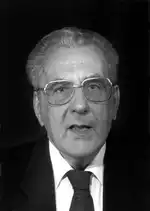
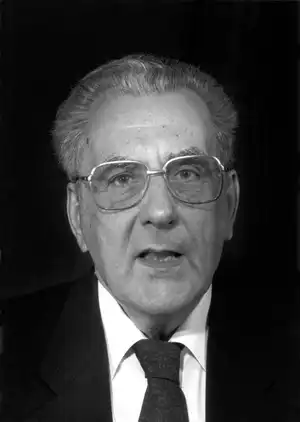
Prof. Dr. Andreas Oksche (✝︎)
- Section Anatomy and Anthropology
- Location Gießen, Germany
- Election year 1973
Research
Unter der Führung von Andreas Oksche (1965-1994) wurde die Gießener Anatomie zu einem renommierten Zentrum neuroendokrinologischer und neurobiologischer Forschung, die zahlreiche Gäste aus dem In- und Ausland anzog. Seine Lehrmeister waren Ernst und Berta Scharrer (New York) und Wolfgang Bargmann (Kiel), deren fundamentales Konzept der Neurosekretion seine wissenschaftliche Entwicklung wesentlich geprägt hat. Das zentrale Thema der Studien von Oksche war die sensorische und sekretorische Kapazität des Gehirns unter besonderer Berücksichtigung vergleichender und phylogenetischer Gesichtspunkte. In diesem Rahmen hat er sich besonders mit den von Ernst Scharrer postulierten photoneuroendokrinen Systemen befasst. Eine wichtige Komponente dieser Systeme ist das Pinealorgan. Das Pinealorgan der wechselwarmen Wirbeltiere ist ein extraoculärer Photorezeptor und zugleich ein sekretorisches, das circadiane Hormon Melatonin bildendes Organ. Das rein sekretorische Pinealorgan der Säugetiere geht aus solchen stammesgeschichtlichen Vorläufern hervor. Auf Grund von vergleichenden ultrastrukturellen, fluoreszenzmikroskopischen und cytochemischen Befunden schloss Oksche, dass sensorische und sekretorische Leistungen nicht zwangsläufig einen neuronalen Schaltkreis mit unterschiedlichen Zellelementen erfordern, sondern von einem einzigen Zelltyp bewerkstelligt werden können. Diesen Zelltyp hat er als ‚photoneuroendokrine Zelle’ definiert. Neben den Studien am Pinealkomplex hat Oksche neue Erkenntnisse auch an anderen circumventriculären Organen, zur Organisation neurosekretorischer Zentren im Hypothalamus und zur sekretorischen Leistung der Neuroglia gewonnen. Die spezialisierten ependymalen Gliazellen des Subcommissuralorgans sezernieren nicht nur in den Liquor cerebrospinalis und die Interzellulärräume des Neuropils, sondern auch in die Blutbahn. Die Bedeutung des Pinealkomplexes für die biologische Uhr und des Sekrets des Subcommissuralorgans für das Wachstum und die Differenzierung des ZNS kann jetzt mit molekularen Methoden weiter verfolgt werden.
Under the leadership of Andreas Oksche (1965 – 1994) the Anatomical Department of the Gießen University developed into a highly esteemed center of neuroendocrinological and neurobiological research that attracted numerous guest workers from different countries. Ernst and Berta Scharrer (New York) and Wolfgang Bargmann (Kiel) were the scientific masters of Oksche; his scientific development was markedly influenced by the fundamental concept of neurosecretion coined by these pioneers. The sensory and secretory capacity of the brain became the central topic of Oksche’s research, under special consideration of comparative and phylogenetic aspects. In this context, he paid particular attention to the photoneuroendocrine systems as postulated by Ernst Scharrer. The pineal organ is an important component of these systems. The pineal organ of poikilothermic vertebrates is an extraocular photoreceptor and at the same time a secretory organ that produces the circadian hormone melatonin. The exclusively secretory pineal organ of mammals is a phylogenetic derivative of such ‘pineal eyes’. On the basis of his comparative ultrastructural, fluorescence microscopic and cytochemical investigations Oksche came to the conclusion that sensory and secretory functions of the brain do not necessarily afford a neuronal circuit with different cellular elements, but may be carried on by just one cell type. This cell type was defined by Oksche as the ‘photoneuroendocrine cell’. In addition to his studies on the pineal complex, Oksche also elucidated other circumventricular organs, the organisation of neurosecretory centers in the hypothalamus and the secretory capacity of the neuroglia. The specialized ependymal gliocytes of the subcommissural organ discharge their secretory product(s) not only into the cerebrospinal fluid and into the intercellular space of the neuropil but also into the circulation. On the basis of the above new evidence, the role of the pineal complex in the mechanisms of the biological clock and the significance of the subcommissural secretion for processes of neural growth and differentiation can now be analyzed by molecular methods.
Under the leadership of Andreas Oksche (1965 – 1994) the Anatomical Department of the Gießen University developed into a highly esteemed center of neuroendocrinological and neurobiological research that attracted numerous guest workers from different countries. Ernst and Berta Scharrer (New York) and Wolfgang Bargmann (Kiel) were the scientific masters of Oksche; his scientific development was markedly influenced by the fundamental concept of neurosecretion coined by these pioneers. The sensory and secretory capacity of the brain became the central topic of Oksche’s research, under special consideration of comparative and phylogenetic aspects. In this context, he paid particular attention to the photoneuroendocrine systems as postulated by Ernst Scharrer. The pineal organ is an important component of these systems. The pineal organ of poikilothermic vertebrates is an extraocular photoreceptor and at the same time a secretory organ that produces the circadian hormone melatonin. The exclusively secretory pineal organ of mammals is a phylogenetic derivative of such ‘pineal eyes’. On the basis of his comparative ultrastructural, fluorescence microscopic and cytochemical investigations Oksche came to the conclusion that sensory and secretory functions of the brain do not necessarily afford a neuronal circuit with different cellular elements, but may be carried on by just one cell type. This cell type was defined by Oksche as the ‘photoneuroendocrine cell’. In addition to his studies on the pineal complex, Oksche also elucidated other circumventricular organs, the organisation of neurosecretory centers in the hypothalamus and the secretory capacity of the neuroglia. The specialized ependymal gliocytes of the subcommissural organ discharge their secretory product(s) not only into the cerebrospinal fluid and into the intercellular space of the neuropil but also into the circulation. On the basis of the above new evidence, the role of the pineal complex in the mechanisms of the biological clock and the significance of the subcommissural secretion for processes of neural growth and differentiation can now be analyzed by molecular methods.