Carl Hermann Knoblauch (✝︎)
XV. Präsident of the Leopoldina (1878-1895)
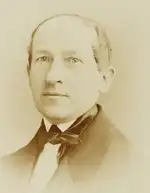
- Section Physics
- Location Halle (Saale), Germany
- Election year 1862
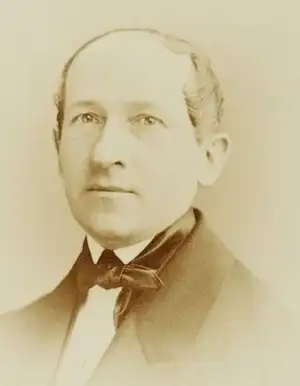
Research
Carl Hermann Knoblauch was a German physicist. As one of the first in his field, he described the wave characteristics of thermal radiation. His research was a breakthrough in terms of understanding the constancy of energy. He proved that thermal radiation includes the phenomena of diffraction, birefringence in crystals, interference and polarisation. Furthermore, he excelled as a science organiser and patron. He was rector of the University of Halle and XV. President of the German National Academy of Sciences Leopoldina. He was one the founding members of the German Physical Society.
Person
Carl Hermann Knoblauch was born on 11 April 1820 in Berlin, the son of Carl Friedrich Wilhelm Knoblauch, a silk fabrics and medal ribbon manufacturer, and his wife Henriette (née Keibel). Carl Hermann’s sister Marie Henriette died at the young age of 16. His father wanted him to train in business and commerce.
Carl Hermann Knoblauch first attended the Cöllnische Realgymnasium in Berlin. Due to Carl Hermann’s ill health, his father decided to send him to the countryside, and later to a boarding school for gifted children in Züllichau, a small town in the Kingdom of Prussia. After his confirmation, he was sent to stay with relatives in Frankfurt am Main to train in business and commerce. Knoblauch did not have any interest in the subject and – without his father’s knowledge – continued to take private lessons to prepare for his university entrance qualifications, which he eventually passed as an external candidate at the Werdersche Gymnasium in Berlin.
After a long career as a scientist, he retired on 15 December 1894. He died on 30 June 1895 during a stay at a health resort in Baden-Baden and was laid to rest at the Stadtgottesacker cemetery in Halle.
A street on the Weinberg Campus of the Martin Luther University Halle-Wittenberg has been named after him. A memorial plaque at his residence on Große Märkerstraße in Halle commemorates Carl Hermann Knoblauch.
Career
Carl Hermann Knoblauch studied mathematics, natural sciences, and philosophy at the Gewerbeakademie as well as at the University of Berlin. In 1847, he was awarded a doctorate for his paper on “radiant heat”; one year later, on 21 June 1848, he became a full professor following his Habilitation. In 1850, Carl Hermann Knoblauch became a private lecturer of physics at the University of Bonn. In the same year, he was appointed associate professor at the University of Marburg, and in 1852, full professor of experimental physics. In 1853, he joined the University of Halle, where he taught until the winter semester 1894/1895. Between 1868 and 1871 he was rector for three consecutive terms.
In Halle, he continued with his research on “radiant heat”, which had already been the topic of his doctor’s thesis at the University of Berlin. At that time, there was hardly any proven knowledge about thermal radiation. His research contributed to determining the place of this form of radiation within the electromagnetic spectrum and to proving that thermal radiation takes the form of waves. It was also an important prerequisite for the subsequent formulation of the Quantum Hypothesis.
During Carl Hermann Knoblauch’s time at the University of Halle, the position of physics at the university was consolidated, making the – only recently introduced – distinction between physics and chemistry even clearer. The growing importance of the physics department under Knoblauch’s rectorship was reflected in the new build for the Institute of Physics on what is now Friedemann-Bach-Platz in Halle.
In 1871, he was appointed a privy councillor.
Presidency at the Leopoldina
On 24 December 1877, Carl Hermann Knoblauch was elected Vice President of the German National Academy of Sciences Leopoldina. On 7 August 1878, he was elected the academy’s XV. President, which he remained until 1895.
During his tenure, he focussed on the promotion and renewal of the academy, which led to a fundamental change: Previously, the learned society had moved its headquarters every time a new president was appointed, which had become increasingly cumbersome as the library grew in size. When Carl Hermann Knoblauch was elected, the academy changed its headquarters from Dresden to Halle, where it had been located before in the 18th century. The new president set the course for the headquarters to permanently stay in Halle. Thus, in 1879 he arranged the relocation of the library, which had been housed in Dresden under unfavourable conditions. Knoblauch managed to secure financial support from the Prussian ministry of education for the move. All of these activities contributed to the academy’s increasing recognition in Prussia as a science institution worthy of support.
Immediately after being elected President, Carl Hermann Knoblauch started promoting the addition of new members from the Halle scientific community in order to consolidate the academy in the city on the river Saale. He also strengthened the link between the Leopoldina and the University of Halle by involving local academics in the preparation of elections for additional memberships.