Carl Ludwig Christian Rümker (✝︎)
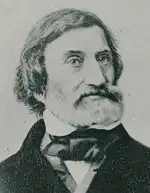
- Election year 1859
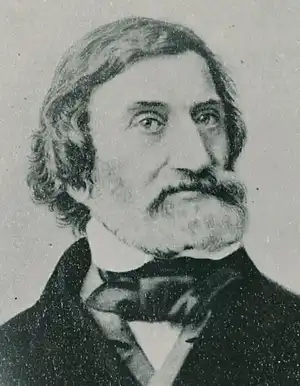
Research
Person
Carl Rümker was born in Neubrandenburg in 1788. He was the youngest child of the legal scholar Justus Rümker and his wife Dorothea Maria. He went to school at the Evangelisches Gymnasium zum Grauen Kloster in Berlin.
His interests in astronomy had a great impact on the rest of his family: His wife Marie discovered a comet in 1847 and his son George, born in 1832 in Hamburg, also became an astronomer and eventually took over his father’s position as director at the Hamburg Observatory.
Carl Rümker died on 21 December 1862 in Lisbon. In his honour, a volcanic range on the Earth’s Moon was named Mons Rümker in 1935.
Career
Having passed his building trade examinations, Carl Rümker graduated from the Bauakademie (Building Academy) in Berlin in 1807. In the same year, he moved to Hamburg and took up a post as a mathematics teacher. In 1809, he moved to England and became a sailor. Having started out as a cadet, he was eventually deployed to the Mediterranean fleet as a lieutenant and navigation instructor.
During a visit to Genoa, he met the German-Austrian astronomer Baron Franz Xaver von Zach, who encouraged his interest in astronomy, prompting Rümker to quit his service for the British in 1817 and take over the management of the nautical navigation school in Hamburg.
In 1821, Carl Rümker set off to Australia, following the Scottish astronomer Sir Thomas Brisbane, who had been appointed governor of New South Wales. Brisbane constructed the first Australian observatory in 1822 in Parramatta, his seat of government west of Sydney. He employed Carl Rümker as the director of the observatory, who worked there with the Scottish astronomer James Dunlop until 1830.
Rümker’s work soon made the observatory famous. He was able to determine the orbit and position of the periodic Comet Encke – the second rediscovery of a comet after Halley’s comet.
Another big project was the extensive star catalogue of the southern hemisphere documenting the position of over 7,000 stars.
In 1830, Rümker returned to Hamburg ,where he took over as director of the local observatoryand started teaching at the nautical navigation school, which was located in the same building.
The star catalogue he created in Paramatta was published in Hamburg in 1832. In the Hanseatic city of Hamburg, he carried out an even more extensive catalogue project, containing 12,000 descriptions of star positions, with the title “Apparent places of 12,000 fixed stars” („Mittlere Oerter von 12 000 Fixsternen“).
Rümker’s official position as director of the nautical navigation school affected his work, shifting the focus towards nautical astronomy. This is evident from publications such as “On the location of navigational triangles” (1834) (“Ueber die Oerter sphpärischer Dreiecke”) or “Length determination using the Moon, a nautical-astronomical essay” (1849) (“Längenbestimmung durch den Mond, eine nautisch-astronomische|Abhandlung”).
The growing number of students shows that Rümker’s workload at the navigation school increased. When he first joined the school, he had around 60 students and by the time he resigned in 1857, it was over 250.
This took a toll on his health: In March 1854, he had a dizzy spell and fell from a ladder at the observatory. Rümker never fully recovered, and handed over the reigns as director of the observatory to his son George in 1857. He spent his retirement in Lisbon.
Honours and Memberships
Carl Rümker received numerous awards for his scientific research, such as the Silver Medal of the Royal Astronomical Society (1823) and the Gold Medal (1854) of the Royal Astronomical Society.
Beyond that, several scientific academies and associations granted him membership, like the American Philosophical Society in Philadelphia (1839) and the German National Academy of Sciences Leopoldina (1859). The Bavarian Academy of Sciences and Humanities (1854) and the Göttingen Academy of Sciences and Humanities made him a Corresponding Member.