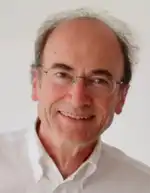
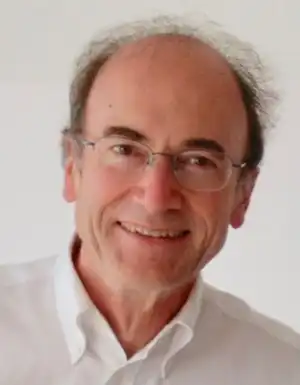
Professor Dr Christian Chopin
- Section Earth Sciences
- Location Paris, France
- Election year 2005
Research
Research Priorities: Mineralogy, metamorphic petrology, high- and ultrahigh-pressure metamorphism, continental subduction, crystal chemistry of rock-forming minerals
Christian Chopin is a French geologist, with interest in the chemistry of minerals. He investigates metamorphic rocks and played a key role in establishing the field of ultrahigh-pressure metamorphism. He demonstrated the presence of the mineral coesite, a high-pressure silica phase, in the Western Alps and thus provided evidence for continental subduction. In 2007 the newly discovered phosphate mineral chopinite was named after him.
Metamorphism refers to the transformation of rocks due to changes in temperature or pressure conditions within the Earth. This process results in progressive changes in the chemistry and nature of rock-forming minerals, sometimes in the chemical composition of rock. Metamorphic rocks are exposed over very large areas, like the metamorphic belts of the Alps and Himalayas, for example. Regional metamorphism is a manifestation of the continuous activity of planet Earth, through plate tectonics, for instance the diving (subduction) of oceanic plates beneath continental plates.
Christian Chopin’s finding of the mineral coesite in the Western Alps proved that fragments of continental crust can also be dragged to depths exceeding 100 kilometres in subduction zones – and come back to the surface. Chopin was thus key to the discovery of ultrahigh-pressure metamorphism.
His experimental work on the stability of minerals is based on observations of nature. He has been working together with thermodynamicists on these experimental aspects, and with crystallographers on the crystal chemistry of various minerals, in particular complex phosphates. In 2007 the newly discovered high-pressure mineral chopinite, Mg3(PO4)2, was named after him.
Christian Chopin is a French geologist, with interest in the chemistry of minerals. He investigates metamorphic rocks and played a key role in establishing the field of ultrahigh-pressure metamorphism. He demonstrated the presence of the mineral coesite, a high-pressure silica phase, in the Western Alps and thus provided evidence for continental subduction. In 2007 the newly discovered phosphate mineral chopinite was named after him.
Metamorphism refers to the transformation of rocks due to changes in temperature or pressure conditions within the Earth. This process results in progressive changes in the chemistry and nature of rock-forming minerals, sometimes in the chemical composition of rock. Metamorphic rocks are exposed over very large areas, like the metamorphic belts of the Alps and Himalayas, for example. Regional metamorphism is a manifestation of the continuous activity of planet Earth, through plate tectonics, for instance the diving (subduction) of oceanic plates beneath continental plates.
Christian Chopin’s finding of the mineral coesite in the Western Alps proved that fragments of continental crust can also be dragged to depths exceeding 100 kilometres in subduction zones – and come back to the surface. Chopin was thus key to the discovery of ultrahigh-pressure metamorphism.
His experimental work on the stability of minerals is based on observations of nature. He has been working together with thermodynamicists on these experimental aspects, and with crystallographers on the crystal chemistry of various minerals, in particular complex phosphates. In 2007 the newly discovered high-pressure mineral chopinite, Mg3(PO4)2, was named after him.
Career
- since 2021 Emeritus Senior Researcher, French National Centre for Scientific Research (CNRS) at École normale supérieure (ENS), Paris, France
- 2002-2021 Senior Researcher, CNRS at ENS, Paris, France
- 1990-2002 Researcher, CNRS at ENS, Paris, France
- 1981-1990 Research Associate, CNRS at ENS, Paris, France
- 1979-1981 Postdoctoral Fellow, Ruhr University Bochum, Bochum, Germany
- 1985 Habilitation, Pierre and Marie Curie University, Paris, France
- 1979 Doctorate, Pierre and Marie Curie University, Paris, France
- 1974-1978 Degree, École normale supérieure (ENS), Paris, France
Functions
- since 2016 Treasurer, French Society of Mineralogy and Crystallography (SFMC), France
- 2004-2011 Vice-President, European Mineralogical Union
- 2001-2019 Managing Editor, European Journal of Mineralogy
- 1988-2000 Chief Editor, European Journal of Mineralogy
Honours and Memberships
- 2022 SFMC Merit Award, SFMC, France
- 2019 Honorary Member, German Mineralogical Society (DMG), Germany
- since 2019 Member, Accademia delle Scienze, Torino, Italy
- since 2012 Member, Accademia nazionale dei Lincei, Italy
- since 2005 Member, German National Academy of Sciences Leopoldina, Germany
- 1995 Research Excellence Medal, European Mineralogical Union (EMU)
- 1994 Fellowship, Mineralogical Society of America, USA
- 1994 Buttgenbach Prize, Royal Academies for Science and the Arts of Belgium (RASAB), Belgium
- 1993 Van den Broeck Medal, Geological Survey of Belgium (GSB), Belgium
- 1987 Bronze Medal, CNRS, France
- 1986 Victor-Moritz-Goldschmidt Award, German Mineralogical Society (DMG), Germany
- 1979-1981 Scholarship, German Academic Exchange Service (DAAD), Germany