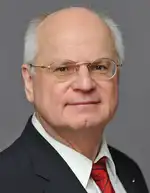
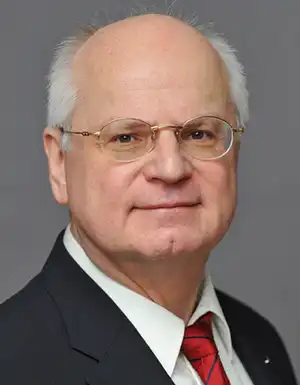
Professor Dr Christoph Clauser
- Section Earth Sciences
- Location Aachen, Germany
- Election year 2011
Research
Christoph Clauser is distinguished by his contributions to geothermal research and petrophysics. His main research addresses geophysical aspects of reservoir engineering, in particular with regard to geothermal energy and geological storage of carbon dioxide. It is based both on petrophysical lab experiments and interpretation of geophysical borehole logs, and on numerical simulation of forward and inverse problems in subsurface reactive flow and transport.
His analysis of conductive and advective heat transport mechanisms in sedimentary basins yielded the first conclusive evidence that the heat flow anomaly beneath the Rhine graben is not of igneous origin but caused by the redistribution of heat in a regional groundwater flow system. His research on regional heat transport around the Russian and German super–deep research boreholes, based on the widely used simulation code SHEMAT, enabled both estimating flow and transport rock properties and identifying and quantifying different heat transport mechanisms. His analysis of the downward diffusion of the transient Earth’s surface temperature yielded both a correction algorithm for heat flow measurements in shallow boreholes and the first geothermal reconstruction of the end of the last ice-age in Central Europe from temperature measurements in a 4 km deep borehole. His petrophysical work resulted in several compilations of thermal and hydraulic rock properties.
Since 1997, he has been supervising 28 doctoral students. He published four books and ∼110 publications in refereed journals, books, and conference proceedings volumes, served in the editorial boards of Journal of Geodynamics and Geothermics, and filed one German and one European patent.
His analysis of conductive and advective heat transport mechanisms in sedimentary basins yielded the first conclusive evidence that the heat flow anomaly beneath the Rhine graben is not of igneous origin but caused by the redistribution of heat in a regional groundwater flow system. His research on regional heat transport around the Russian and German super–deep research boreholes, based on the widely used simulation code SHEMAT, enabled both estimating flow and transport rock properties and identifying and quantifying different heat transport mechanisms. His analysis of the downward diffusion of the transient Earth’s surface temperature yielded both a correction algorithm for heat flow measurements in shallow boreholes and the first geothermal reconstruction of the end of the last ice-age in Central Europe from temperature measurements in a 4 km deep borehole. His petrophysical work resulted in several compilations of thermal and hydraulic rock properties.
Since 1997, he has been supervising 28 doctoral students. He published four books and ∼110 publications in refereed journals, books, and conference proceedings volumes, served in the editorial boards of Journal of Geodynamics and Geothermics, and filed one German and one European patent.