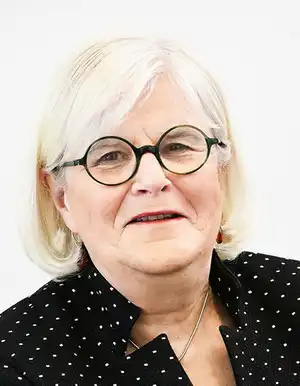
Professor Dr Dame Linda Partridge
- Section Genetics/Molecular Biology and Cell Biology
- Location London, United Kingdom
- Election year 2023
Research
Research Priorities: Ageing, metabolism, genetics, nutrition
Dame Linda Partridge is a British-Irish biologist and geneticist, who researches the biological base and mechanisms of aging. With the help of model organisms, such as the fruit fly and the roundworm, she demonstrated that a somewhat reduced caloric intake can prolong the organism’s life. Her work has focused particularly on the role of nutrient-sensing pathways, diet, and geroprotective drugs. Linda partridge significantly contributed to a physiological understanding of aging processes.
The biologist studied the interaction of genetic and environmental factors and identified specific genes and signalling pathways that influence the aging processes and the predisposition for age-associated diseases such as Alzheimer’s disease, dementia, or Parkinson’s disease. She focuses on the signalling pathway of insulin and the insulin-like growth factor-1 (IGF-1). Together with her team she was able to show that a calorie restriction for roundworms is associated with a prolonged lifespan. This effect, however, only occurred if the reduced food intake did not lead to malnutrition. The life-prolonging effect of reduced food intake was also verified on mice.
The work of Linda Partridge also includes the development of pharmacological interventions that prolong the life and increase the vitality of certain organisms. She studies the potential of drugs that are already authorised for another indication to imitate the effect of calorie restriction and to delay the onset of age-induced disease.
As a researcher of ageing, she pursues an interdisciplinary approach that combines genetics, physiology, and evolutionary biology. Linda Partridge not only significantly advanced the fundamental research on processes of aging, but she also shaped the contemporary knowledge in genetics and evolutionary biology. Her recent research has identified the molecular, cellular, and organismal mechanisms of aging. She established biogerontology as an independent research area and co-founded the Max Planck Institute for Biology of Aging in Cologne, Germany. Furthermore, Linda Partridge taught at numerous universities around the globe and advocated both the further development of her discipline and its inclusion in the curriculum of various study courses in the life sciences.
Dame Linda Partridge is a British-Irish biologist and geneticist, who researches the biological base and mechanisms of aging. With the help of model organisms, such as the fruit fly and the roundworm, she demonstrated that a somewhat reduced caloric intake can prolong the organism’s life. Her work has focused particularly on the role of nutrient-sensing pathways, diet, and geroprotective drugs. Linda partridge significantly contributed to a physiological understanding of aging processes.
The biologist studied the interaction of genetic and environmental factors and identified specific genes and signalling pathways that influence the aging processes and the predisposition for age-associated diseases such as Alzheimer’s disease, dementia, or Parkinson’s disease. She focuses on the signalling pathway of insulin and the insulin-like growth factor-1 (IGF-1). Together with her team she was able to show that a calorie restriction for roundworms is associated with a prolonged lifespan. This effect, however, only occurred if the reduced food intake did not lead to malnutrition. The life-prolonging effect of reduced food intake was also verified on mice.
The work of Linda Partridge also includes the development of pharmacological interventions that prolong the life and increase the vitality of certain organisms. She studies the potential of drugs that are already authorised for another indication to imitate the effect of calorie restriction and to delay the onset of age-induced disease.
As a researcher of ageing, she pursues an interdisciplinary approach that combines genetics, physiology, and evolutionary biology. Linda Partridge not only significantly advanced the fundamental research on processes of aging, but she also shaped the contemporary knowledge in genetics and evolutionary biology. Her recent research has identified the molecular, cellular, and organismal mechanisms of aging. She established biogerontology as an independent research area and co-founded the Max Planck Institute for Biology of Aging in Cologne, Germany. Furthermore, Linda Partridge taught at numerous universities around the globe and advocated both the further development of her discipline and its inclusion in the curriculum of various study courses in the life sciences.
Career
- since 2019 Biological Secretary, The Royal Society, UK
- 2008-2022 Founding Director, Max Planck Institute for Biology of Aging, Cologne, Germany
- 2007-2019 Director, Institute of Healthy Ageing, Genetics, Evolution & Environment, University College London, London, UK
- 2002-2007 Professorial Research Fellow, Biotechnology and Biological Research Council (BBSRC), University College London, London, UK
- 1997-2002 Research Professor, Natural Environment Research Council (NERC), University College London, London, UK
- since 1994 Weldon Professor of Biometry, Genetics, Evolution and Environment, University College London (UCL), London, UK
- 1994-2007 Director, Centre for Ecology and Evolution, University College London, London, UK
- 1992 Professor of Evolutionary Biology, University of Edinburgh, Edinburgh, UK
- 1976-1993 Reader/Lecturer, Department of Zoology, University of Edinburgh, Edinburgh, UK
- 1974-1976 Postdoctoral Fellow, Department of Biology, University of York, York, UK
- 1974 PhD, University of Oxford, Oxford, UK
- 1971 Bachelor of Arts (BA) in Zoology, University of Oxford, Oxford, UK
Honours and Memberships
- 2023 Member, German Academy of Sciences Leopoldina, Germany
- 2021 Mendal Medal Award, Genetics Society, London, UK
- 2019 Honorary Doctorate, University of East Anglia, Norwich, UK
- 2019 Honorary Doctorate, Imperial College London, London, UK
- 2017 Honorary Doctorate, University of Kent, Canterbury, UK
- 2017 Honorary Doctorate, University of Edinburgh, Edinburgh, UK
- 2016 Galton Lecture and Prize, The Galton Institute, London, UK
- 2014 Anniversary Award for Excellence in Bioscience, Biotechnology and Biological Sciences Research Council (BBSRC), Swindon, UK
- 2012 Honorary Doctorate, University of Brighton, Brighton, UK
- 2011 Honorary Doctorate, University of Oxford, Oxford, UK
- 2011 Honorary Doctorate, University of Bath, Bath, UK
- since 2010 Foreign Honorary Member, American Academy of Arts and Sciences, USA
- 2009 Dame Commander of the British Empire, Order of the British Empire, UK
- 2009 Darwin-Wallace Medal, Linnean Society of London, London, UK
- 2009 Royal Society Croonian Prize Lecture, Royal Society, UK
- 2009 Women of Outstanding Achievement Award for Science Discovery, UK Resource Center (UKRC) for Women, UK
- 2008 Thomassen à Thuessink Medal, University of Groningen, Groningen, Netherlands
- 2004 Honorary Doctorate, University of St. Andrews, St. Andrews, UK
- 2004 Lord Cohen Medal, British Society for Research on Ageing (BSRA), UK
- 2003 Commander of the British Empire, Order of the British Empire, UK
- 1996 Member, Royal Society, UK
- 1992 Member, Royal Society of Edinburgh, UK