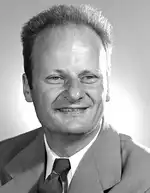
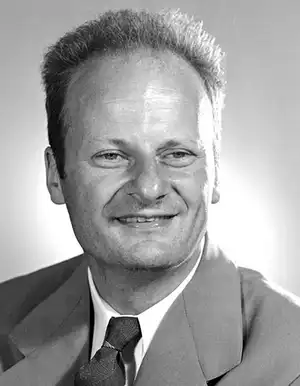
Hans A. Bethe (✝︎)
Nobel Prize for Physics 1967
- Section Physics
- Location Ithaca, NY, United States
- Election year 1978
Research
Hans Albrecht Bethe was a German-American physicist. He is considered to be a pioneer in the application of quantum mechanics across numerous areas of physics. The semi-empirical mass formula, or Bethe–Weizsäcker formula, was named after him and his contributions to the theory of nuclear reactions, specifically stellar nucleosynthesis, earned him the Nobel Prize in Physics in 1967.
Hans Albrecht Bethe was born in Strasbourg on 2 July 1906, as the only child of Albrecht Bethe and his wife Anna Kuhn. His father was a professor of physiology at the University of Strasbourg. Hans Bethe spent his early years in Strasbourg, until 1912, when his father, Albrecht Bethe, accepted a post as a Professor in Kiel. In 1915, the family moved once again, when the father was offered a post at the newly founded Goethe University Frankfurt.
In 1937, Bethe married Rosemarie (Rose) Ewald, who, like Bethe, was of Jewish descent and was also forced to leave Germany during the Third Reich. The couple had two children, Henry and Monica.
In 1941, Hans Bethe attained American citizenship. He consulted US President Dwight D. Eisenhower on questions concerning nuclear weapons tests. Until his death, Hans Bethe remained an active member of the scientific community and society. He later increasingly advocated nuclear disarmament. One year before his death, together with 47 other Nobel Prize winners, 98-year-old Bethe signed an open letter against the re-election of George W. Bush and protesting against Bush’s policy of cutting research funding.
In 1998, the American Physical Society introduced an award named after Bethe, and the University of Bonn honours his memory with the Bethe Center for Theoretical Physics.
Career
In 1924, Hans Bethe took up his studies of physics at the Goethe University Frankfurt. In 1926, he changed to Munich, where he studied under Arnold Sommerfeld, a German theoretical physicist, who oversaw his thesis on the theory of electron diffraction in 1928. Following his return to Munich, in 1929, he took on a post as an Independent Lecturer in May 1930. During the early 1930s, Bethe received a travelling scholarship from the American Rockefeller Foundation, which allowed him to go to Cambridge in the autumn of 1930, and in the spring of 1931, he moved to Rome to work with Italian physicist Enrico Fermi. In the winter semester of 1932/33, he was finally offered a post at the University of Tübingen, where he would only be able to stay for one semester. Due to his Jewish descent, Bethe was dismissed from academic service and emigrated to the United Kingdom in 1933, where he worked at the Universities of Manchester and Bristol. In 1935, Bethe was promoted to Assistant Professor, and in 1937 he was offered a post as Professor at Cornell University in Ithaca, New York in the United States. He would remain loyal to Cornell with just brief interruptions for the rest of his life.
During the Second World War, Bethe worked at the Radiation Laboratory of the Massachusetts Institute of Technology (MIT) in Boston. He also spent one semester at the University of California in Berkeley upon invitation by J. Robert Oppenheimer. From Berkeley, he joined the Los Alamos Scientific Laboratory as head of the Theoretical Division to work on the American atomic bomb as part of the Manhattan Project. He justified his involvement with the fear that the German National Socialist government may develop an atomic bomb before the USA.
In 1952, after the end of the Korean War, Bethe returned to Los Alamos to work on research into a hydrogen bomb. In 1954, at the Oppenheimer security clearance hearing, he publicly admitted his doubts about the project, saying: “I still feel that I did the wrong thing. But I did it.”
Honours and Memberships
Hans Bethe received a great number of awards, such as the Max Planck Medal (1955), the Eddington Medal of the Royal Astronomical Society (1961), the Enrico Fermi Award by the U.S. Atomic Energy Commission (1961) and the Bruce Medal (2001). Bethe was a member of scientific organisations such as the Deutsche Akademie der Naturforscher Leopoldina (German Academy of Natural Scientists Leopoldina) since 1978, and held an Honorary Doctorate of the University of Strasbourg, the Technical University of Munich and the Goethe University Frankfurt.
Nobel Prize
Hans Bethe was awarded the Nobel Prize in Physics in 1967. The work that earned him the prize went back to 1938, when Bethe – within a very short period of time – proved that the nuclear fusion of hydrogen nuclei produces the enormous energy emitted by stars in the form of light and heat without depleting their own source.
Previously, Carl Friedrich von Weizsäcker, a German physicist and philosopher had found how the Sun fuses hydrogen into helium. Bethe was then able to prove that the process found by von Weizsäcker indeed generates the radiation volume observed in the case of the Sun, but that this is not the case for hot, high mass stars. He discovered the fusion reactions, which – combined with von Weizsäcker’s discoveries – form the Bethe-Weizsäcker cycle. The two scientists laid the foundation for the physical investigation of the stars.