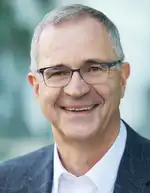
Professor Dr Harald Fuchs
- Section Physics
- Location Münster, Germany
- Election year 2003
Research
Research Priorities: Nanoscience, nanotechnology, nanobiotechnology, nanomedicine, scanning probe microscopy, self-organised systems, theory of tip/sample interaction
Harald Fuchs is a pioneer in the field of nanoscience. He investigates how material in molecular and atomic dimensions can be systematically studied and manipulated in a targeted manner.
Harald Fuchs has been working with scanning probe methods, including scanning tunnelling microscopy (STM) and atomic force microscopy (AFM), since the beginning of his scientific career. He subsequently developed such devices at BASF AG for the chemicals industry, and over his career has worked with an ever expanding range of such technologies. These technologies include scanning near-field optical microscopy (SNOM), which enables optical observations below the diffraction limit; scanning ion-conductance microscopy (SICM), which is particularly suited to biological samples such as living cells; and scanning probe lithography (SPL) methods such as polymer pen lithography (PPL) and dip-pen nanolithography. The latter methods combine the benefits of electron beam lithography, inkjet printing, and microcontact printing with respect to resolution, integration, and throughput.
Harald Fuchs and his team focus in particular on nanoparticles, proteins, cells, cell membranes, thin organic films, and interfaces of organic and inorganic materials. He is interested in the relationships between structure and properties such as adhesion and stability, as well as self-organisation possibilities.
His work represents a significant contribution to the development of instruments and devices, as well as to basic research. His work is also aimed at applications in various fields, including opto-electronics (LEDs and solar cells), and medicine, where nanotechnology enables new diagnostic and therapeutic procedures. In addition, Fuchs examines the risks associated with nanotechnology.
The nanoscientist’s work is characterised by the close interplay between physics, chemistry, biology, and medicine, for example at the CeNTech Münster and via the use of research findings in industry. He holds more than 50 patents and has co-founded two startups. He also conducted research projects in cooperation with the Chinese Academy of Sciences (CAS), Chinese universities, and the Chinese National Center for Nanoscience and Technology (NCNST).
Career
- 2018 Co-Founder, Center for Soft Nanoscience (SoN), University of Münster, Muenster, Germany
- since 2014 Director, Physical Institute, University of Münster, Münster, Germany
- 2009-2013 Foreign Faculty Member, Korean Word Class University Program, Gwangju Institute of Science and Technology, Gwangju, South Korea
- 2004-2019 Division Manager, Institute of Nanotechnology (INT), KIT, Karlsruhe
- since 2003 Founder and Scientific Director, Center for NanoTechnology (CeNTech), University of Münster, Muenster, Germany
- 1998-2000 Director, Physical Institute, University of Münster, Münster, Germany
- 1993-2026 Professor, University of Münster, Muenster, Germany
- 1985-1993 Project Manager for Ultrathin Organic Films, BASF AG, Ludwigshafen on the Rhine, Germany
- 1984-1985 Postdoctoral Fellowship, STM Group, IBM Research Zurich, Rüschlikon, Switzerland
- 1982 Doctorate in Material Science, Saarland University, Saarbrücken, Germany
- 1977-1980 Research Associate for Membrane Research, Medical Department, Saarland University, Saarbrücken, Germany
- 1977 Degree in Theoretical Physics, Saarland University, Saarbrücken, Germany
Functions
- 2024 Co-Organiser, 2nd Science for Future Conference, Berlin, German National Academy of Sciences Leopoldina as well as Chinese Academy of Sciences (CAS), China
- 2019 Co-Organiser, 1st Science for Future Conference, Beijing, German National Academy of Sciences Leopoldina as well as Chinese Academy of Sciences (CAS), China
- 2008-2014 Member, Senate, University of Münster, Münster, Germany
- 2005-2017 Member, Scientific Advisory Board, Deutsches Museum Munich, Munich, Germany
- since 2003 Member, Working Committee “Chemical Nanotechnology”, DECHEMA Society for Chemical Engineering and Biotechnology, Frankfurt am Main, Germany
- 2000 Founding Chairperson, CeNTech, University of Münster, Münster, Germany
- 1999-2004 Member, Senate, University of Münster, Münster, Germany
- 1998-2000 Spokesperson, Competence Centre “nanoAnalytics”, Federal Ministry of Education and Research (BMBF), Germany
- 1998-2003 Co-Chair, Competence Center “Nanoanalysis”, BMBF, Germany
- 1995-1997 Dean, Physics Department, University of Münster, Münster, Germany
Projects
- 2017-2021 Project “Quantitative High-Resolution Atomic Force Microscopy of Organic Compounds with Copper-Oxide Functionalized Tips”, German Research Foundation (DFG), Germany
- 2017-2020 Project “Patterned organic molecular architecture by vacuum deposition”, DFG, Germany
- 2016-2022 Project “Functional optimization by control of the electronic and structural properties of organic molecules on surfaces studied by scanning tunnelling microscopy”, DFG, Germany
- 2013-2015 Project “DiaNa – Diagnostic in early inflammation: Application of Nanotechnology”, BMBF, Germany
- 2011-2015 Project “MINAC – China Cooperation Project: Mechanisms of the Interaction of Nanoparticles with Cells”, BMBF, Germany
- 2010-2021 Subproject “2D Reactions at Surfaces”, Collaborative Research Centre (CRC) 858, DFG, Germany
- 2010-2014 Project “MICROCARE – Microsystems and Bioanalysis Platforms for Health Care”, Marie Curie Actions, European Union (EU)
- 2010-2012 Project “JINBiT – Preparation for Founding a Virtual Joint Institute for Nanobiotechnology”, BMBF, Germany
- 2008-2017 Speaker, TRR 61“Multilevel Molecular Assemblies: Structure, Dynamics and Functions”, DFG, Germany, and National Natural Science Foundation of China (NFSC), China
- 2007-2011 Project “Lipid Dip-Pen Nanolithography for Model Bio-Membrane Systems”, DFG, Germany
Honours and Memberships
- since 2026 Foreign Member, Chinese Academy of Sciences (CAS), China
- 2022 International Cooperation Award for Science and Technology, China
- 2021 Honorary Member, Chinese Chemical Society (CCS), China
- 2019 Chinese Government Friendship Award, China
- 2015 Honorary Professorship, Nanjing Tech University, Nanjing, China
- 2014-2021 Member, Joint Committee, CDZ/SGC, DFG, Germany and NFSC, China, Beijing, China
- 2012 Founding Member, Herbert Gleiter Institute (HGI), Nanjing, China
- since 2011 Member, The World Academy of Sciences (TWAS)
- 2009 Bundesverdienstkreuz 1st Class, Federal Republic of Germany
- 2009 Friedrich Emich Plaque, Austrian Society of Analytical Chemistry, Austria
- since 2008 Member, acatech – National Academy of Science and Engineering, Germany
- since 2003 Member, German National Academy of Sciences Leopoldina, Germany
- 2001 Innovation Prize Münsterland for Science and Business, Münsterland Association for the Promotion of Münsterland, Greven, Germany
- 1994 Philip Morris Research Award for Nanotechnology, Philip Morris Foundation, Munich, Germany