Johann Georg Volckamer (sen.) (✝︎)
III. President of the Leopoldina (1686-1693)
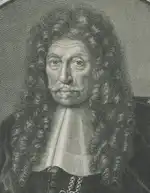
- Location Nürnberg, Germany
- Election year 1678
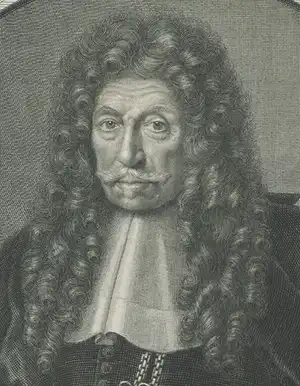
Research
Person
Johann Georg Volckamer was born in Nuremberg on 9 June 1616 to Johann Volckamer, a merchant from Lobenstein in Thuringia, and his wife, Helena Ayrer. He had a good education and upbringing.
On 7 August 1643, Johann Georg Volckamer married Barbara, née Vierer. The couple had six sons and six daughters. Among his children were the physician and botanist Johann Georg Volckamer Jnr (1662 to 1744) and the merchant, factory owner and botanist Johann Christoph Volckamer (1644 to 1720). Both of them were also members of the Leopoldina.
Johann Georg Volckamer died on 17 May 1693 in Nuremberg.
Career
In 1633, Johann Georg Volckamer enrolled at the Friedrich Schiller University Jena to study philosophy and mathematics. In 1636, he transferred to the University of Altdorf, where he switched to medicine. From 1638 to 1641, he continued his studies at the University of Padua, where he also worked as a librarian.
On a subsequent educational trip, he spent some time in France and Italy, which included a stay with a surgeon in Naples, who taught him the theory and practice of surgery. On 30 April 1643, he earned his M.D. at the University of Altdorf and joined the Collegium Medicum in Nuremberg as general practitioner. He remained a member until 1693.
Volckamer had a wide range of scientific interests: He investigated and published work on mechanics and optics. He knew how to make lenses for telescopes. He also constructed a sundial for his garden, which led him to the important discovery that magnetic declination may change over time.
As a member of the Pegnitz Flower Society, he wrote many poems in Latin. In 1682 Volckamer published a book on numismatics in Nuremberg, which comprised a description of coins he had collected in Italy.
Volckamer’s reputation as a physician and natural scientist extended beyond his domain and made his house in Nuremberg a magnet for scholars.
In 1683, he was appointed the first Director Ephemeridum by Johann Michael Fehr, President of the Leopoldina. In this capacity, he was the editor of the scientific journal “Miscellanea curiosa sive Ephemeridum medico-physicarum” in Nuremberg.
Honours and Memberships
In 1646, Johann Georg Volckamer joined the Pegnitz Flower Society. On 1 November 1678, he became a member of the Leopoldina; on 20 November 1678 he was appointed civil servant. He adopted the byname Helianthus I.
Presidency at the Leopoldina
On 7 December 1686, the Leopoldina announced the election of Johann Georg Volckamer as its third president following Michael Fehr, who had resigned on 20 July 1686. At the same time, the association, which had previously operated as an informal society, was granted the rank of Imperial Academy. It received the honourable title “Sacri Romani Imerpii Academia Caesareo-Leopoldina Naturae Curiosorum”.
This elevation to the rank of Imperial Academy came with several improvements: Emperor Leopold I granted the academy special privileges, including independence, absolute freedom from censorship of writings published by the Leopoldina and the right to use its own coat of arms.
As president of the academy, Johann Georg Volckamer was elevated to the peerage and given the privilege of working as the personal physician to the emperor. These privileges also benefitted his successors and helped the academy in its quest for public recognition.
In the same year that Johann Georg Volckamer Snr took up his post as president, the Leopoldina was moved from its domain in Schweinfurt, Germany, where it had been founded, to its new location in the free imperial city of Nuremberg. During Volckamer’s presidency, the Leopoldina experienced an upswing. Johann Georg Volckamer Snr’s term ended upon his death in 1693.