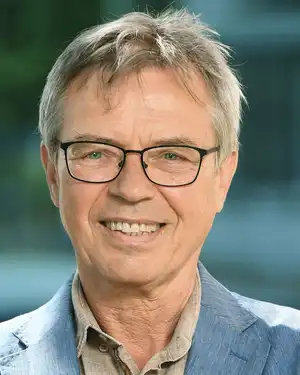
Professor Dr Johannes Lelieveld

- Section Earth Sciences
- Location Mainz, Germany
- Election year 2015
Research
Research Priorities: Atmospheric chemistry, troposphere, air pollution, climate change, ozone, development of models and measuring devices, HALO research
Johannes Lelieveld is a Dutch atmospheric scientist. The focus of his research is on atmospheric chemistry. He develops aircraft-based measuring programmes and models that describe transport processes in the atmosphere as well as climate change. Recent research is concerned with air pollution’s impact on humans.
Johannes Lelieveld researches the interplay between the atmosphere and processes back on earth. He asks what effect ozone and organic substances have on the climate and how the lifestyles of humans impact atmospheric processes. For his research, he developed computational models that simulate the interaction of chemical and meteorological processes and describe processes like the exchange between the liquid and the gaseous stage of the atmosphere. With these models, he was able to show that processes in the clouds affect the chemistry of ozone. His studies on the influence of tropospheric ozone, methane, and sulphate aerosols on the climate were important contributions for understanding climatic and chemical processes in the atmosphere and to the prognosis of global climate change.
Together with his team, Johannes Lelieveld develops measurement devices which are deployed on ships, satellites, and aircraft. The scientists researched, for example, the influence of the Asian monsoon on the atmosphere’s ability to self-clean during a mission with the HALO research aircraft.
The working group around Johannes Lelieveld also described the risks of nuclear catastrophes like those of Chernobyl and Fukushima with the aid of computer simulations. For this, they developed models with data from all currently-active nuclear power plants on Earth. As a result, they found that the risks associated with a nuclear meltdown are higher than previously expected.
Johannes Lelieveld was also the first to study how different sources for emissions impact the mortality rate in humans: the deaths of more than three million people around the globe are linked to air pollution. In many countries, this means that about ten times as many people die from air pollution than from traffic accidents.
The research done by Johannes Lelieveld aims to increase the understanding of chemical processes and processes of transportation in the atmosphere in order to sharpen the predictions of air pollution and climate change so that better-suited measures can be taken.
Career
- 2020-2025 Managing Director, Max-Planck-Institute for Chemistry, Mainz, Germany
- 2010-2013 Managing Director, Max-Planck-Institute for Chemistry, Mainz, Germany
- since 2008 Parttime Professor, Cyprus Institute, Nikosia, Cyprus
- 2004-2007 Managing Director, Max-Planck-Institute for Chemistry, Mainz, Germany
- since 2002 Professor of Atmospheric Physics, Universität Mainz, Mainz, Germany
- since 2000 Director, Department Atmospheric Chemistry and Scientific Member, Max-Planck Institute for Chemistry, Mainz, Germany
- 1993-2000 Professor of Atmospheric Physics and Chemistry, University of Wageningen, Wageningen, Netherlands and Utrecht University, Utrecht, Netherlands
- 1992 Extended Visit, University of California (UC) San Diego, San Diego, USA
- 1991 Extended Visit, Stockholm University, Stockholm, Sweden
- 1990 PhD in Physics, Utrecht University, Utrecht, Netherlands
- 1987-1993 Research Associate, Department of Atmospheric Chemistry, Max-Planck Institute for Chemistry, Mainz, Germany
- 1984-1987 Staff, GEOsens GmbH, Rotterdam, Netherlands
- Studies in Science, Leiden University, Leiden, Netherlands
Functions
- since 2019 Member, Advisory Board, Panhellenic infrastructure for atmospheric composition and climate change (PANACEA), National Observatory of Athens, Athens, Greece
- since 2019 Member, Advisory Board, Ruisdael Observatory, Rotterdam, Netherlands
- since 2019 Member, Scientific Advisory Board, National Observatory of Athens, Athens, Greece
- since 2018 Guest Editor, National Academy of Sciences (NAS), USA
- since 2016 Member, Kick-off-Committee, International Silk Road Academy of Sciences
- since 2013 Member, Evaluation Committee, Institute for Basic Science, Daejeon, South Korea
- since 2010 Member, Editorial Board, Earth System Dynamics
- since 2008 Member, Steering Committee, Max Planck Graduate Center with Johannes Gutenberg-Universität Mainz, Mainz Germany
- 2008-2012 Member, Advisory Board, Netherlands Institute for Space Research (SRON), Netherlands
- 2007-2012 Member, Advisory Council, COSMOS network, Community Earth System Model (CESM), Boulder, USA
- 2006-2019 Member, Scientific-Technical Committee, Executive Board and Chair, Advisory Board, Atmosphere and Climate Programme, Karlsruher Institute of Technology (KIT), Karlsruhe, Germany
- 2003-2017 Member, Scientific Steering Committee, Research Plane HALO (High Altitude and Long Range Research Aircraft), German Aerospace Center (DLR)
- 2003-2008 Member, Programme Committee, Earth Observation Center (EOC), DLR
- 2003-2005 Chair, Science Panel on Atmospheric Research, European Commission
- since 2002 Spokesperson, International Max Planck Research School (IMPRS)
- 1997-2003 Member, Scientific Advisory Board, Stratospheric Ozone Research, European Union (EU)
- 1997-2001 Associate Editor, Journal of Geophysical Research
- 1997-2000 Founding Director, International Research School “Cooperation on Oceanic, Atmospheric and Climate Change Studies” (COACh)
- 1996-2003 Member, Curatorium, Leibniz Institute for Tropospheric Research, Leipzig, Germany
- since 1996 Member, Editorial Board, Journal of Atmospheric Chemistry
- since 1996 Member, Advisory Board, Tellus B
- 1995-2005 Member, Editorial Board, Water, Air and Soil Pollution
- 1994-2002 Member, Committee, Atmospheric Chemistry and Global Pollution, International Association of Meteorology and Atmospheric Sciences (IAMAS)
Projects
- 2015-2018 Co-Investigator, Project “Impact of Organic Aerosols on Air Quality and Climate“, DFG
- 2008 Advanced Grant “Consistent computation of the chemistry-cloud continuum and climate change in Cyprus”, European Research Council (ERC)
- 2007-2011 Applicant, Project “Coupling of the LM and ECHAMS/MESSy for consistently investigating chemistry and transport from the global to the regional scale”, DFG
- 2005-2008 Deputy Spokesperson, Clusters of Excellence “Geocycles: time and space in the Earth sciences”, DFG
Honours and Memberships
- 2024 Carl-Friedrich-von-Weizsäcker-Prize, German National Academy of Sciences Leopoldina and Stifterverband
- 2021 Cardiovascular research high impact award, European Society of Cardiology (ESC)
- 2019 Vilhelm Bjerknes Medal, European Geosciences Union (EGU)
- 2018 Fellow, American Geophysical Union (AGU), USA
- since 2017 Member, Royal Society of Chemistry, London, UK
- 2016 Honorary Doctorate, School of Sciences and Technology, University of Crete, Heraklion, Greece
- since 2015 Member, German National Academy of Sciences Leopoldina. Gerrmany
- since 2015 Member, European Geosciences Union (EGU)
- 2013 Presidential plaquette for the advancement of science in the Republic of Cyprus, Cyprus
- 2010 Yuval Ne’eman distinguished lecturer in Geophysics, Tel Aviv University, Tel Aviv, Israel
- 2010 Honorary Professor of Geophysics, King Saud University, Riad, Saudi-Arabia
- 2008 Hubert Curien Lecturer, Cyprus Institute, Cyprus
- 2007 Honor, Academy of Athens, Athens, Greece
- 2005 Distinguished Lecturer, Weizmann Institute, Rechovot, Israel
- 2002 Harold Schiff Lecturer, York University, Toronto, Canada
- 2001-2014 Highly cited researcher, ISI Web of Knowledge
- 2000 Professor of the Year 2000, Utrecht University, Utrecht, Netherlands
- 1994 J.W. van Oostrom Meyjes Prijs, Royal Association of Gas Producers in the Netherlands (Koninklijk Vereniging van Gasfabrikanten in Nederland, KGNV), Niederlande