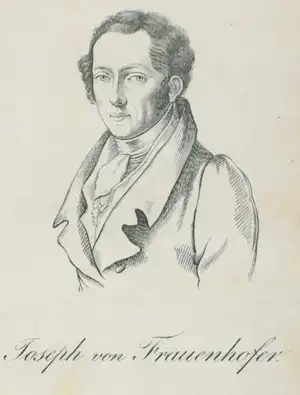
Prof. Dr. Joseph von Fraunhofer (✝︎)

- Location München, Germany
- Election year 1824
Research
Joseph von Fraunhofer was a German inventor, scientist, and developer of instruments. He is considered the founder of modern methods in the fields of optics and precision mechanics. The technique he developed for processing and manufacturing optical lenses was key to improving their quality and strength.
Fraunhofer developed a variety of optical instruments and conducted experiments for diffracting light on optical grating. A well-known special type is called Fraunhofer diffraction. Additionally, he succeeded in measuring the spectrum of sunlight. The dark absorption lines found therein are known as Fraunhofer lines. Another instrument which bears his name is the Fraunhofer objective, which consists of two individual lenses separated by an air gap.
Person
Joseph von Fraunhofer was born in Straubing on 6 March 1787 as the eleventh child of the glassmaker Franz Xaver Fraunhofer and his wife, Anna Maria. At the age of twelve, he was orphaned. He followed in his father’s footsteps and began pursuing a career in glassmaking in Munich in 1799. In 1801, Fraunhofer was caught beneath debris after the house of his teacher collapsed. However, he was rescued and was unharmed. He soon made the acquaintance of the entrepreneur Joseph von Utzschneider, who fostered Fraunhofer’s talent. This allowed him to go to school. In 1806, he joined the mathematical and mechanical institute of the famous inventor Georg von Reichenbach near Munich as an optical technician.
On 7 June 1826, Joseph von Fraunhofer died in Munich from tuberculosis of the lung. He was 39 years old. He is buried in the Munich cemetery Alter Südfriedhof.
Career
Aged 22, Joseph von Fraunhofer was named head of a glassmaking institute in Benediktbeuren in the foothills of the Alps (now known as the district of Bad Tölz-Wolfratshausen). Here, he developed new types of glass and optimised manufacturing methods. Under his leadership, the institute was able to improve the quality of the optical instruments it manufactured, which made it very successful. In short order, the lenses, magnifying glasses, microscopes and telescopes made at the institute were being sold across Europe.
Fraunhofer published his first scientific work in 1808. In 1811, he took over leadership of the glassmaking institute at the mathematics and mechanics institute at the Benediktbeuren location. In 1814 he became the sole partner and head of the entire institute. That same year, he invented the spectroscope, an optical instrument with which light can be split up and examined. He also discovered a type of light diffraction now known as Fraunhofer diffraction. While experimenting with sunlight shortly before that, he had discovered lines in the spectrum of sunlight. These lines have since been dubbed Fraunhofer lines.
In 1819, Fraunhofer, along with the entire Benediktbeuren institute, moved to Munich. He became a professor that same year. In 1823, Fraunhofer became a paid professor and conservator of the physics cabinet at the Bavarian Academy of Sciences.
The optical instruments he developed and built earned him an excellent international reputation. For instance, in 1824, he built a telescope with a 244-millimetre opening and a focal distance of 4.33 metres, specifications which were outstanding at the time. Visitors to his workshop included the mathematician Carl Friedrich Gauss, the Bavarian king, and the Russian Tsar.
Honours and Memberships
Joseph von Fraunhofer received great public acclaim, despite never having received formal academic training. He acquired all of his scientific knowledge independently. He was granted an honorary doctorate by the University of Erlangen in 1822. One year later, he became a member of the Bavarian Academy of Sciences and Humanities and he joined the German National Academy of Sciences Leopoldina in 1824. The King of Bavaria knighted him that same year.
1824 was also the year he became an honorary citizen of the city of Munich. In 1949, the Fraunhofer-Gesellschaft zur Förderung der angewandten Forschung e.V. was founded in Munich, named after him to honour his linking of foundational science and practical applications.