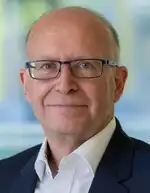
Professor Dr Jürgen Janek
- Section Chemistry
- Location Gießen, Germany
- Election year 2022
Research
Research Priorities: Solid-state chemistry, electrochemistry, interfacial chemistry, energy storage, batteries
Jürgen Janek is a German physical chemist. His research focuses on solid-state electrochemistry, defect and interfacial chemistry of inorganic functional materials, and electrochemical energy storage in batteries.
He conducts research in particular on innovative materials and concepts for electrochemical energy storage and converters. Since 2011 Janek has also been head of the BASF-KIT community laboratory at the Institute of Nanotechnology at the Karlsruhe Institute of Technology (KIT), where systematic studies are conducted on the cell reactions of lithium-ion batteries (LIB) and material developments for improved LIB.
Jürgen Janek is focused on the physical-chemical fundamentals of solid-state processes, which are important for modern energy and interface technologies. Currently, solid-state batteries are the focus of his research. Analytical studies on the formation of interphases on anodes and cathodes are additional areas of focus. Janek works in particular on transport and reaction in mixed conducting solids and in solid electrolytes. He is also researching new cell concepts for batteries based on metal-oxygen reactions (Li/O2, Na/O2) and metal-sulphur (Li/S8, Na/S8).
Solid-state batteries are considered the next generation of rechargeable batteries. They could enable faster charging processes and increase the ranges of e-cars. Also they are likely to have a longer lifetime than the current leading lithium-ion battery. Solid-state batteries based on ceramic electrolytes are expected to have a number of advantages. The conductivity of solid ionic conductors increases with temperature, and together with their higher chemical stability, this possibly also leads to less damage when overheated. There is major hope regarding the use of lithium metal as an electrode material , which tends to form short circuits (dendrite formation) in conventional batteries. Solid electrolytes reduce this risk – this could also lead to batteries with higher energy storage capacity in the long term.
Jürgen Janek is a German physical chemist. His research focuses on solid-state electrochemistry, defect and interfacial chemistry of inorganic functional materials, and electrochemical energy storage in batteries.
He conducts research in particular on innovative materials and concepts for electrochemical energy storage and converters. Since 2011 Janek has also been head of the BASF-KIT community laboratory at the Institute of Nanotechnology at the Karlsruhe Institute of Technology (KIT), where systematic studies are conducted on the cell reactions of lithium-ion batteries (LIB) and material developments for improved LIB.
Jürgen Janek is focused on the physical-chemical fundamentals of solid-state processes, which are important for modern energy and interface technologies. Currently, solid-state batteries are the focus of his research. Analytical studies on the formation of interphases on anodes and cathodes are additional areas of focus. Janek works in particular on transport and reaction in mixed conducting solids and in solid electrolytes. He is also researching new cell concepts for batteries based on metal-oxygen reactions (Li/O2, Na/O2) and metal-sulphur (Li/S8, Na/S8).
Solid-state batteries are considered the next generation of rechargeable batteries. They could enable faster charging processes and increase the ranges of e-cars. Also they are likely to have a longer lifetime than the current leading lithium-ion battery. Solid-state batteries based on ceramic electrolytes are expected to have a number of advantages. The conductivity of solid ionic conductors increases with temperature, and together with their higher chemical stability, this possibly also leads to less damage when overheated. There is major hope regarding the use of lithium metal as an electrode material , which tends to form short circuits (dendrite formation) in conventional batteries. Solid electrolytes reduce this risk – this could also lead to batteries with higher energy storage capacity in the long term.
Career
- since 2016 Director, Center for Materials Research (ZfM), Justus-Liebig-University (JLU) Gießen, Gießen, Germany
- since 2011 Director, Community Laboratory, Battery and Electrochemistry Laboratory (BELLA), BASF SE, Karlsruhe and Karlsruhe Institute of Technology (KIT), Germany
- 2008 Visiting Professor, Aix-Marseille University, Marseilles, France
- 2004 Visiting Professor, Department of Materials Science and Engineering, Seoul National University, Seoul, South Korea
- 2004 Visiting Professor, Tohoku University, Sendai, Japan
- since 1999 Professor of Physical Chemistry, Institute of Physical Chemistry, JLU Gießen, Gießen, Germany
- 1999 Professor of Physical Chemistry, Christian-Albrechts University Kiel, Kiel, Germany
- 1997 Habilitation in Physical Chemistry, Gottfried Wilhelm Leibniz University Hanover, Hanover, Germany
- 1997-1999 Senior Assistant, Institute of Physical Chemistry and Electrochemistry, Gottfried Wilhelm Leibniz University Hanover, Hanover, Germany
- 1992-1997 Research Assistant, Institute of Physical Chemistry and Electrochemistry, Gottfried Wilhelm Leibniz University Hanover, Hanover, Germany
- 1992 PhD in Physical Chemistry, Gottfried Wilhelm Leibniz University Hanover, Hanover, Germany
- 1989 Degree in Chemistry, Gottfried Wilhelm Leibniz University Hanover, Hanover, Germany
Functions
- since 2020 Member, Advisory Board, Bavarian Centre for Battery Technology (BayBatt), Bayreuth, Germany
- since 2020 Member, Advisory Board, Centre for Solar Energy and Hydrogen Research Baden-Württemberg (ZSW), Stuttgart, Germany
- 2019-2020 1st Chairperson, German Bunsen Society for Physical Chemistry (DBG), Germany
- 2018-2021 Dean, Faculty of Biology and Chemistry, JLU Gießen, Gießen, Germany
- since 2018 Member, Advisory Board, Max-Planck Institute for Solid Sate Research, Stuttgart, Germany
- since 2018 Deputy Chairperson, Advisory Board “Battery Forum Germany“, Federal Ministry of Education and Research (BMBF), Germany
- since 2018 Member, Advisory Board, Battery Research Centre, Münster Electrochemical Energy Technology (MEET), Westfalian Wilhelms University (WWU) Münster, Münster, Germany
- 2017-2022 Member, Research Council, Research Campus Mittelhessen (FCMH), Gießen, Germany
- 2011-2015 Scientific Member, Senate and Grants Committee for Collaborative Research Centres (SFB), German Research Foundation (DFG), Germany
- 2015-2018 Vice Dean, Faculty of Biology and Chemistry, JLU Gießen, Gießen, Germany
- 2009-2011 Chairperson, Federal Association of Materials Science and Technology (BVMatWerk), Germany
- 2007-2009 Chairperson, Working Group of German University Professors for Chemistry (ADUC), Germany
- 2007-2009 Member, Advisory Board and Delegate, German Chemical Society (GDCh) and BVMatWerk, Germany
- 2006-2012 Member, Board of Directors, Division of Solid State Research and Materials Science , GDCh, Germany
- 2004-2010 Deputy Spokesperson, Review Board for Chemical Solid State Research , DFG, Germany
- 2004-2006 Vice President, JLU Gießen, Gießen, Germany
- 2001-2003 Dean, Faculty of Biology, Chemistry and Earth Sciences, JLU Gießen, Gießen, Germany
- 2000 Vice Dean, Faculty of Biology, Chemistry and Earth Sciences, JLU Gießen, Gießen, Germany
Projects
- since 2021 Member, Competence Cluster Analytics & Quality Assurance (AQua), BMBF, Germany
- since 2021 Applicant, Subproject “Ion- and Electron-conductive hetero-aggregates for electrochemical applications”, Priority Programme (SPP) 2289, DFG, Germany
- since 2020 Applicant, Project “Catalysis mediated by oxygen storage: HCl oxidation reaction by CeO2-x(111)-based model catalysts”, DFG, Germany
- since 2020 Member, Project “NFDI4Ing – National Research Data Infrastructure for Engineering”, DFG, Germany
- since 2019 Member, Cluster of Excellence (EXC) 2154 “POLiS – Post Lithium Storage Cluster of Excellence“, DFG, Germany
- since 2018 Scientific Coordinator, Competence cluster for solid-state batteries (FestBatt), BMBF, Germany
- since 2017 Cooperation partner, Project “Lattice dynamics in ionic conductors”, DFG, Germany
- since 2017 Head, various projects, battery research programmes, BMBF, Germany
- since 2016 Scientific Coordinator, German-Israeli Battery School (GIBS), BMBF, Germany
- 2014-2016 Coordinator, Graduate Programme “Scientific and Technological Foundations of Electromobility”, Hessen Ministry of Science and Art, Wiesbaden, Germany
- 2013-2016 Coordinator, LOEWE focus on STORE-E “Material storage in interfaces for energy technologies of tomorrow“, Hessen Ministry of Science and Art, Wiesbaden, Germany
- 2010-2018 Head, Subproject “Interfacial Chemistry and 3D Analysis of Implant Interfaces of Osteoporotic Bone“, Transregio (TRR) 79, DFG, Germany
- 2010-2020 Member, International Research Network “Electrochemistry and Batteries”, BASF SE, Karlsruhe, Germany
- 2002-2008 Coordinator, SPP 1136 “Substitution effects in ionic solids“, DFG, Germany
- 1992-1997 Member, SFB 173 “Local particle motion, transport and chemical reaction in ion crystals”, DFG, Germany
Honours and Memberships
- 2025 Heinrich-Hertz-Prize, Stiftung Energie & Klimaschutz (Energy & Climate Protection Foundation), Karlsruhe, Germany and Karlsruhe Institute of Technology (KIT), Karlsruhe, Germany
- 2024, 2023, 2022,2021,2020 Highly Cited Researcher, Category „Cross-Field – 2020“, Clarivate, London, UK
- 2023 IBA Research Award, International Battery Materials Association (IBA), Strongsville, USA
- 2022 Greve Prize, German National Academy of Sciences Leopoldina, Germany
- since 2022 Member, German National Academy of Sciences Leopoldina, Germany
- 2022 Honorary Doctorate, Delft University of Technology (TU Delft), Delft, the Netherlands
- 2016 Wilhelm-Jost Commemorative Medal, Göttingen Academy of Sciences and Humanities, Göttingen, Germany
- 1999 Gerhard Hess Award for Young Scientists, DFG, Germany
- 1998 Karl-Winnacker Grant, Hoechst Foundation, Frankfurt am Main, Germany
- 1998 Nernst-Haber-Bodenstein Prize, German Bunsen Society (DBG), Germany
- 1989 Grant, German Chemical Industry Association (VCI), Frankfurt am Main, Germany