Julius Kühn (✝︎)
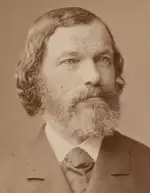
- Election year 1874
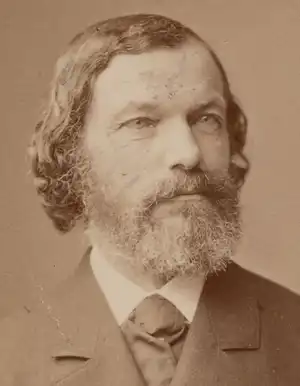
Research
Person
Julius Kühn was born on 23 October 1825 in Pulsnitz in Upper Lusatia as the son of an estate manager. At first, he attended the local elementary school and, even though his family encountered financial difficulties after his father fell ill, he was able to receive a higher education: From 1837 to 1841 he attended secondary school and later a technical school in Dresden.
In 1857, he married Anna Gansel, with whom he had two daughters and three sons.
Julius Kühn died on 14 April 1910 in Halle (Saale).
The German Phytomedicine Society in Braunschweig has been awarding the Julius Kühn Prize to young researchers since 1979. The Martin Luther University Halle-Wittenberg awarded the Julius Kühn plaque to students for outstanding achievements from 1983 to 1990, and commendable scientists received the Julius Kühn medal from 1980 to 2004. In 2008, the Federal Research Centre for Cultivated Plants in Quedlinburg was named Julius Kühn Institute.
Career
After completing school, Julius Kühn worked on a farm, at first as an apprentice in various operations – among them his father’s – and later as an estate manager in Lower Silesia (1848 to 1855), among other places. He already started researching cultigens back then.
In 1855, he enrolled at the agricultural school in Bonn-Poppelsdorf, where he was granted a unique scholarship that paid him 200 thalers for two semesters. However, this was not enough to support him all the way through and he had to quit prematurely. In the winter semester of 1856/57, he taught as a private lecturer at the agricultural academy in Prószków in Upper Silesia. In 1857 he obtained his doctorate at Leipzig University for his thesis “About Grain Smut, Infected Rapeseed and the Development of Corn Smut” (“Über den Brand des Getreides und das Befallen des Rapses und über die Entwicklung des Maisbrandes”), and in the same year, he earned his qualification to become a professor (Habilitation) at the agricultural academy in Prószków. He went back to practical agricultural work in 1857 and became Count Egloffstein’s Commercial Director near Głogów (Lower Silesia).
In subsequent years, Kühn published several ground-breaking textbooks, such as “The Diseases of Agricultural Crops, their Cause and their Prevention” („Die Krankheiten der Kulturgewächse, ihre Ursachen und ihre Verhütung“) (1858) and “The Appropriate Nutrition for Cattle from a Scientific and Practical Approach” („Die zweckmäßigste Ernährung des Rindviehes vom wissenschaftlichen und praktischen Gesichtspunkte“) (1861), the latter of which was reprinted multiple times, and even published abroad.
In the spring of 1862, Kühn was appointed a full professor at the Martin Luther University of Halle-Wittenberg, where he established the agricultural institute along with a 115-hectare testing ground and a testing station. He also added a garden for domesticated animals, which formed the basis for a teaching collection (later it became the Museum for Animal Lifestock). Under his leadership, the Martin Luther University Halle-Wittenberg grew into one of the most relevant education and research institutions in Germany. In 1863, Kühn was offered a chair at the University of Göttingen, which he declined, followed by offers from the Universities of Hohenheim and Vienna in 1865 and 1869, respectively.
Kühn promoted and standardized academic teaching. He defined it as a form of applied natural sciences that also includes aspects of business administration. Due to the strong practical relevance, he expected course applicants to provide proof of practical experience. On the close relation between academic research and agricultural practice, he stated: “One-sided specialized education easily leads, if not to superficiality, to a common realism that gradually impedes higher aspirations and leads one astray from one’s true destiny – giving rise to a selfish, heartless, purely profit-oriented character of average usefulness. University education, on the other hand, grants farmers a larger number of more ambitious perspectives.”
In 1878, Julius Kühn initiated the long-term field experiment “eternal rye cultivation” at the University of Halle-Wittenberg, which is still on-going today. His work on crop protection led to the identification of pests, such as the sugarbeet nematode, which stifles the beet’s growth. Kühn was given emeritus status in Halle in 1909.
Honours and Memberships
Kühn received numerous awards for his scientific work, such as the titles “Geheimer Regierungsrat” (privy councillor) (1882), “Geheimer Oberregierungsrat” (senior councillor) (1892), “Wirklich Geheimer Rat” (member of the privy council) (1903). He was also awarded the Golden Liebig Medal (1877) and the 2nd Class Order of the Red Eagle with oak leaves and star, the Imperial Austrian Order of Franz Joseph, as well as the Imperial Russian 2nd Class Order of Saint Stanislaus with star. He was bestowed honorary citizenship by his birthplace Pulsnitz and the city of Halle in 1889 and 1895, respectively.
Julius Kühn was a member of several scientific academies and institutions, such as the German National Academy of Sciences Leopoldina Halle (1874), Corresponding Member of the French Academy of Sciences in Paris (1899), and Honorary Member of the Royal Hanoverian Agricultural Society of Celle (1864), Imperial and Royal Agricultural Society of Vienna (1888), as well as the Imperial Agricultural Society of Moscow (1893). He was also awarded an Honorary Doctorate by the Jagiellonian University in Krakow (1900).