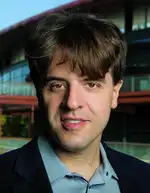
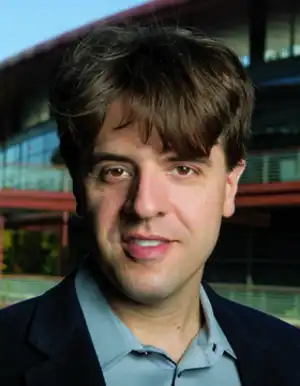
Professor Dr Karl Deisseroth
- Section Neurosciences
- Location Stanford, CA, United States
- Election year 2014
Research
Main areas of research: Optogenetics, CLARITY method (Clear Lipid-exchanged Anatomically Rigid/Immunostaining-compatible Tissue Hydrogel), Channelrhodopsin, Channelrhodopsin-2, neurological diseases, depression, autism diseases
Karl Deisseroth was one of the founders of optogenetics and also developed the CLARITY method. Unimagined insights into the brain have been gained through the use of both methods. Deisseroth hopes that these will then lead to a greater understanding of neurological diseases.
Optogenetics is a combination of optics and genetics. Proteins that react to light (channelrhodopsin) like, for example, those that are found in green algae, are introduced into nerve cells with the aid of a virus. The proteins act like a light switch by which the nerve cells in the brain can be externally controlled. Deisseroth was able to demonstrate his method on living animals. His team used viruses to implant the blueprint for the gene channelrhodopsin-2 in the brains of mice. When exposed to a certain light, the switch opened an ionic channel and the nerve cells fired signals. For the first time, researchers were thus able to selectively turn nerve cells on and off.
In the case of the mice, neurons that utilize dopamine could be turned on and off, which meant that the symptoms of Parkinson’s disease could possibly be palliated. Deisseroth hopes that his method will lead to a better understanding of neurological diseases like depression, anxiety disorders and Parkinson’s disease. What is more, he has been able to gain new insights into motivation, aggression and addiction. In the meantime, working groups all over the world are doing research using the optogenetic method.
The second method developed by Deisseroth is called the CLARITY method (Clear Lipid-exchanged Anatomically Rigid/immunostaining-compatible Tissue hydrogel). The team headed by Karl Deisseroth has succeeded in making the brain “transparent”. Brain tissue is immersed in a hydrogel and the lipids are dissolved out. What remains is a realistic, transparent brain-hydrogel hybrid. This allows post-mortem tissue to be investigated in its anatomic structure. In this way an entire brain of a mouse with all its nerve connections and cellular details can be made transparent. The method also has implications for cancer research.
In addition to his work in the lab, Karl Deisseroth continues practicing psychiatry. He treats patients with severe therapy-resistant depression and autism. His research is primarily undertaken for the benefit of his patients. He seeks to identify the neural networks that are impaired by psychiatric diseases. For this he plans on combining the optogenetic and CLARITY methods in the future.
Karl Deisseroth was one of the founders of optogenetics and also developed the CLARITY method. Unimagined insights into the brain have been gained through the use of both methods. Deisseroth hopes that these will then lead to a greater understanding of neurological diseases.
Optogenetics is a combination of optics and genetics. Proteins that react to light (channelrhodopsin) like, for example, those that are found in green algae, are introduced into nerve cells with the aid of a virus. The proteins act like a light switch by which the nerve cells in the brain can be externally controlled. Deisseroth was able to demonstrate his method on living animals. His team used viruses to implant the blueprint for the gene channelrhodopsin-2 in the brains of mice. When exposed to a certain light, the switch opened an ionic channel and the nerve cells fired signals. For the first time, researchers were thus able to selectively turn nerve cells on and off.
In the case of the mice, neurons that utilize dopamine could be turned on and off, which meant that the symptoms of Parkinson’s disease could possibly be palliated. Deisseroth hopes that his method will lead to a better understanding of neurological diseases like depression, anxiety disorders and Parkinson’s disease. What is more, he has been able to gain new insights into motivation, aggression and addiction. In the meantime, working groups all over the world are doing research using the optogenetic method.
The second method developed by Deisseroth is called the CLARITY method (Clear Lipid-exchanged Anatomically Rigid/immunostaining-compatible Tissue hydrogel). The team headed by Karl Deisseroth has succeeded in making the brain “transparent”. Brain tissue is immersed in a hydrogel and the lipids are dissolved out. What remains is a realistic, transparent brain-hydrogel hybrid. This allows post-mortem tissue to be investigated in its anatomic structure. In this way an entire brain of a mouse with all its nerve connections and cellular details can be made transparent. The method also has implications for cancer research.
In addition to his work in the lab, Karl Deisseroth continues practicing psychiatry. He treats patients with severe therapy-resistant depression and autism. His research is primarily undertaken for the benefit of his patients. He seeks to identify the neural networks that are impaired by psychiatric diseases. For this he plans on combining the optogenetic and CLARITY methods in the future.
Career
- since 2014 Investigator, Howard Hughes Medical Institute (HHMI), Maryland, USA
- since 2013 Extraordinary Professor, Karolinska Institutet, Schweden
- seit 2012 D.H. Chen Professor of Bioengineering, Psychiatry and Behavioral Sciences, Stanford University, USA
- since 2012 Professor of Bioengineering and Psychiatry, Stanford
- 2009 - 2013 HHMI Early Career Investigator
- 2009 - 2012 Associate Professor of Bioengineering and Psychiatry, Stanford University
- 2005 - 2008 Assistant Professor of Bioengineering and Psychiatry, Stanford University
- 2004 - 2005 Principal Investigator and Clinical Educator, Institute of Psychiatry, Stanford University School of Medicine
- 2000 - 2004 Assistant Psychiatrist, Stanford University
- 2000 - 2001 MD internship/licensure, Stanford University
- 1994 - 1998 Ph.D. Stanford University (neurosciences)
- 1992 - 2000 M.D., Stanford University Medical School (MSTP Program)
- 1988 - 1992 Studies of Biochemistry, Harvard University, USA
Functions
- since 2009 Member of the Scientific Board, Brain and Behavior Research Foundation (formerly NARSAD)
- since 2007 Scientific advisor, nonprofit: Kinetics Foundation for Parkinson's Research
- since 2007 Ad hoc Member, National Institutes of Health (NIH), study sections
- 2007-2009 Member of the National Institutes of Health Molecular Neurogenetics chartered study section (MNG)
- 2006 Diplomate, American Board of Neurology and Psychiatry
- 2005-2007 Scientific advisor,, nonprofit: Michael J Fox Foundation for Parkinson's Research
Honours and Memberships
- 2023 Japan Prize, The Japan Prize Foundation, Tokyo, Japan
- 2021 Lasker Basic Medical Research Award, Lasker Foundation, USA
- 2020 Heineken Prize 2020
- 2018 Berthold Leibinger Zukunftspreis
- 2017 Else Kröner Fresenius Preis für Medizinische Forschung
- 2015 Breakthrough Prize in life sciences 2016
- 2015 Dickson Prize in Medicine
- 2015 Albany Medical Center Prize
- 2015 Lurie Prize in Biomedical Sciences, for optogenetics and CLARITY
- since 2014 Member of the National Academy of Sciences Leopoldina
- 2014 Keio Medical Science Prize
- 2014 Dickson Prize in Science
- 2013 Richard Lounsbery Prize from the National Academy of Sciences
- 2013 Brain Prize
- 2013 Gabbay Award
- 2012 Zülch Prize of the Max Planck Society
- since 2012 Member of the US-National Academy of Sciences
- 2012 Record Prize, Baylor
- 2012 Perl/UNC Prize
- 2011 Alden Spencer Prize, Columbia
- since 2010 Member of the Institute of Medicine (IOM)
- 2010 Nakasone Prize laureate, International Human Frontier Science Program/HFSP
- 2010 Koetser Prize
- 2010 Gill YIA Award, Indiana University
- 2009 Society for Neuroscience YIA Award
- 2008 Schuetze Prize, Columbia University
- 2008 Lawrence C. Katz Prize, Duke University
- 2008 William M. Keck Foundation Medical Research Award
- 2008 World Economic Forum Lecturer
- 2008 Brilliant 10 Award, Popular Science
- 2007 Top 10 Technologies Award, MIT Technology Review
- 2007 McKnight Foundation Scholar Award
- 2006 Presidential Early Career Award in Science and Engineering (PECASE)
- 2005 NIH Director's Pioneer Award
- 2005 Coulter Foundation Early Career Translational Research Award
- 2005 McKnight Foundation Technological Innovations in Neuroscience Award
- 2005 American Psychiatric Institute for Research and Education Young Faculty Award
- 2005 NARSAD Young Investigator Award
- 2005 Whitehall Foundation Award
- 2005 Klingenstein Fellowship Award and Robert H. Ebert Clinical Scholar Award
- 2004 Charles E. Culpeper Scholarship in Medical Science Award
- 2004 American Psychiatric Association Resident Research Award
- 2002 NIMH Outstanding Resident Award
- 1997 Stanford Yanofsky Graduate Research Award
- 1992 Highest Honors, Department of Biochemistry and Molecular Biology, Harvard
- 1992 Phi Beta Kappa, Harvard
- 1990-1992 John Harvard Scholarship: Academic Achievement of the Highest Distinction, Harvard