Prof. Dr. Leopold Ružička (✝︎)
Nobel Prize for Chemistry 1939
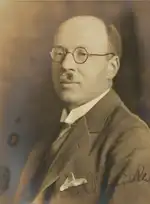
- Section Chemistry
- Location Zürich, Switzerland
- Election year 1932
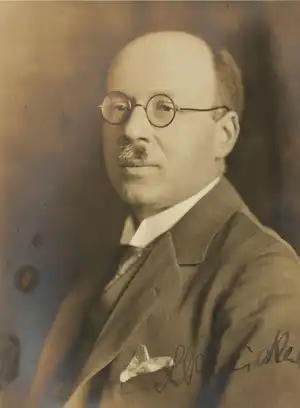
Research
Leopold Ružička was a Swiss chemist. He studied the active ingredients of insecticides, the structural elucidation and synthesis of fragrances, the synthesis of androsterone and cholesterol, as well as the semisynthesis of testosterone. Ružička received the Nobel Prize in Chemistry for his research on polymethylenes and higher terpenes in 1939.
Person
Leopold Ružička was born on 13 September 1887 as Lavoslav Stjepan Ružička in Vukovar (at that time Kingdom of Croatia and Slavonia, in present-day Croatia). His parents were the cooper Stjepan Ružička and his wife Ljubica Sever. After his father’s untimely death in 1891, he moved with his mother to her old hometown of Osijek, where he attended elementary and secondary school.
In 1912, Ružička married Anna Hausmann. The couple did not have any children and divorced in 1950. A year later he married Gertrud Acklin.
In 1917, Ružička attained Swiss citizenship. In his later years, he made a name for himself as an art collector. He donated paintings by Dutch masters to the Kunsthaus Zürich and established the Ružička Foundation to provide the art museum with additional funding.
Leopold Ružička died on 26 September 1976 in Mammern in the Swiss canton of Thurgau.
The Swiss Federal Institute of Technology Zurich annually awards young chemists the Ruzicka Prize.
Career
Leopold Ružička’s aspiration had been to study at the Swiss Federal Institute of Technology (ETH) in Zurich, however, out of fear of not passing the entrance exam in descriptive geometry, he took up chemistry at the Karlsruhe Institute of Technology in 1906. His doctoral advisor was Hermann Staudinger, who later received the Nobel Prize in Chemistry (1953), and after earning his doctorate in 1910, Ružička went on to become his assistant. Ružička and Staudiger studied the hitherto unexplored structure and effects of insecticides. In 1912, Ružička followed Staudinger, who was appointed professor at the Swiss Federal Institute of Technology (ETH), to Zurich.
In 1916, Ružička began working on his qualification to become a professor (Habilitation), but Staudinger disagreed with his choice of research topic. Ružička ultimately prevailed and began working on the structural elucidation and synthesis of fragrances. As a punishment, Staudinger dismissed him as assistant and restricted his research opportunities. Ružička was thus forced to find partners in the industry, such as the fragrance and flavour producer Haarmann & Reimer in Holzminden in Lower Saxony. Two years later, Ružička submitted his habilitation thesis. From 1921, he studied fragrances for the perfumeries owned by fragrance Chuit, Naef & Firmenich in Geneva.
In 1923, he was appointed honorary professor at the Swiss Federal Institute of Technology Zurich. In 1926, he transferred to Geneva, where he initially sought co-operation with the industry. In the same year, he accepted an offer from Utrecht University and was appointed professor for organic chemistry. In 1929, he returned to ETH in Zurich, where he finally settled and proceeded to expand the chemistry laboratory. One of his assistants was Tadeus Reichstein, who went on to win the Nobel Prize in Physiology or Medicine in 1950. In 1930, another collaboration with the industry started taking shape: Ružička studied male sex hormones for the Swiss chemical company Ciba. From 1937, he received financial support from the Rockefeller Foundation for researching natural hormones, especially steroids.
Ružička remained in Zurich until his retirement in 1957.
Honours and Memberships
Ružička received numerous awards for his scientific work, such as the Marcel Benoist Prize of the Swiss Marcel Benoist Foundation (1938) and the Faraday Lectureship Prize (1958). He was a member of several academies and scientific associations, among them the German National Academy of Sciences Leopoldina (1932), as well as the American Academy of Arts and Sciences (1938).
Nobel Prize
Leopold Ružička studied polyterpenes. Thanks to his experimental skills, he accomplished difficult structural determinations, characterising a large number of essential polyterpenes. He discovered that polyterpenes consist of isoprene components and established the so-called biogenetic isoprene rule.
Ružička also investigated natural fragrances, which had previously barely received any attention. He discovered connections between the polyterpenes investigated and other essential physiological compounds, such as bile acid, sterols and sex hormones. The analysis of related substances greatly contributed to the canon of knowledge on physiologically significant sex hormones.
Ružička received the Nobel Prize in Chemistry for his research on polymethylenes and higher terpenes in 1939. Due to the political situation at the time, the award ceremony could not take place in Stockholm as was customary, and instead the Swedish ambassador presented Ružička with the award in Zurich in January 1940.