Professor Dr Leticia Quintanilla-Martínez de Fend
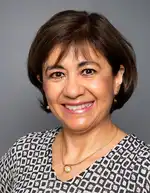
- Section Pathology and Forensic Medicine
- Location Tübingen, Germany
- Election year 2023

Research
Research Priorities: Pathogenesis and classification of lymphomas, Epstein-Barr virus-associated lymphoproliferations, B- and T-cells lymphomas.
Leticia Quintanilla-Martinez de Fend a pathologist. She is actively involved with the classification as well as the genetic and pathological characterisation of malignant lymphomas and other diseases that show uncontrolled cell proliferation of the lymphatic system. Especially lymphproliferations that are associated with Epstein-Barr virus infections are her focus. The understanding of these diseases and their early diagnosis contributes to a better therapy and improvement of their prognosis.
The basis of Leticia Quintanilla-Martinez de Fend’s research are morphological observations and molecular analyses of malignant lymphomas, to gain both a deeper understanding of their development and a more thorough classification. Malignant lymphomas are diseases of the lymphatic system characterized by a rapid and uncontrolled proliferation of lymphoid cells. Her interest is especially in those lymphoproliferations that are associated to the Epstein Barr virus (EBV). EBV infections are a worldwide medical problem as around 95% of the world’s population are latently infected with the Epstein Barr virus. The research of Leticia Quintanilla-Martinez de Fend helped to describe the pathogenesis of Epstein-Barr virus-associated lymphoproliferations. These investigations also form the basis for the classification of EBV-positive lymphoproliferative diseases of immune cells during childhood and adulthood, which was made by the World Health Organisation (WHO).
A further interest of Leticia Quintanilla-Martinez de Fend are the genetic alterations in pediatric B-cell lymphomas. In a global cooperation, her team described the genetic alteration in recently discovered lymphoma subtypes. This contributed to a deeper understanding of these diseases and changed the treatment approach.
Leticia Quintanilla-Martinez de Fend is also involved in the establishment of standards in the pathology of mouse models.
Leticia Quintanilla-Martinez de Fend a pathologist. She is actively involved with the classification as well as the genetic and pathological characterisation of malignant lymphomas and other diseases that show uncontrolled cell proliferation of the lymphatic system. Especially lymphproliferations that are associated with Epstein-Barr virus infections are her focus. The understanding of these diseases and their early diagnosis contributes to a better therapy and improvement of their prognosis.
The basis of Leticia Quintanilla-Martinez de Fend’s research are morphological observations and molecular analyses of malignant lymphomas, to gain both a deeper understanding of their development and a more thorough classification. Malignant lymphomas are diseases of the lymphatic system characterized by a rapid and uncontrolled proliferation of lymphoid cells. Her interest is especially in those lymphoproliferations that are associated to the Epstein Barr virus (EBV). EBV infections are a worldwide medical problem as around 95% of the world’s population are latently infected with the Epstein Barr virus. The research of Leticia Quintanilla-Martinez de Fend helped to describe the pathogenesis of Epstein-Barr virus-associated lymphoproliferations. These investigations also form the basis for the classification of EBV-positive lymphoproliferative diseases of immune cells during childhood and adulthood, which was made by the World Health Organisation (WHO).
A further interest of Leticia Quintanilla-Martinez de Fend are the genetic alterations in pediatric B-cell lymphomas. In a global cooperation, her team described the genetic alteration in recently discovered lymphoma subtypes. This contributed to a deeper understanding of these diseases and changed the treatment approach.
Leticia Quintanilla-Martinez de Fend is also involved in the establishment of standards in the pathology of mouse models.
Career
- seit 2008 Außerplanmäßge Professorin für Pathologie, Eberhard-Karls Universität Tübingen
- 2000-2008 Wissenschaftliche Mitarbeiterin, Institut für Pathologie, Helmholtz Zentrum München
- 2000 Habilitation im Fach Pathologie, Universität Innsbruck, Innsbruck, Österreich
- 1997-1999 Forschungsstipendiatin, National Cancer Institute, National Institutes of Health, Bethesda, USA
- 1992-1995 Oberärztin, Instituto Nacional de Ciencias y de la Nutricion, Mexiko-Stadt, Mexiko
- 1992-1995 Wissenschaftlerin, Instituto Nacional de Ciencias y de la Nutricion, Mexiko-Stadt, Mexiko
- 1991-1992 Ärztin, Massachussetts General Hospital, Harvard Medical School, Boston, USA
- 1990-1991 Ärztin, Minneapolis University Hospital, Minneapolis, USA
- 1987-1990 Facharztausbildung Pathologie, Instituto Nacional de Ciencias y de la Nutricion, Mexiko-Stadt, Mexiko
- 1985-1987 Facharztausbildung Innere Medizin, Instituto Nacional de Ciencias y de la Nutricion, Mexiko-Stadt, Mexiko
- 1978-1984 Studium der Humanmedizin, Universidad Nacional Autonoma de Mexico, Mexiko-Stadt, Mexiko
Functions
- 2020-2022 Präsidentin, Europäische Gesellschaft für Hämatopathologie (EA4HP)
- 2021 Mitglied, Clinical Advisory Committee (CAC), International consensus classification of lymphoid and myeloid neoplasms
- 2020 Mitglied, Wissenschaftlicher Beirat, American Society of Hematology (ASH), USA
- 2016-2023 Mitglied, Executive Committee, Mantle Cell Lymphoma Consortium and Initiative, Lymphoma Research Foundation (LRF), New York City, USA
- 2016-2020 Mitglied, Scientific Committee, European School of Medicine (ESMO)
- 2016 Mitglied, Scientific Committee, International Conference in Malignant lymphoma (ICML)
- 2014 Mitglied, Advisory Group, 4th edition of the WHO classification of Lymphomas, World Health Organization (WHO)
- seit 2013 Mitglied, International Lymphoma Study Group (ILSG)
- 2012-2018 Sprecherin der EA4HP, Society for Hematopathology, USA
- 2010-2018 Wissenschaftliche Sekretärin, EA4HP
Projects
- 2019 Beteiligte Wissenschaftlerin, Exzellenzcluster (EXC) 2180 „Individualisierung von Tumortherapien durch molekulare Bildgebung und funktionelle Identifizierung therapeutischer Zielstrukturen“, Deutsche Forschungsgemeinschaft (DFG)
- 2009-2017 Leiterin, Teilprojekt „Die Regulation und biologische Funktion der Überexpression von C/EBPβ im ALK+ großzellig-anaplastischen Lymphom“, Sonderforschungsbereich (SFB) 685, DFG
Honours and Memberships
- seit 2023 Mitglied, Nationale Akademie der Wissenschaften Leopoldina
- 1997-1999 Fogarty Award, National Institutes of Health, Bethesda, USA
- 1997 Charlotte-Bühler-Habilitationsstipendium, Bundesministerium für Bildung, Wissenschaft und Forschung (BBWF) sowie Fonds zur Förderung der wissenschaftlichen Forschung (FWF), Österreich
- 1997 Carl von Rokitansky-Preis, Österreichische Gesellschaft für Pathologie