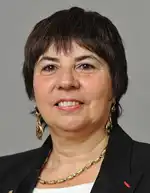
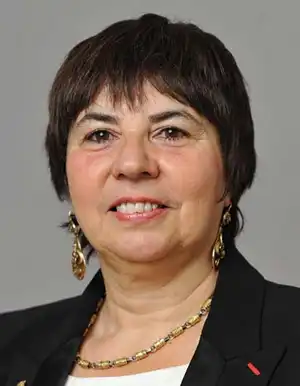
Professor Dr Luisa De Cola
- Section Chemistry
- Location Straßburg, France
- Election year 2014
Research
Research Priorities: electro-luminscent materials, nanomaterials for photonics, energy conversion, biomedicine, nanoporous materials, supramolecular self-assembly, optoelectronics, in vitro and in vivo imaging
Luisa de Cola is an Italian nanoscientist and has made a name for herself in two essential areas of interest: luminescent and electro-luminescent materials for optical and electro-optical applications as well as nanomaterials for medical imaging, diagnostics and therapy.
Her research on electro-luminescence was able to demonstrate how the structure of molecules can be used to regulate the colour of light emitted. In cooperation with the industry, these findings have been directly applied to the development of novel light sources such as OLEDs, PLEDs and LEECs. Luisa De Cola also specialises in porous nanomaterials, which are produced from various elements, in various shapes and with varying pore sizes. For example, they provide a base for the targeted growth of biological cells and tissues when applied as coating, thus opening up new strategies for regenerative medicine. Other applications – including of other nanoparticles such as nanocontainers – can be found in the transporting of substances in the body as well as in in vitro and in vivo imaging, i.e. biomedical imaging, when combined with luminescence effects. In all these applications, the self-assembly of supramolecular structures plays an essential role as a way of producing, shaping and functionalising nanomaterials.
Throughout her research career, Luisa De Cola has repeatedly pioneered new scientific approaches and she sets great store by breaking down barriers between research disciplines and bringing together researchers from around the globe who complement each other’s knowledge. She herself has conducted research in different parts of the world, collaborating closely with the industry and contributing to more than 30 patents.
Luisa de Cola is an Italian nanoscientist and has made a name for herself in two essential areas of interest: luminescent and electro-luminescent materials for optical and electro-optical applications as well as nanomaterials for medical imaging, diagnostics and therapy.
Her research on electro-luminescence was able to demonstrate how the structure of molecules can be used to regulate the colour of light emitted. In cooperation with the industry, these findings have been directly applied to the development of novel light sources such as OLEDs, PLEDs and LEECs. Luisa De Cola also specialises in porous nanomaterials, which are produced from various elements, in various shapes and with varying pore sizes. For example, they provide a base for the targeted growth of biological cells and tissues when applied as coating, thus opening up new strategies for regenerative medicine. Other applications – including of other nanoparticles such as nanocontainers – can be found in the transporting of substances in the body as well as in in vitro and in vivo imaging, i.e. biomedical imaging, when combined with luminescence effects. In all these applications, the self-assembly of supramolecular structures plays an essential role as a way of producing, shaping and functionalising nanomaterials.
Throughout her research career, Luisa De Cola has repeatedly pioneered new scientific approaches and she sets great store by breaking down barriers between research disciplines and bringing together researchers from around the globe who complement each other’s knowledge. She herself has conducted research in different parts of the world, collaborating closely with the industry and contributing to more than 30 patents.
Career
- since 2012 AXA Chair on Supramolecular Chemistry, University of Strasbourg, Strasbourg, France
- since 2012 Extraordinary Professor, Karlsruhe Institute of Technology (KIT), Karlsruhe, Germany
- since 2006 Part-time Professor, Department of Chemistry, University of Twente (UT), Twente, Netherlands
- 2005-2006 Extraordinary Professor, Van’t Hoff Institute for Molecular Sciences (HIMS), University of Amsterdam, Amsterdam, Netherlands
- 2005-2012 Professor of Nanoelectronics and Nanophotonics, University of Münster, Münster, Germany
- 1998-2004 Professor of Molecular Photonic Materials, University of Amsterdam, Amsterdam, Netherlands
- 1990-1998 Assistant Professor, University of Bologna, Bologna, Italy
- 1987-1988 Visiting Scholar, University of Fribourg, Fribourg, Switzerland
- 1986-1990 Researcher, Institute of Photochemistry and High-Energy Radiation (FRAE), National Research Council (CNR), Bologna, Italy
- 1984-1986 Postdoctoral Fellow, Virginia Commonwealth University, Richmond, USA
- 1978-1983 Laurea in Chemistry summa cum laude, University of Messina, Messina, Italy
Honours and Memberships
- since 2016 Corresponding Member, Academy of Sciences and Literature, Mainz, Germany
- 2014 L. Tartufari Prize, International Prize for Chemistry, Accademia dei Lincei, Rome, Italy
- since 2014 Member, German National Academy of Sciences Leopoldina, Germany
- 2014 Chevalier de la Légion d’Honneur, Order of Merit, France
- since 2013 Member, Academia Europaea
- 2012 Gutenberg Chair Award, Cercle Gutenberg, Region Grand Est, Eurométropole de Strasbourg, Strasbourg, France
- 2011 Distinguished Women in Chemistry or Chemical Engineering, International Union of Pure and Applied Chemistry (IUPAC)
- 2009 ERC Advanced Grant Award, European Research Council (ERC)
- 2004 Finalist, Descartes Prize 2004, European Commission
- 1995 International “Grammaticakis-Neumann” Prize, European Photochemistry Association
- 1995 “Per un futuro intelligente” Prize, Federchimica, Italian Federation of the Chemical Industry, Italy
- 1993 Chemistry Prize, Accademia di Scienze Fisiche e Matematiche di Napoli, Napoli, Italy
- 1986 Chemistry Prize, Fondazione U. Bonino e M.S. Pulejo, Messina, Italy