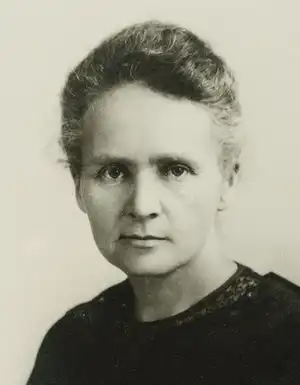
Professor Dr Marie Curie-Skłodowska (✝︎)
Nobel Prize for Physics 1903 Nobel Prize for Chemistry 1911
- Section Physics
- Location Paris, France
- Election year 1932
Research
Marie Curie-Skłodowska was a physicist and chemist of Polish origin. Together with her husband Pierre Curie, she was awarded the Nobel Prize in Physics in 1903 for her research on radioactive radiation. In 1911, she was also awarded the Nobel Prize in Chemistry for her research on radium and its production as a pure metal. Marie Curie-Skłodowska was the first woman to be honoured with a Nobel Prize. At the same time, she was the first person to receive this highest scientific honour twice.
Person
Marie Curie-Skłodowska was born in Warsaw, PL, on 7 November 1867, as the youngest of five children. Her father was a mathematics and physics teacher at a secondary school. Her mother was the headmistress of a girls' school. After her schooling and the early death of her mother, she initially became a governess so that she could earn a living.
She had been married to the physicist Pierre Curie since 1895. They had two daughters, Irène (1897) and Ève (1904). Marie Curie-Sklodowska passed away on 4 July 1934 in Sancellemoz (Haute-Savoie), FR, as a result of the radiation to which she had been exposed through her research work. On the initiative of former President Mitterand, the coffins of Pierre and Marie Curie were transferred to the Pantheon in Paris in 1995, where the most eminent Frenchmen are laid to rest.
Career
In 1891, Maria Skłodowska, as she was known by her maiden name, moved to Paris. The reason was that women were not allowed to study in Poland. In November 1891, she enrolled at the Sorbonne to study physics and chemistry. In 1894, she met Pierre Curie, who was working as a teacher at a school for physics and chemistry in Paris. The two worked together in a small laboratory at the school from then on. Marie began a dissertation on the spontaneous emission of ionising rays from uranium, a phenomenon that had previously been discovered by her doctoral supervisor Henri Becquerel.
In July 1898, Marie Curie-Skłodowska discovered a new radioactive substance after gruelling experimentation. In honour of her Polish homeland, she gave it the name polonium. Only five months later, with the support of her husband Pierre Curie, she identified another radioactive element: radium. As a result of this work, Marie Curie-Skłodowska experienced health problems for the first time in 1903, apparently due to the handling of radioactive material.
In 1905, her husband Pierre was given a chair at the Sorbonne. He was also granted access to a laboratory. Only one year later, on 19 April 1906, he died in a cab accident shortly before his 47th birthday. After his death, Marie took over the chair and, at the same time, the management of the laboratory. She thus became the first female university lecturer at the Sorbonne.
In 1911, Marie Curie-Skłodowska was denied a seat in the Académie des Sciences in her adopted country, citing her gender. In the same year, her relationship with the French physicist Paul Langevin came to light. Hostility and personal attacks fanned by press reports were the results. Almost simultaneously with this affair came the news that Marie Curie-Skłodowska was to be the only researcher ever to be awarded the Nobel Prize for a second time.
In 1914, she became the director of the Institut du Radium. This institution was founded to promote research into the physical and chemical principles of radioactive elements as well as the medical applications of radioactivity. The first lectures were launched in 1919. Renowned researchers emerged from this school, including Curie's daughter Irène Joliot-Curie, who, together with her husband Frédérik Joliot-Curie, would later also be honoured with the Nobel Prize.
During the First World War, Curie-Skłodowska organised X-ray facilities for the French army, drove an X-ray car she had developed herself and trained radiology nurses. This enabled soldiers near the front lines to be examined radiologically.
From 1922 to 1934, Marie Curie-Skłodowska worked for the League of Nations, where she was elected to the International Commission for Intellectual Cooperation. There she worked on aspects of copyright protection for scientific works. In addition, she campaigned for the creation of an international bibliography of scientific works and the transnational awarding of research grants.
Due to her constant contact with radium, she became a victim of her own research work over the years, as she could not protect herself effectively from the damaging effects of the element in the long term. She passed away on 4 July 1934 in a sanatorium in Sancellemoz in Haute-Savoie from the effects of anaemia, which was probably due to her many years of contact with radioactive substances.
Honours and Memberships
Marie Curie-Skłodowska was a member of numerous societies, including the Academies of Science of Sweden (1910) and Poland (1909), the American Philosophical Society (1910) as well as the Académie nationale de Médecine in France (1922) and the German Academy of Sciences Leopoldina (1932). In addition, numerous universities around the world awarded her honorary doctorates.
Nobel Prize
Under the most challenging conditions, Marie Curie-Skłodowska and her husband Pierre Curie extracted radium from waste of the mineral pitchblende (uraninite) in a draughty shed in Paris. They had a tonne of pitchblende delivered especially for this purpose, from which they were able to extract one decigram of radium chloride - enough to determine the atomic mass of radium. Her dissertation, which Marie Curie-Skłodowska subsequently wrote on radioactive substances and successfully defended in 1903, was translated into five languages and printed 17 times within a year. Her exceptional merit was that she was able to interpret radioactivity as an atomic process.
In addition, the Curies discovered the effects of radium rays. Together with physicians, Pierre Curie subsequently undertook experiments on animals; shortly afterwards, radium treatment of cancer patients began. However, the two scientists did not want to gain any financial benefit from their research work. Therefore, they refrained from patenting the process of radium production.
Marie Curie-Skłodowska received two Nobel Prizes: In 1903, she was awarded the Nobel Prize in Physics together with her husband Pierre Curie and her teacher Henri Becquerel for the discovery of radioactivity. In 1911, she received the Nobel Prize in Chemistry, this time "in recognition of her services to the progress of chemistry through the discovery of the elements radium and polonium, through the isolation of radium, and the study of the nature and compounds of this remarkable element."