Professor Dr Niels Bohr (✝︎)
Nobel Prize for Physics 1922
- Section Physics
- Location Kopenhagen, Denmark
- Election year 1932
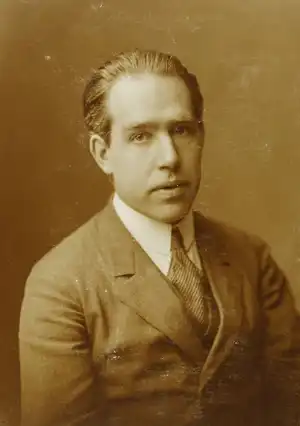
Research
Niels Bohr was a Danish physicist. He is considered a pioneer of quantum physics. He developed the Bohr model of the atom, named after him. He was honoured with the Nobel Prize in Physics in 1922 for his achievements in researching the structure of atoms and the radiation they emit.
Person
Niels Bohr was born on 7 October 1885 in Copenhagen, DK, to Christian and Ellen Bohr. His father was a professor of physiology and introduced his sons to scientific topics at an early age. Harald Bohr, Niels Bohr's younger brother, not only played successfully in the Danish national football team, with which he won Olympic silver in 1908, but was also a professor of mathematics at the University of Copenhagen.
In 1912, Niels Bohr married Margarethe Nörlund. Two of their six sons died prematurely. The other four, Hans Henrik (1918), Erik (1920), Aage (1922) and Ernest (1924), all became successful in their respective careers. Aage Bohr not only became his father's assistant but was also awarded the Nobel Prize in Physics in 1975.
During the German occupation of Denmark, Niels Bohr was involved in the resistance. In 1943, he fled to Sweden because of his Jewish roots, where he successfully campaigned for the admission of his Jewish compatriots. At the invitation of the German-born physicist Frederick Alexander Lindemann (Lord Chairwell), Bohr went to Scotland as of October 1943. Two months later, he met with the director of the "Manhattan Project" in Washington D.C. In the following two years, he and his son Aage spent several extended periods of time in Los Alamos in New Mexico, where the American atomic bomb project laboratories were located. After the end of the Second World War, Niels Bohr returned to his home country and henceforth campaigned against the misuse of atomic energy.
In honour of Niels Bohr, the chemical element with the atomic number 107 was named Bohrium. The Institute for Theoretical Physics at the University of Copenhagen, founded in 1921, also bears his name today. Niels Bohr passed away in Copenhagen, Denmark, on 18 November 1962.
Career
Niels Bohr attended the Latin and upper secondary schools in Copenhagen. In 1903 he began studying physics at the University of Copenhagen. Just four years later, he received the Royal Danish Academy of Sciences gold medal for work on the surface tension of liquids, which he had carried out in his father's laboratory. In 1909 Bohr obtained a master's degree, and in 1911 he was awarded a doctorate for a thesis on the magnetic properties of metals. In the following years, Bohr was influenced by his time was able to spend at various institutes, each of which was headed by Nobel Prize winners: In 1911, for example, he moved to the Cavendish Laboratory in Cambridge to work with Joseph John Thomson, the 1906 Nobel Prize laureate in Physics. In 1912, he headed to Manchester to work with Ernest Rutherford, who had received the Nobel Prize in Chemistry in 1908.
In 1914, Niels Bohr became a lecturer, first in Manchester and shortly afterwards in Copenhagen. In 1916 he received a professorship in physics at the University of Copenhagen. In 1921, the Institute for Theoretical Physics was opened at the University of Copenhagen, which Bohr established. Under his leadership, it became the centre of quantum physics at the time, alongside the Institute of Physics at Göttingen University.
The atomic model developed by Bohr in 1913 was modified and expanded in the following years. In 1918, Bohr succeeded in establishing the connection between quantum theory and classical physics by formulating Bohr's correspondence principle.
The final breakthrough for quantum mechanics came with the works of Werner Heisenberg and Erwin Schrödinger, who later won the Nobel Prize in Physics. Bohr's work flanked this new development in a mainly conceptual and philosophical way. In 1926/27, Werner Heisenberg stayed at Bohr's institute in Copenhagen, and the two physicists entered into a lively exchange. This collaboration resulted in both Heisenberg's uncertainty principle and the complementarity principle developed by Bohr. Both concepts have gone down in the history of science as the Copenhagen interpretation of the quantum theory.
Honours and Memberships
Niels Bohr received numerous other awards. These included the Gold Medal of the Royal Danish Academy of Sciences (1906), the Hughes Medal of the Royal Society (1921), the Barnard Medal of Columbia University (1925), the Copley Medal of the Royal Society (1938), the Atoms for Peace Award (1957) and the Helmholtz Medal and Sonning Prize of the University of Copenhagen (both 1961). In 1917, Niels Bohr was appointed to the Danish Academy of Sciences, and in 1932 to the German Academy of Sciences Leopoldina. Numerous universities awarded him honorary doctorates, including Berkeley, Cambridge, Princeton, Paris (all 1923), Manchester (1924), Oxford (1926) and others.
Nobel Prize
Several of Niels Bohr's works were of great importance for the future development of understanding the processes within atoms and quantum mechanics. At the age of 28, he formulated the Bohr atomic model, which was later named after him. Although it is outdated from today's perspective, it nevertheless marks a milestone in theoretical physics. For this work, Niels Bohr was awarded the Nobel Prize in Physics in 1922.