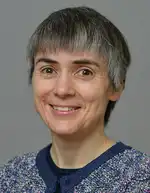
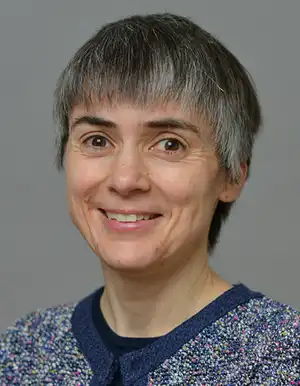
Professor Dr Ottoline Leyser
- Section Organismic and Evolutionary Biology
- Location Cambridge, United Kingdom
- Election year 2014
Research
Research Priorities: Shoot branching, shoot meristems, environmental adaptation, plant growth, plant hormones
Dame Ottoline Leyser is a British plant biologist. Her core research focuses on the genetics of plant development and the role of plant hormones in integrating endogenous developmental factors with those from the environment. In particular, her research uses shoot branching as a model to understand the role of plant hormones in developmental plasticity.
Plants continuously adapt their structure to the environment in which they grow. A good example of this is the regulation of shoot branching. Axillary meristems, which are established in the axil of each leaf base, can either remain inactive as buds or become active and form a branch. Whether or not an axillary meristem becomes active involves the integration of many environmental, physiological, and developmental factors. Increasingly, the evidence indicates that the regulatory system for bud activity centres on the self-organising properties of the transport network of the plant hormone auxin.
Ottoline Leyser’s research seeks to shed light on this network and how it functions. She combines molecular-biological, physiological, and quantitative genetic approaches with computer models to better understand how shoot branching patterns respond to the environment.
Dame Ottoline Leyser is a British plant biologist. Her core research focuses on the genetics of plant development and the role of plant hormones in integrating endogenous developmental factors with those from the environment. In particular, her research uses shoot branching as a model to understand the role of plant hormones in developmental plasticity.
Plants continuously adapt their structure to the environment in which they grow. A good example of this is the regulation of shoot branching. Axillary meristems, which are established in the axil of each leaf base, can either remain inactive as buds or become active and form a branch. Whether or not an axillary meristem becomes active involves the integration of many environmental, physiological, and developmental factors. Increasingly, the evidence indicates that the regulatory system for bud activity centres on the self-organising properties of the transport network of the plant hormone auxin.
Ottoline Leyser’s research seeks to shed light on this network and how it functions. She combines molecular-biological, physiological, and quantitative genetic approaches with computer models to better understand how shoot branching patterns respond to the environment.
Career
- 2020-2025 Chief Executive, United Kingdom Research and Innovation (UKRI), London, UK
- since 2020 Regius Professor of Botany, Department of Plant Science, University of Cambridge, Cambridge, UK
- 2013-2020 Director, Sainsbury Laboratory, University of Cambridge, Cambridge, UK
- 2011-2012 Associate Director, Sainsbury Laboratory, University of Cambridge, Cambridge, UK
- 2011-2020 Professor of Plant Development, Sainsbury Laboratory, University of Cambridge, Cambridge, UK
- 1994-2010 Lecturer, Reader, Professor of Plant Developmental Genetics, University of York, York, UK
- 1990-1994 Research Associate, Indiana University, Bloomington, USA and University of Cambridge, Cambridge, UK
- 1990 Ph.D. in Genetics, University of Cambridge, Cambridge, UK
- 1986 B.A. in Genetics, University of Cambridge, Cambridge, UK
Functions
- since 2017 Member, Prime Minister’s Council for Science and Technology, UK
- 2016-2019 Member, Selection Panel, NOW Spinoza Prize, Dutch Research Council (NWO), Netherlands
- 2016-2020 Member, Advisory Board, Open Research, Wellcome Trust, London, UK
- 2015-2020 Member, Advanced Grant Panel for Cell and Developmental Biology, European Research Council (ERC)
- 2014-2019 Chairperson, British Society for Developmental Biology, UK
- 2013-2017 Chairperson, Science Policy Expert Advisory Group, Royal Society, UK
- 2012-2015 Member, Council, Royal Society, UK
- 2012-2015 Deputy Chair, Nuffield Council on Bioethics (NCOB), London, UK
- 2011-2015 President, Council, International Congress of Plant Molecular Biology (IPMB)
- 2011-2017 Editor, Development
- 2011-2016 Member, International Advisory Board, Gregor Mendel Institute of Molecular Plant Biology (GMI), Austrian Academy of Sciences, Vienna, Austria
- 2010-2020 Board of Reviewing Editors, Science
- 2010-2012 Chair, Sectional Committee 9 “Patterns in Populations”, Royal Society, UK
- 2009-2018 Member, International Advisory Board, Max Planck Institute for Biology Tübingen, Tübingen, Germany
- 2009-2012 Member, NCOB, London, UK
- 2009-2012 Chair, Bioscience Skills and Careers Strategy Panel, Biotechnology and Biological Sciences Research Council (BBSRC), Swindon, UK
- 2008-2010 Member, Sectional Committee 9 “Patterns in Populations”, Royal Society, UK
- 2004-2006 Chair, Genes and Developmental Biology Committee, Biotechnology and Biological Sciences Research Council (BBSRC), Swindon, UK
- 2003-2012 Member, Council, IPMB
- 1999-2004 Treasurer, British Society for Developmental Biology, UK
Projects
- 1999-2004 Co-Gründerin und Koordinatorin, Genomic Arabidopsis Resource Network (GARNet), UK
Honours and Memberships
- 2022 Croonian Medal and Lecture, Royal Society of London/Royal College of Physicians, UK
- since 2021 Member, Academia Europaea
- since 2021 Fellow, Science Museum Group, London, UK
- 2020 British Society for Developmental Biology’s Waddington Medal, UK
- since 2020 Honorary Fellow, Academy of Medical Sciences, London, UK
- 2020 Honorary Doctorate, University of Guelph, Guelph, Canada
- 2019 Honorary Doctorate, University of Aberdeen, Aberdeen, UK
- 2018 OlChemIn Award, Auxins and Cytokinins in Plant Development International Symposium (ACPD2018)
- 2017 Appointed Dame Commander, Order of the British Empire, UK
- 2017 EMBO Women in Science Award, European Molecular Biology Organisation (EMBO) and Federation of European Biochemical Societies (FEBS)
- 2016 Medal, Genetics Society, UK
- 2016 Honorary Doctorate, Norwegian University of Science and Technology, Trondheim, Norway
- since 2014 Member, German National Academy of Sciences Leopoldina, Germany
- 2014 Honorary Doctorate, Swedish University of Agricultural Sciences, Uppsala, Sweden
- since 2012 International Member, National Academy of Sciences, USA
- 2010 Silver Medal, International Plant Growth Substances Association
- 2009 Commander, Order of the British Empire, UK
- 2007 Rosalind Franklin Award, Royal Society, UK
- since 2007 Member, European Molecular Biology Organisation (EMBO)
- since 2007 Fellow, Royal Society, UK
- 2000 President’s Medal, Society of Experimental Biology, UK
- 1993 KM Stott Research Fellowship Prize, Newnham College, Cambridge, UK