Philipp Jakob Sachs von Lewenhaimb (✝︎)
- Election year 1658
Research
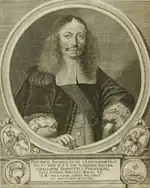
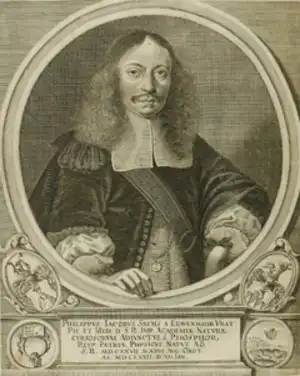
Philipp Jakob Sachs von Lewenhaimb (also known as Sachs von Löwenheim) was a German medical doctor. He was the city physician of Wrocław (in modern-day Poland) and co-founded the Miscellanea Curiosa Medico-physica Academiae Naturae Curiosorum, the world’s first journal of natural science and medicine.
Person
Philipp Jakob Sachs von Lewenhaimb was born in Wrocław on 26 August 1627 to Tobias Sachs von Lewenhaimb and his wife Ursula. He was related to renowned medical doctors on both his father’s and mother’s side, including Daniel Rindfleisch (Bucretius), the personal doctor of Archduke Charles of Austria.
Sachs von Lewenhaimb attended the Elisabeth-Gymnasium school in Wrocław. After finishing his studies, he established a medical practice in the city. He married Anna Magdalena Beckens from Namysłów in Silesia in November 1653 and the couple had three children: Johannes Tobias, who died as an infant in 1655, Ernst Philipp (born on 21 May 1661) and Ursula Magdalena (born in 1665).
Philipp Jakob Sachs von Lewenhaimb died in Wrocław on 7 January 1672.
Career
Philipp Jakob Sachs von Lewenhaimb studied medicine in Leipzig, Germany, from 1646 to 1649. Between 1649 and 1651, he spent time in several university cities and learnt from renowned medical doctors in the Netherlands, France and finally Italy, where he gained his doctorate from the University of Padua on 27 March 1651. He then started working as a doctor in Wrocław and, 20 years later, on 11 May 1671, the City Council there appointed him city physician.
Sachs von Lewenhaimb had an exceptional talent for communication and scientific correspondence with colleagues. He was able to put these skills to excellent use at the Academia Naturae Curiosorum (the Leopoldina), which was founded by four medical doctors in the Free Imperial City of Schweinfurt in 1652. Sachs von Lewenhaimb became a member of the Academy in 1658 and later an assistant to the second President of the Leopoldina, Johann Michael Fehr, in 1666.
The founders of the learned society envisioned an institution dedicated to the advancement of medicine. They believed that knowledge should be conveyed through the critical reading of and reflection on literature and made accessible through the publication of personal observations. They wanted each of the Academy’s members to contribute to a medical encyclopedia by describing a plant, animal or mineral in accordance with specific criteria, focusing on the medical benefits of their chosen subject-matter. The first volume of this encyclopedia was published in 1671 and featured a detailed essay on wine written by Philipp Jakob Sachs von Lewenhaimb.
Prior to this, the founders had realized that in order to draft the encyclopedia, they would have to gather existing knowledge and subject it to discussion. With this in mind, the Leopoldina created the journal Miscellanea Curiosa Medico-physica Academiae Naturae Curiosorum on the initiative of Sachs von Lewenhaimb in 1670. Although it has since changed names several times, it is still published today under the title Nova Acta Leopoldina, making it the oldest journal of natural science and medicine in the world. It later helped the Leopoldina to gain international recognition.
Due to his failing health, Sachs von Lewenhaimb was only able to oversee the publication during its initial two years. The first volume for which he was editor-in-chief contained 160 observations from 36 authors. Sachs von Lewenhaimb himself penned 14 of these observations. The volume also included a dedication to the Holy Roman Emperor Leopold I and an invitation to Europe’s medical doctors to contribute to following editions.
When the second volume was published in 1671, it was already clear that the Academy’s approach was working. As demonstrated by the readers’ letters printed in the journal, the publication had met with a positive response from the scientific world. This volume also included a history of the Academy, likely written by Sachs von Lewenhaimb, new statutes with firm objectives and a list of members. The publication had also grown in size, its main section featuring 260 observations by 52 authors, including seven contributions from Sachs von Lewenhaimb.
The two editions for which Sachs von Lewenhaimb was responsible also garnered the approval of the Emperor’s imperial court. However, Sachs von Lewenhaimb’s sudden and premature death and disagreements between Schweinfurt and Wrocław initially delayed the Leopoldina from being recognised as an Imperial Academy. Sachs von Lewenhaimb had strived for this moment for seven years and his work helped pave the way for the Emperor to finally grant the Leopoldina official approval on 3 August 1677. Two city physicians of Wrocław with whom Sachs von Lewenhaimb had worked, Heinrich Vollgnad and Johannes Jänisius, assumed responsibility for the publication after his death.