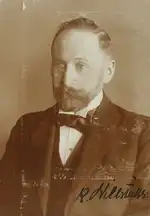
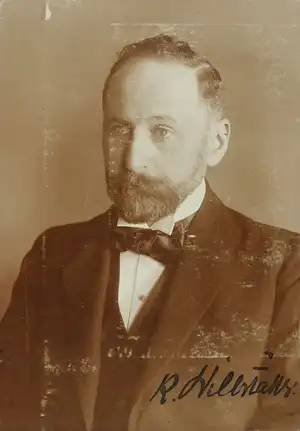
Professor Dr Richard Willstätter (✝︎)
Nobel Prize for Chemistry 1915
- Section Chemistry
- Location München, Germany
- Election year 1919
Research
Richard Willstätter was a German chemist. He worked on complex organic compounds, including the green plant pigment chlorophyll and the red blood pigment haemoglobin. He developed methods for the particularly gentle processing of sensitive natural substances. He isolated enzymes of a purity that had hardly been achieved before. He also succeeded in the multi-stage total synthesis of the alkaloid cocaine and developed the painkillers Voluntal and Aventin. He was awarded the Nobel Prize in Chemistry in 1915 for his research on plant pigments, especially chlorophyll.
Person
Richard Willstätter was born in Karlsruhe on 13 August 1872 as the son of Jewish merchant Max Willstätter and his wife Sophie, née Ullmann. His father first worked as a draper and clothing manufacturer in New York before returning to Germany in 1900. Richard was raised initially in Karlsruhe, and from 1883 in Nuremberg. There he attended secondary school (Realgymnasium), from which he graduated in 1890.
In 1903 he married Sophie Leser, the daughter of a professor in Heidelberg. The couple had a son Ludwig (1904), and a daughter Margarete (1905), who later became a physicist. Richard Willstätter had to endure several strokes of fate. His wife died in 1908, followed by his son in 1915. He was also confronted with anti-Semitism early in his life. Richard Willstätter was not particularly religious, but he strictly refused to convert to Christianity in order to avoid disadvantages because of his Jewish faith.
Richard Willstätter passed away on 3 August 1942 in Muralto-Locarno, located on the shores of the Lago Maggiore in the Swiss canton of Ticino, where he had retired.
The Swedish Post Office issued a stamp in his honour in 1975. The Society of German Chemists (GDCh) has organised the Richard Willstätter Lecture held both in Germany and at the Hebrew University of Jerusalem since 1993.
Career
Richard Willstätter studied chemistry at the University of Munich from 1890 to 1894. He received his doctorate on 17 March 1894. His habilitation followed in 1896. He then worked as a private lecturer at the University of Munich, after which he was appointed associate professor. In 1905, he accepted an appointment to the chair of general chemistry at the Swiss Federal Polytechnic School in Zurich. In 1912, Fritz Haber called him to the newly founded Kaiser Wilhelm Institute for Chemistry in Berlin-Dahlem. He also taught at the Chemical Institute of the Berlin University. During this time, he played a leading role in the development of a filtration system for gas masks.
In 1916, he succeeded Adolf von Baeyer at the Ludwig Maximilian University in Munich. In 1925 he resigned as a full professor. His reason was the growing anti-Semitism in Germany, which also began to manifest itself at the universities. In 1939 he fled Germany to Switzerland and had to leave his possessions behind. Through mediation efforts by his student Arthur Stoll, he became a scientific advisor at the Sandoz company in Basel.
Honours and Memberships
Willstätter received numerous other awards for his scientific work, including the Adolf von Baeyer Commemorative Coin (1914), the Iron Cross II. Class on the white-black ribbon (1917), the Order Pour le Mérite for Sciences and Arts (1924), the Bavarian Maximilian Order for Science and Art (1925), Faraday Lectureship Prize of the Royal Chemical Society London (1927), Davy Medal of the Royal Society London and Goethe Medal for Art and Science (both 1932) as well as the Willard Gibbs Medal of the American Chemical Society (1933).
Academies and scientific associations around the world granted him membership, including the Royal Prussian Academy of Sciences and the Bavarian Academy of Sciences (both 1914), German Academy of Natural Scientists Leopoldina (1919), of which he became an honorary member in 1932, Royal Danish Academy of Sciences (1920), honorary citizen of the Technical University of Karlsruhe (1922), Accademia Nazionale di Lincei Rome (1923), National Academy of Sciences of the United States, Royal Dutch Academy of Sciences in Haarlem, Russian Academy of Sciences (all 1926), Royal Society London (1928), Honorary Citizen of the Technical University of Stuttgart (1932), Royal Swedish Academy of Sciences Stockholm (1932), American Academy of Arts and Sciences Boston (1934), Indian Academy of Science Bangalore, Physiological Society England, Society of Biological Chemistry India (all 1936). Willstätter was also President of the German Chemical Society in Berlin from 1924 to 1926.
Many colleges and universities awarded him honorary doctorates, including the University of Halle (1913), the Technical University of Munich (1918), the Technical University of Darmstadt and the University of Frankfurt am Main (both 1922), ETH Zurich (1925), the University of Manchester (1928) and the Technical University of Prague (1931).
Nobel Prize
Willstätter investigated complex organic compounds, such as plant pigments, especially the green leaf pigment chlorophyll. He succeeded in presenting this substance in pure form. He also discovered that chlorophyll contains magnesium. It gives the substance its green colour and also the ability to absorb energy-rich parts of solar radiation. This energy is converted through photosynthesis into usable energy for the organism. Furthermore, Willstätter was able to prove that chlorophyll is very similar to the red blood pigment haemoglobin in its chemical structure. He was awarded the Nobel Prize in Chemistry in 1915 for his research on plant pigments, especially chlorophyll.