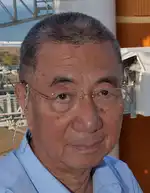
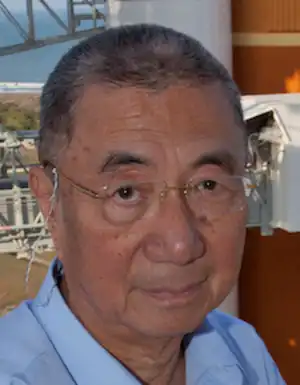
Prof. Dr. Samuel C. Ting
Nobel Prize for Physics 1976
- Section Physics
- Location Genf, Switzerland
- Election year 1996
Research
Research Priorities: Elementary-particle physics, quarks, charm quarks, photon-matter interaction, J/psi particle, mesons, nuclear collisions, Alpha Magnetic Spectrometer (AMS), International Space Station (ISS), anti-matter
Samuel Chao Chung Ting is an US-American physicist. His research priorities include elementary-particle physics, the elementary particles known as quarks, and the interaction of photons and matter. He and the American physicist Burton Richter jointly received the 1976 Nobel Prize in Physics for their discovery of the subatomic particle J/psi.
The J/psi particle is a heavy meson (subatomic particle). Mesons are created in the first phase following a nuclear collision, for example in particle-accelerator experiments. The J/psi particle owes its double name to the two researchers Ting and Richter, who worked independently of one another. Ting and his group used a particle accelerator at the Brookhaven National Laboratory, while Burton and his team used one at Stanford. Both discovered new particles when particles collided – and gave them different names: Ting named it the J-particle, Burton psi. The new particle retained both names and, compared to other mesons, proved extremely durable. This indicated a new type of quark – a charm quark – an elementary particle that had already been theoretically predicted. Thanks to the discovery of the new particle, Ting and Richter proved the quark’s existence.
Furthermore, Samuel C. Ting discovered the anti-nuclear matter of the anti-deuteron. An anti-deuteron is an anti-nucleus which consists of a bound state of an anti-proton and an anti-neutron. This is the anti-particle of the deuteron, a form of heavy hydrogen. In addition, he and his research group successfully carried out a precision measurement of muon charge asymmetry, demonstrating for the first time the validity of the Standard Electroweak Model (Weinberg, Glashow and Salam). This model is based on a weak electromagnetic force that unites the gauge group SU(2) × U(1). The gauge bosons, initially massless, obtain their required mass vie spontaneous symmetry breaking.
In recent years Ting has led and advanced the development of the Alpha Magnetic Spectrometer (AMS) at the particle research centre CERN. The AMS has been used at the International Space Station (ISS) since 2011, where it measures cosmic rays and, in particular, detects particles consisting of anti-matter (positrons).
Career
- since 1977 Professor, Thomas Dudley Cabot Institute, Massachusetts Institute of Technology (MIT), Cambridge, USA
- 1969-1977 Professor of Physics, MIT, Cambridge, USA
- 1967-1969 Associate Professor of Physics, MIT, Cambridge, USA
- 1966-1969 Team Leader, Deutsches Elektronen-Synchrotron DESY, Hamburg, Germany
- 1965-1967 Assistant Professor in Physics, Columbia University, New York City, USA
- 1964-1965 Lecturer in Physics, Columbia University, New York City, USA
- 1963-1964 Ford Foundation Fellow, European Organization for Nuclear Research (CERN), Geneva, Switzerland
- 1962 PhD in Physics, University of Michigan, Ann Arbor, USA
- 1960 Master of Science, University of Michigan, Ann Arbor, USA
- 1959 BSc in Physics and Mathematics, University of Michigan, Ann Arbor, USA
Functions
- since 1980 Member, Editorial Board, Mathematical Modeling
- since 1977 Member, Editorial Board, Nuclear Instruments and Methods
- since 1970 Associate Editor, Nuclear Physics B
Projects
- since 1989 Member, Collaborative Research Project “Third Large Electron-Positron (LEP) Collider experiment (L3) Collaboration”, European Organization for Nuclear Research (CERN), Geneva, Switzerland
- 1996-2007 Member, Collaborative Research Project “Omni-Purpose Apparatus for LEP(OPAL)”, CERN, Geneva, Switzerland
- 1996-2007 Member, Collaborative Research Project “Detector with Lepton, Photon and Hadron Identification (DELPHI)”, CERN, Geneva, Switzerland
- 1996-2007 Member, Collaborative Research Project “Apparatus for LEP PHysics (ALEPH)”, CERN, Geneva, Switzerland
Honours and Memberships
- 2018 Theodore von Karman Lecture, American Institute of Aeronautics and Astronautics (AIAA), USA
- 2017 Award for Compelling Results in Physical Sciences, National Aeronautics and Space Administration (NASA), USA
- 2013 Doctor Honoris Causa, Gustavus Adolphus College, St. Peter, USA
- 2013 Member, American Association for the Advancement of Science, USA
- 2012 University Distinguished Professor, University of Hawaiʻi at Mānoa, Honolulu, USA
- 2011 Erice Prize for Peace, World Federation of Scientists
- 2005 Honorary Doctorate, Hong Kong University of Science and Technology, Hong Kong
- 2005 Honorary Doctorate, National Central University, Taoyuan City, Taiwan
- 2004 Honorary Member, Tata Institute of Fundamental Research, Mumbai, India
- 2004 Honorary Doctorate, Rhine-Westphalian Technical University (RWTH Aachen), Aachen, Germany
- 2003 Member, Real Academia de Ciencias Exactas, Físicas y Naturales de España, Spain
- 2003 Honorary Doctorate, National Chiao-Tung University, Hsinchu, Taiwan
- 2002 Honorary Doctorate, National Tsing Hua University, Hsinchu, Taiwan
- 2001 Exceptional Public Service Medal, National Aeronautics and Space Administration (NASA), USA
- 1996 Forum Engelberg Prize, Forum Engelberg Prize Award Foundation, Zürich, Switzerland
- since 1995 Member, Russian Academy of Sciences, Russia
- since 1994 Member, Chinese Academy of Sciences (CAS), China
- 1993 Honorary Doctorate, University of Bucharest, Bucharest, Romania
- since 1993 Member, Hungarian Academy of Sciences, Hungary
- 1991 Honorary Doctorate, M. V. Lomonosov Moscow State University, Moscow, USSR
- 1990 Honorary Doctorate, Columbia University, New York City, USA
- 1990 Honorary Doctorate, University of Science and Technology, China
- since 1989 Member, Soviet Academy of Sciences, USSR
- 1988 DeGasperi Award in Science from the Government of Italy, Italy
- 1988 Gold Medal for Science and Peace from the city of Brescia, Brescia, Italy
- 1988 Honorary Doctorate, University of Bologna, Bologna, Italy
- 1987 Honorary Doctorate, Chinese University of Hong Kong (CUHK), Hong Kong, China
- since 1984 Member, Pakistani Academy of Sciences (PAS), Pakistan
- 1978 Honorary Doctorate, University of Michigan, Ann Arbor, USA
- since 1977 Member, National Academy of Sciences, USA
- 1977 A.C. Eringen Medal, Society of Engineering Science (SES), USA
- 1976 Nobel Prize in Physics (jointly with Burton Richter), Royal Swedish Academy of Sciences, Stockholm, Sweden
- 1976 Ernest Orlando Lawrence Award, Department of Energy's Office of Science, USA
- since 1975 Member, Academia Sinica, Taiwan
- since 1975 Member, American Academy of Arts and Sciences, USA
- 1963 Fellow, Ford Foundation, New York City, USA