Sir Hans Adolf Krebs (✝︎)
Nobel Prize for Physiology or Medicine 1953
- Section Biochemistry and Biophysics
- Location Oxford, United Kingdom
- Election year 1956
Research
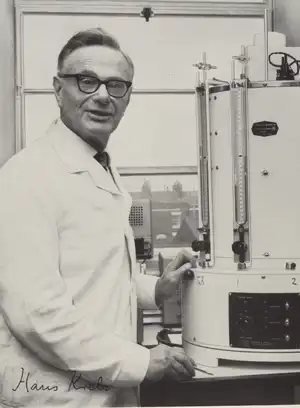
Hans Krebs was a German-British physician and biochemist. His fields of work included the research and elucidation of metabolic processes (intermediary metabolism). The Krebs-Henseleit cycle (urea cycle) and the Krebs cycle (citric acid cycle) are named after him. Krebs was awarded the Nobel Prize in Physiology or Medicine in 1953 for his biochemical work, especially for discovering the citric acid cycle.
Person
Hans Krebs was born to Jewish otolaryngologist Georg Krebs and his wife Alma in Hildesheim, Germany, on 25 August 1900. He attended the humanistic Gymnasium Andreanum in his native town.
In 1938 he married Margaret Fieldhouse. The couple was blessed with sons Paul and John and daughter Helen. His son John Krebs is a zoology professor at Oxford and a member of the House of Lords. In 1939 Krebs was granted British citizenship.
In 1966, Hans Krebs became an honorary citizen of his native city of Hildesheim. In addition, a street was named after him in Freiburg in 2012. Every year, the Society of Friends of the Hannover Medical School awards the Sir Hans Krebs Prize, endowed with 10,000 euros, in recognition of outstanding work in basic medical research published in a journal.
Hans Krebs passed away on 22 November 1981 in Oxford, where he was still scientifically active shortly before his death.
Career
Hans Krebs studied medicine at the universities of Göttingen, Freiburg, Berlin and Munich between 1918 and 1923. He received his doctorate from the University of Hamburg in 1925 and subsequently studied chemistry in Berlin for a year. He worked there until 1930 as an assistant to Nobel Prize winner Otto Warburg at what used to be the Kaiser-Wilhelm-Institut für Biologie. He later worked as a physician in Hamburg and became an assistant at the university clinic in Freiburg in 1931. There he habilitated in 1932 and, together with Kurt Henseleit, discovered the urea cycle, also called the Krebs-Henseleit cycle.
In Germany, the “Law for the Restoration of the Professional Civil Service” came into force in 1933, whereby Jewish scientists were deprived of their authorisation to teach. Hans Krebs, who came from a Jewish family of doctors, was initially given a leave of absence. On 15 July 1933, the rector of the University of Freiburg finally informed him of his dismissal from all university duties. He had already fled to England on 10 June 1933 for this very reason, where he continued his studies at the University of Cambridge, but this time in biochemistry. The move to England was made possible by invitation from the president of the Royal Society at the time, Sir Frederick G. Hopkins, who had already become aware of Krebs' work in 1932.
In 1935, Hans Krebs became a lecturer in pharmacology. Two years later he discovered the citric acid cycle, which is still called the Krebs cycle today. In 1945 he received a professorship in biochemistry at the University of Sheffield. In 1954 he was appointed to the University of Oxford.
Honours and Memberships
Krebs received numerous other awards, including the Albert Lasker Award for Basic Medical Research (1953), Royal Medal of the Royal Society London (1954), Copley Medal (1961), Otto Warburg Medal (1969), Order Pour le Mérite for Science and the Arts (1972). He was also knighted in 1958.
He was a member of many scientific associations and academies, including the Royal Society London (1947), the German Academy of Natural Sciences Leopoldina (1956) and the American Academy of Arts and Sciences (1957).
Numerous universities awarded him honorary doctorates, including the Hanover Medical School (1974), the University of Cambridge (1979) and the universities of Chicago, Freiburg im Breisgau, Paris, Glasgow, Sheffield, London, Jerusalem, Berlin and Göttingen.
Nobel Prize
In 1932, Hans Krebs had already discovered the urea cycle and thus the principle of cyclic reaction sequences in living cells. It emerged from his investigation into the mechanism of urea formation in the animal body.
During his studies on the oxidation of pyruvic acid later on, he discovered a second metabolic cycle occurring in the biological system, which has become known as the citric acid cycle. The processes involved allow cells which utilise oxygen to oxidise their food substances maximum use of the energy released. Carbon dioxide and water are formed in the process. Krebs sent his findings on the citric acid cycle to the scientific journal Nature in 1937. It rejected the paper, indicating an overload of manuscript submissions at the time. This meant that Krebs could only publish his work in a less prestigious journal. Nevertheless, he was awarded the Nobel Prize in Physiology or Medicine for his findings in 1953.