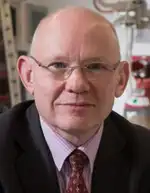
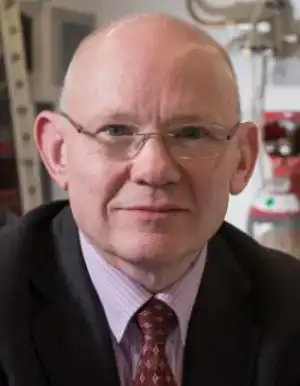
Professor Dr Sir Peter Bruce
- Section Chemistry
- Location Oxford, United Kingdom
- Election year 2024
Research
Research Priorities: Batteries, energy storage, electrochemistry, solid-state chemistry
Peter Bruce is a British materials scientist. He researches in the fields of materials chemistry and electrochemistry, with a particular emphasis on energy storage materials for lithium and sodium batteries. In his research he focuses on developing a fundamental understanding of the properties of materials and the processes taking place in batteries.
Peter Bruce is a pioneer of the lithium-air battery, which has the highest theoretical energy density of any battery and could transform energy storage. His research interests span materials chemistry and electrochemistry from energy storage materials and devices. He is currently researching three key topics: solid-state batteries, new anionic redox materials for lithium-ion batteries, and the lithium-air battery. He is also interested in understanding the fundamentals of materials chemistry, the synthesis of new materials and their applications in energy storage.
Replacing the flammable organic liquid electrolyte with a solid will enable the use of an alkali metal anode. Recent work in this field has investigated the processes occurring during cycling, such as dendrite and void formation, which ultimately lead to the failing of solid-state cells. Peter Bruce is investigating strategies to mitigate these issues.
In addition he researches cathode materials necessary for increasing the energy density of lithium-ion cells. Current research concerns compounds which can store additional charge, beyond the transition metal redox capacity, by participation of oxide ions in the redox processes. For this purpose Peter Bruce analyses the role played by molecular oxygen.
Peter Bruce is a British materials scientist. He researches in the fields of materials chemistry and electrochemistry, with a particular emphasis on energy storage materials for lithium and sodium batteries. In his research he focuses on developing a fundamental understanding of the properties of materials and the processes taking place in batteries.
Peter Bruce is a pioneer of the lithium-air battery, which has the highest theoretical energy density of any battery and could transform energy storage. His research interests span materials chemistry and electrochemistry from energy storage materials and devices. He is currently researching three key topics: solid-state batteries, new anionic redox materials for lithium-ion batteries, and the lithium-air battery. He is also interested in understanding the fundamentals of materials chemistry, the synthesis of new materials and their applications in energy storage.
Replacing the flammable organic liquid electrolyte with a solid will enable the use of an alkali metal anode. Recent work in this field has investigated the processes occurring during cycling, such as dendrite and void formation, which ultimately lead to the failing of solid-state cells. Peter Bruce is investigating strategies to mitigate these issues.
In addition he researches cathode materials necessary for increasing the energy density of lithium-ion cells. Current research concerns compounds which can store additional charge, beyond the transition metal redox capacity, by participation of oxide ions in the redox processes. For this purpose Peter Bruce analyses the role played by molecular oxygen.
Career
- since 2014 Isaac Wolfson Professor of Materials, University of Oxford, Oxford, UK
- 2007-2013 Wardlaw Professor of Chemistry, University of St Andrews, St Andrews, UK
- 1997-2003 Head, School of Chemistry, University of St Andrews, Edinburgh, UK
- 1995-1997 Head of Section, School of Chemistry, University of St Andrews, Edinburgh, UK
- 1994-2007 Professor, Department of Chemistry, University of St Andrews, St Andrews, UK
- 1990-1994 Reader, Department of Chemistry, University of St Andrews, St Andrews, UK
- 1984-1990 Lecturer, Department of Chemistry, Heriot-Watt University, Edinburgh, UK
- 1981-1984 Postdoctoral Research Fellow, University of Oxford, Oxford, UK
- 1982 PhD in Chemistry, University of Aberdeen, Aberdeen, UK
- 1978 Bachelor’s Degree in Chemistry, University of Aberdeen, Aberdeen, UK
Functions
- 2018-2023 Vice-President and Physical Secretary, Royal Society, UK
- 2021 Friends of COP, COP26, UK Government, UK
- since 2018 Chief Scientist and Chair of the Expert Panel, Faraday Institution, Oxfordshire, UK
- since 2017 Chair, Scientific Advisory Board, Max Planck Institute for Solid State Research, Stuttgart, Germany
- since 2017 Member, Advisory Board, Faraday Battery Challenge, Oxfordshire, UK
- since 2017 Co-Founder, Faraday Institution, Oxfordshire, UK
Projects
- since 2020 Lead, Work Package 1, CATMAT Project “Next Generation Lithium-Ion Cathode Materials”, Faraday Institution, UK
- 2020-2024 Member, Project “Battery Interface Genome – Materials Acceleration Platform (BIG-MAP (BIGMAP)”, Battery 2030+, European Union (EU)
- since 2018 Lead, Work Package 1, Project “SOLBAT – Solid State Metal Anode Batteries”, Faraday Institution, UK
- 2018-2023 Principal Investigator, Project “SOLBAT – Solid State Metal Anode Batteries”, Faraday Institution, UK
- 2015-2022 Principal Investigator, Project “Enabling next generation lithium batteries”, Engineering and Physical Sciences Research Council (EPSRC), UK
- 2006-2019 Principal Investigator, Project “Supergen Energy Storage”, EPSRC, UK
Honours and Memberships
- since 2024 Member, German National Academy of Sciences Leopoldina, Germany
- 2024 Honorary Doctorate, University of Aberdeen, Aberdeen, UK
- 2023 Foreign Member, Chinese Academy of Sciences (CAS), China
- 2022 Knighthood, Knighted for Services to Science and Innovation, UK
- 2022 Longstaff Prize, Royal Society of Chemistry, UK
- 2018 Elected Member, Academia Europaea
- 2017 Honorary Professor, Fudan University, Shanghai, China
- 2017 Hughes Medal, Royal Society of Chemistry, UK
- 2016 Liversidge Award, Royal Society of Chemistry, UK
- 2015-2023 Highly Cited Researcher, Clarivate Analytics, Philadelphia, USA
- 2014 Barker Medal, Royal Society of Chemistry, UK
- 2011 Arfvedson Schlenk Award, German Chemical Society, German
- 2011 Carl Wagner Memorial Award, Electrochemical Society, USA
- 2009 Tilden Lectureship, Royal Society of Chemistry, UK
- 2008 Battery Division Award, Electrochemical Society, USA
- 2007 Elected Fellow, Royal Society, UK
- 2005 Solid State Chemistry Award, Royal Society of Chemistry, UK
- 1999 Award in Materials, Royal Society of Chemistry, UK
- 1995 Elected Fellow, Royal Society of Edinburgh, Edinburgh, UK
- 1994 Elected Fellow, Royal Society of Chemistry, UK
- 1990-1995 Pickering Research Fellowship, Royal Society, UK