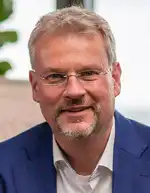
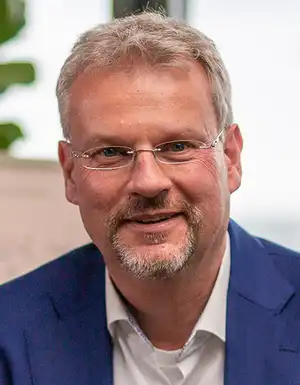
Professor Dr Thomas Carell
- Section Chemistry
- Location München, Germany
- Election year 2008
Research
Research Priorities: DNA repair processes, epigenetic processes, nucleotide chemistry, origins of life
Thomas Carell is an expert in chemistry. His work on DNA repair and epigenetic processes offers major potential for cancer treatment, while his research into the origins of life have led to a new understanding of prebiotic chemistry. His interdisciplinary work ranges from organic chemistry to biology and medicine.
Thomas Carell’s work focuses on the chemical synthesis and modification of nucleic acids. As part of this work he develops new methods to chemically modify nucleic acids, including siRNAs and mRNAs. Synthesis is carried out in order to investigate DNA repair processes and epigenetic information storage in the genome. His research makes use of the latest mass-spectrometic methods, above all to quantify DNA damage and epigenetic bases. This work offers major potential for cancer treatment.
Another key aspect of Thomas Carell’s research involves discovering how epigenetic bases change during embryonic development and how these chemical processes in the genome guide and influence cell differentiation.
At the same time, another project in Carell’s working group investigates how molecules that were essential for the creation of life might have arisen on early Earth. The research has identified new, prebiotically plausible ways in which nucleic acids could have been created under the conditions of early Earth.
Thomas Carell approaches all these topics in an interdisciplinary manner, combining aspects of chemistry, biology, and medicine in particular.
Alongside this basic research, he is also interested in the synthesis of inhibitors for the various processes in DNA. This work is highly application-focused. The results could potentially lead to significant improvements in cancer treatment, as tumour cells require maintenance of epigenetic information.
Thomas Carell is an expert in chemistry. His work on DNA repair and epigenetic processes offers major potential for cancer treatment, while his research into the origins of life have led to a new understanding of prebiotic chemistry. His interdisciplinary work ranges from organic chemistry to biology and medicine.
Thomas Carell’s work focuses on the chemical synthesis and modification of nucleic acids. As part of this work he develops new methods to chemically modify nucleic acids, including siRNAs and mRNAs. Synthesis is carried out in order to investigate DNA repair processes and epigenetic information storage in the genome. His research makes use of the latest mass-spectrometic methods, above all to quantify DNA damage and epigenetic bases. This work offers major potential for cancer treatment.
Another key aspect of Thomas Carell’s research involves discovering how epigenetic bases change during embryonic development and how these chemical processes in the genome guide and influence cell differentiation.
At the same time, another project in Carell’s working group investigates how molecules that were essential for the creation of life might have arisen on early Earth. The research has identified new, prebiotically plausible ways in which nucleic acids could have been created under the conditions of early Earth.
Thomas Carell approaches all these topics in an interdisciplinary manner, combining aspects of chemistry, biology, and medicine in particular.
Alongside this basic research, he is also interested in the synthesis of inhibitors for the various processes in DNA. This work is highly application-focused. The results could potentially lead to significant improvements in cancer treatment, as tumour cells require maintenance of epigenetic information.
Career
- since 2004 Professor of Organic Chemistry, Ludwig-Maximilians-Universität (LMU Munich), Munich, Germany
- 2000-2004 Professor of Organic Chemistry, University of Marburg, Marburg, Germany
- 1999-2000 Lecturer, Laboratory of Organic Chemistry, Eidgenössische Technische Hochschule (ETH Zurich), Zurich, Switzerland
- 1995-1999 Habilitation, Laboratory of Organic Chemistry, ETH Zurich, Zurich, Switzerland
- 1993-1995 Postdoctoral Fellow, Massachusetts Institute of Technology (MIT), Cambridge, USA
- 1990-1993 Dissertation, Max Planck Institute for Medical Research, Heidelberg, Germany
- 1989-1990 Master’s Degree (Diplom), Max Planck Institute for Medical Research, Heidelberg
- 1985-1990 Degree in Chemistry, University of Münster, Münster, Germany
Functions
- since 2020 Vice-President, German Chemical Industry Fund (FCI), Frankfurt am Main, Germany
- since 2019 Member, Supervisory Board, BASF SE, Ludwigshafen, Germany
- since 2019 Member, Board of Trustees, VolkswagenStiftung, Hanover, Germany
- 2009-2011 Vice-President of Research, LMU Munich, Munich, Germany
- since 2008 Founder and Shareholder, Baseclick GmbH, Neuried, Germany
Projects
- since 2023 Spokesperson, Center for Nucleic Acid Therapies (CNATM), Clusters4Future Initiative, Federal Ministry of Education and Research (BMBF), Germany
- since 2023 Principal Investigator, Joint Project “mRNA substances and other principles”, CNATM, Clusters4Future Initiative, BMBF, Germany
- since 2023 Principal Investigator, Subproject “Chemical biology of intracellular nucleic acid recognition”, Transregio (TRR) 237, German Research Foundation (DFG), Germany
- since 2019 Principal Investigator, Subproject “Formation and analysis of DNA-protein crosslinks”, Collaborative Research Centre (CRC) 1361, DFG, Germany
- since 2018 Researcher, Research Training Group (RTG) 2338 “Targets in Toxicology – Deciphering Therapeutic Targets in Lung Toxicology”, DFG, Germany
- since 2018 Spokesperson, CRC 1309 “Chemical Biology of Epigenetic Modifications”, DFG, Germany
- since 2018 Principal Investigator, Subproject “Molecular mechanisms of active demethylation”, CRC 1309, DFG, Germany
- since 2012 Principal Investigator, Subproject “Nano-agents for the manipulation of innate immunity”, CRC 1032, DFG, Germany
- 2007-2019 Spokesperson, CRC 749 “Dynamics and Intermediates of Molecular Transformations”, DFG, Germany
- 2007-2019 Principal Investigator, Subprojects “Dynamics and Intermediates of DNA Damage Creation and Repair” as well as “Central Administration in CRC”, CRC 749, DFG, Germany
- 2006-2019 Spokesperson, Cluster of Excellence (EXC) 114 “Center for Integrated Protein Science (CIPSM)”, DFG, Germany
- 2005-2016 Principal Investigator, Subproject “The chemistry of nucleotide excision repair and cellular development”, CRC 646, DFG, Germany
Honours and Memberships
- 2018 Stanley Miller Lecturer, University of California San Diego (UCSD), La Jolla, USA
- 2017 Nelson Leonard Lecturer, University of Illinois at Urbana-Champaign, Champaign, USA
- 2017 Adolf Windaus Medal for Organic Chemistry, University of Göttingen, Göttingen, Germany
- 2017 Alexander Todd-Hans Krebs Lectureship in Chemical Science, Royal Society of Chemistry (RSC), UK as well as German Chemical Society (GdCH), Germany
- 2016 Inhoffen Medal, Helmholtz Centre for Infection Research (HZI) , Braunschweig, Germany
- 2015 Michael J. Gait Lectureship, RSC, UK
- 2011 Melvin Calvin Lecture in Organic Chemistry, University of California, Berkeley (UC Berkeley), Berkeley, USA
- 2011 Frantisek Sorm Memorial Medal, Czech Academy of Sciences, Czech Republic
- since 2010 Member of the Berlin-Brandenburg Academy of Sciences and Humanities, Berlin, Germany
- 2010 Cross of Merit, Federal Republic of Germany
- 2009 Van’t Hoff Lecture, Royal Netherlands Academy of Arts and Sciences (KNAW), the Netherlands
- since 2008 Member, German National Academy of Sciences Leopoldina, Germany
- 2008 Ferdinand Lecture, University of Sheffield, Sheffield, UK
- 2008 Otto Bayer Award, Bayer Foundation, Leverkusen, Germany
- 2006 Philip Morris Research Award, Philip Morris Deutschland, Germany
- 2006 Novartis Middle European Lectureship, Novartis AG, Switzerland
- 2004 Gottfried Wilhelm Leibniz Prize, DFG, Germany
- 2004 Lady Davis Award, Technion – Israel Institute of Technology, Israel
- 2003 Novartis European Young Investigator Award, Novartis AG, Switzerland
- 2002 David Ginsburg Memorial Lecture, Technion – Israel Institute of Technology, Israel
- 2001 Louis Pasteur Medal, Institut Pasteur, Paris, France
- 1999 Young Investigator Award for Medicinal/Pharmaceutical Research, GDCh as well as Germany Pharmaceutical Society (DPhG), Germany
- 1999 Young Investigator Award, German Chemical Industry Fund (FCI), Frankfurt am Main, Germany
- 1995 ADUC Award, Association of German University Professors of Chemistry (ADUC), Frankfurt am Main, Germany
- 1995 Young Investigator Award, Werner von Siemens Ring Foundation, Berlin, Germany
- 1995 Justus von Liebig Award, FCI, Frankfurt am Main, Germany
- 1993 Feodor Lynen Fellowship, Alexander von Humboldt Foundation, Bonn, Germany
- 1993 Study Award, FCI, Frankfurt am Main, Germany
- 1990 Kekulé Scholarship, FCI, Frankfurt am Main, Germany