Thomas Henry Huxley (✝︎)
- Location London, United Kingdom
- Election year 1857
Research
Person
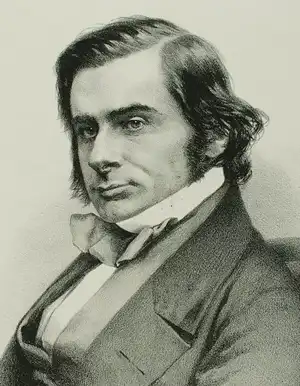
Thomas Henry Huxley was born on 4 May 1825 as the seventh of eight children to the mathematics teacher George Huxley and his wife Rachel Withers in Ealing, Middlesex (now a part of London).
In 1855, he married Henrietta Heathorn and the couple had eight children: Noel (1856), Jessie (1856), Mariam (1859), Leonard (1860), Rachel (1862), Nettie (1863), Henry (1865) und Ethel (1866). Huxley’s son Leonard is the father of the author Aldous Huxley, of the physiologist and biophysicist and winner of the Nobel Prize in Physiology or Medicine Andrew Fielding Huxley, and of the biologist and ethologist Julian Huxley, who was the first Secretary-General of the United Nations Educational, Scientific and Cultural Organization (UNESCO).
Thomas Henry Huxley died on 29 June 1895 in the seaside town Eastbourne in East Sussex. Huxley and his companions from the X Club had a radical impact on the world of science.
A crater on the moon was named after him in 1973, and Mount Huxley, located on the West Coast region of Tasmania, Australia, was named after him in 1863. In 1858, the British doctor and natural scientist Frederick Daniel Dyster named the moss animal of the genus Huxleya in honour of Thomas Henry Huxley.
Career
From 1841, Thomas Henry Huxley was apprenticed to a relative’s medical practice and from 1842, he read medicine at the University of London. After his graduation in 1845, went on to work at a Royal Navy hospital. From 1846 to 1850, he took part in an expedition as naval surgeon to the Torres Strait between the Australian peninsula Cape York and the southern coast of New Guinea. This voyage gave him an opportunity to carry out zoological studies.
In 1854, he was offered a Chair for natural history at the Royal School of Mines in London, followed by an appointment as Fullerian Professor for physiology at the Royal Institution of Great Britain until 1858. After Charles Darwin’s book “On the Origin of Species” was published in 1860, Huxley fought hard for the establishment of the new world view of evolution, which was largely disputed by the Anglican church and conservative scientists. Huxley’s commitment – especially against one of the evolution theory’s most prominent critics, Bishop Samuel Wilberforce, a member of the House of Lords and the Royal Society London – was so ardent that he was nicknamed Darwin’s Bulldog. Huxley was renowned for his linguistic style and eloquence, which he employed to make his friend Charles Darwin’s teachings more accessible to a wider public.
In 1864, Huxley founded the X Club in London, a group of nine scientists and friends, including Huxley himself, dedicated to spreading Darwin’s theory. The group’s motto was “devotion to science, pure and free, untrammelled by religious dogmas” and their goal was to push back against the church’s influence. The X Club was also involved in launching the scientific journal “Nature” and making it thrive by contributing countless articles.
Between 1863 and 1869, Huxley accepted a Hunterian Professorship at the Royal College of Surgeons. In the years of 1875 and 1876, he held a Chair at the University of Edinburgh. In 1879, he took over the administration of Eton College in Berkshire, where he remained until his retirement in 1888.
Honours and Memberships
Thomas Henry Huxley received numerous awards, such as the Royal Medal of the Royal Society London (1852), the Wollaston Medal (1876), the Clarke Medal of the Royal Society of New South Wales (1880), the Copley Medal of the Royal Society (1888), the Linnean Medal of the Linnean Society of London (1890), as well as the Darwin Medal of the Royal Society London (1894).
International academies and scientific associations awarded him their membership, among them the Royal Society London (1851), the Royal Geographical Society (1856), the German National Academy of Sciences Leopoldina (1857), the Göttingen Academy of Sciences and Humanities, the Russian Academy of Sciences Saint Petersburg (Corresponding Member) (1864), the Royal Prussian Academy of Sciences (1865), the Accademia dei Lincei Rome (Foreign Member), as well as the American Academy of Arts and Sciences (1883). From 1883 to 1885, Huxley was also President of the Royal Society London.