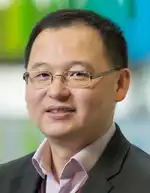
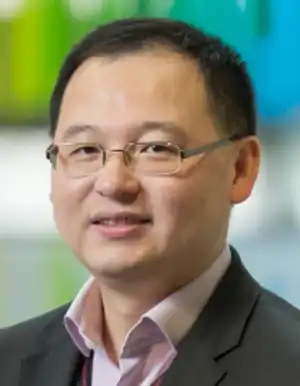
Professor Dr Xinliang Feng
- Section Chemistry
- Location Dresden, Germany
- Election year 2024
Research
Research Priorities: Graphene nanostructures, 2D polymers, 2D conjugated polymers, 2D conjugated metal-organic frameworks, 2D materials, energy devices
Xinliang Feng is a Chinese chemistry and materials science expert who specialises in researching graphene and 2D materials. He and his team have developed atomically precise graphene nanoribbons (GNRs) and organic 2D crystal materials for use in sustainable electronics and quantum technology.
A focal point of Xinliang Feng’s work concerns graphene, a carbon structure consisting of a single layer of carbon atoms and possessing exceptional electronic and mechanical properties. However, as graphene lacks a band gap, it is of limited use as a semiconductor material. In semi-conductor technology, the band gap refers to the energy difference between the top of a material’s valence band and the bottom of its conduction band. The valence band is filled with electrons that do not contribute to conductivity, while the conduction band is occupied by free electrons that move through the material and thus enable the flow of electricity.
Xinliang Feng addresses the problem of the absent band gaps by synthesising graphene nanoribbons (GNRs), which are narrow strips of graphene with atomically precise edges. By controlling width, edge geometry, and atomic structure, he can produce GNRs with individually adjusted band gaps, which are suitable for use in transistors and nanoelectronics.
These synthesis methods offer extraordinary precision. By atomically controlling the electronic properties, Xinliang Feng optimises the charge carrier mobility. Furthermore, GNRs possess special magnetic properties related to specific structures, such as spin-edge states, which are used in spintronics. This technology uses electron spin to transmit information and enables progress in storage technologies and quantum bits (qubits) for quantum computing.
In addition to GNRs, Xinliang Feng develops new methods for synthesising organic 2D crystals, including 2D polymers, conduction polymers, 2D conjugated polymers or conjugagted covalent organic frameworks (COFs), and 2D conjugated metal-organic frameworks (MOFs). A particular achievement is synthesis on the surface of water, which enables the production of these materials in precise, single-to-multilayer structures, thereby improving crystallinity and homogeneity. This provides benefits for use of organic 2D crystals in electronic and optoelectronic devices.
Xinliang Feng’s research also involves developing novel organic 2D crystal materials for sustainable electronics, membrane, energy storage and conversion devices. Innovative polymerisation techniques make it possible to create materials with high levels of molecular control, which possess, in particular, electrochemical properties. These 2D crystal materials can be used for batteries, supercapacitors, and fuel cells, as their large surface area and efficient ion transport pathways make higher energy densities and faster charging times possible.
The materials scientist is also investigating the development of printable energy storage systems. Xinliang Feng’s team use electrochemical delamination to create 2D materials from crystals, which enable flexible, light batteries, as well as supercapacitors, thus promoting sustainable energy storage. His team also develops new types of battery devices, such as sustainable aqueous Zn-ion and Al-ion batteries by involving new material concepts.
Xinliang Feng’s research has led to significant progress in materials science, which supports transformation processes in industry. These achievements are also relevant to society, as they help combine sustainability goals with economic development.
Xinliang Feng is a Chinese chemistry and materials science expert who specialises in researching graphene and 2D materials. He and his team have developed atomically precise graphene nanoribbons (GNRs) and organic 2D crystal materials for use in sustainable electronics and quantum technology.
A focal point of Xinliang Feng’s work concerns graphene, a carbon structure consisting of a single layer of carbon atoms and possessing exceptional electronic and mechanical properties. However, as graphene lacks a band gap, it is of limited use as a semiconductor material. In semi-conductor technology, the band gap refers to the energy difference between the top of a material’s valence band and the bottom of its conduction band. The valence band is filled with electrons that do not contribute to conductivity, while the conduction band is occupied by free electrons that move through the material and thus enable the flow of electricity.
Xinliang Feng addresses the problem of the absent band gaps by synthesising graphene nanoribbons (GNRs), which are narrow strips of graphene with atomically precise edges. By controlling width, edge geometry, and atomic structure, he can produce GNRs with individually adjusted band gaps, which are suitable for use in transistors and nanoelectronics.
These synthesis methods offer extraordinary precision. By atomically controlling the electronic properties, Xinliang Feng optimises the charge carrier mobility. Furthermore, GNRs possess special magnetic properties related to specific structures, such as spin-edge states, which are used in spintronics. This technology uses electron spin to transmit information and enables progress in storage technologies and quantum bits (qubits) for quantum computing.
In addition to GNRs, Xinliang Feng develops new methods for synthesising organic 2D crystals, including 2D polymers, conduction polymers, 2D conjugated polymers or conjugagted covalent organic frameworks (COFs), and 2D conjugated metal-organic frameworks (MOFs). A particular achievement is synthesis on the surface of water, which enables the production of these materials in precise, single-to-multilayer structures, thereby improving crystallinity and homogeneity. This provides benefits for use of organic 2D crystals in electronic and optoelectronic devices.
Xinliang Feng’s research also involves developing novel organic 2D crystal materials for sustainable electronics, membrane, energy storage and conversion devices. Innovative polymerisation techniques make it possible to create materials with high levels of molecular control, which possess, in particular, electrochemical properties. These 2D crystal materials can be used for batteries, supercapacitors, and fuel cells, as their large surface area and efficient ion transport pathways make higher energy densities and faster charging times possible.
The materials scientist is also investigating the development of printable energy storage systems. Xinliang Feng’s team use electrochemical delamination to create 2D materials from crystals, which enable flexible, light batteries, as well as supercapacitors, thus promoting sustainable energy storage. His team also develops new types of battery devices, such as sustainable aqueous Zn-ion and Al-ion batteries by involving new material concepts.
Xinliang Feng’s research has led to significant progress in materials science, which supports transformation processes in industry. These achievements are also relevant to society, as they help combine sustainability goals with economic development.
Career
- since 2021 Director, Department “Synthetic Materials and Functional Devices (SMFD)”, Max Planck Institute of Microstructure Physics, Halle (Saale), Germany
- 2018-2021 Adjunct Professor, Shanghai Jiao Tong University, Shanghai, China
- since 2014 Professor, Dresden University of Technology, Dresden, Germany
- 2012-2014 Group Leader, Max Planck Institute for Polymer Research, Mainz, Germany
- 2012-2014 Senior Advisory Researcher, Carbon Materials Innovation Center (CMIC), BASF Digital Solutions, Ludwigshafen, Germany
- 2011-2018 Professor, Shanghai Jiao Tong University, Shanghai, China
- 2010-2018 Founder and Director, Institute of Advanced Organic Materials, Shanghai Jiao Tong University, Shanghai, China
- 2007-2012 Group Leader, Max Planck Institute for Polymer Research, Mainz, Germany
- 2004-2008 Doctoral Student, Max Planck Institute for Polymer Research, Mainz, Germany
- 2004 Master’s Degree in Organic Chemistry, Shanghai Jiao Tong University, Shanghai, China
- 1997-2001 Degree in Chemistry, China University of Geosciences (CUGB), Wuhan, China
Functions
- since 2023 Member, International Advisory Board, Chemistry Europe
- since 2022 Member, Editorial Board, Nano Research Energy
- since 2020 Member, International Advisory Board, Materials Advances
- since 2020 Member, International Advisory Board, Aggregate
- since 2020 Member, Jury “Advanced Grant”, European Research Council (ERC)
- since 2020 Member, Editorial Board, Chinese Journal of Polymer Science
- since 2020 Member, International Advisory Board, Small Structures
- since 2019 Associate Editor, Energy Storage Materials
- since 2019 Member, International Advisory Board, Chemical Science
- since 2019 Member, International Advisory Board, ACS Applied Electronic Materials
- since 2019 Member, International Advisory Board, Materials Chemistry Frontiers
- since 2019 Member, International Advisory Board, Trends in Chemistry
- since 2018 Member, International Advisory Board, EnergyChem
- since 2018 Member, International Advisory Board, Journal of Energy Chemistry
- since 2016 Member, International Advisory Board, Small Methods
- 2015-2019 Member, International Advisory Board, Energy Storage Materials
- since 2015 Member, International Advisory Board, ChemNanoMat
- since 2014 Member, Editorial Board, Chemistry – An Asian Journal
- since 2014 Member, Advisory Board, Journal of Materials Chemistry A
- since 2013 Member, Advisory Board, Advanced Materials
- 2011 Member, Editorial Board, Scientific Reports
Projects
- since 2025 Principal Investigator and Coordinator, Synergy Grant “Ultrathin Two-Dimensional Polymer Heterostructure Membranes Enabling Unidirectional Ion Transport (2DPolyMembrane)”, ERC
- since 2023 Member, Research Training Group (RTG) 2861 “Planar Carbon Lattices”, German Research Foundation (DFG), Germany
- 2022-2024 Co-Applicant, Project “Elucidating the Formation of 2D Conjugated Metal Organic Frameworks via In-Situ Nanofluidic-Liquid-Cell Transmission Electron Microscopy”, DFG, Germany
- since 2020 Spokesperson and Project Head, Subproject „2D Conjugated Polymers: π-Conjugation, Nontrivial (Opto)Electronic and Magnetic Properties (A01)”, Collaborative Research Centre (CRC) 1415, DFG, Germany
- since 2020 Project Head, Subproject “On-Liquid Surface Synthesis of 2D Polymers and their van der Waals Heterostructures”, CRC 1415, DFG, Germany
- since 2020 Project Head, Subproject “Central Tasks of the CRC”, CRC 1415, DFG, Germany
- since 2020 Co-Applicant, Subproject “Redox-active covalent organic frameworks for batteries based on readily available metals (Na, Mg, Al) (RACOF-NMA)”, Priority Programme (PP) 2248, DFG, Germany
- since 2020 Co-Applicant, Subproject “Magnetic and electronic properties of graphene/MOFene superlattices”, PP 2244, DFG, Germany
- 2019-2024 Principal Investigator, Consolidator Grant Award “Development of Thiophene Based Conjugated Polymers in Two Dimensions”, ERC
- 2019-2023 Project Head, Project “Exploring synthetic approaches to non-alternant ring topologies in graphene nanostructures”, DFG, Germany, as well as Swiss National Science Foundation (SNSF), Switzerland
- 2019-2022 Co-Applicant, Project “Explore Synthesis and Structural Determination of Crystalline Supramolecular Polyaniline Thin-Films and 2D Polyanilines Assisted by Electron Diffraction and TEM Imaging”, DFG, Germany
- 2018-2022 Project Head, Project “MXene–organic semiconductor blends for high-mobility printed organic electronic devices”, DFG, Germany
- 2018-2021 Project Head, Project “Exploration of Heteroaromatic and Antiaromatic Atomically Precise Nanographenes” DFG, Germany
- 2017-2018 Co-Applicant, Project “Modified highly ductile and electroconductive carbon fibres”, DFG, Germany
- since 2016 Head, Center for Advancing Electronics Dresden (cfaed), TU Dresden, Dresden, Germany
- since 2016 Head, Young Research Group Graphene Center Dresden (GraphD), European Social Fund (ESF)
- 2016-2024 Co-Applicant, Project “Electrocatalytic Coordination Networks”, PP 1928, DFG, Germany
- 2016-2023 Leader, Work Package “Functional Foams and Coatings”, European Future and Emerging Technologies (FET) Flagship “GRAPHENE FLAGSHIP”, European Union (EU)
- 2016-2017 Principal Investigator, Proof-of-Concept Grant “UPscaling GRaphite Electrochemical ExfoliatioN”, ERC
- 2012-2016 Deputy Chair of the European Representatives, European Future and Emerging Technologies (FET) Flagship “GRAPHENE FLAGSHIP”, EU
- 2012 Principal Investigator, Starting Grant “Controlled Synthesis of Two-Dimensional Nanomaterials for Energy Storage and Conversion”, ERC
Honours and Memberships
- since 2024 Member, German National Academy of Sciences Leopoldina, Germany
- since 2023 Honorary Professorship, Nanjing Tech University, Nanjing, China
- since 2021 Member, acatech – National Academy of Science and Engineering, Germany
- since 2019 Member, Academia Europaea
- 2014-2023 Highly Cited Researcher, Chemistry and Materials Science, Clarivate Analytics, Clarivate PLC, St. Helier, USA
- since 2019 Member, European Academy of Sciences
- since 2019 Distinguished Lectureship, Singapore National Institute of Chemistry Fund for Excellence in Chemistry (SNIC Fund), Singapore as well as Nanyang Technological University (NTU), Singapore, Singapore
- 2018 EU-40 Materials Prize, European Materials Research Society (EMRS)
- 2018 Jiaxi Lu Overseas Guest Professor, Haixi Institutes, Chinese Academy of Sciences (CAS), China
- 2018 Visiting Professor, Zhejiang University, China
- 2018 Molecular Science Forum Lecture Professor, Institute of Chemistry, CAS, China
- 2017 Cheung Kong Chair Guest Professor, Ministry of Education, China
- 2017 Hamburger Science Award, Academy of Sciences and Humanities in Hamburg, Germany
- 2017 Small Young Innovator Award, Wiley-VCH
- 2016 Molecular Science Frontier Lecture Professor, Institute of Chemistry, CAS, China
- 2014 Member, Royal Society of Chemistry, UK
- 2014 Highly Cited Researcher, Materials Sciences, Thomson Reuters
- 2014 ChemComm Emerging Investigator Lectureship 2014, Royal Society of Chemistry, UK
- 2013 Lectureship Award, Journal of Materials Chemistry
- 2012 Visiting Professor, CUGB, Wuhan, China
- 2012 Visiting Lecturer of the Chemistry Research Promotion, National Science and Technology Council (NSTC), Taiwan
- 2012 EU FET Young Explorer, Future and Emerging Technologies (FET) Programme, EU
- 2010 Finalist, 3rd European Young Chemist Award
- 2009 Prize for Young Chemists, International Union of Pure and Applied Chemistry (IUPAC)
- 2007 Award for Outstanding Self-Financed Students Abroad, Government, China
- 2005-2006 Marie Skłodowska-Curie Fellowship, Marie Skłodowska-Curie Actions, EC