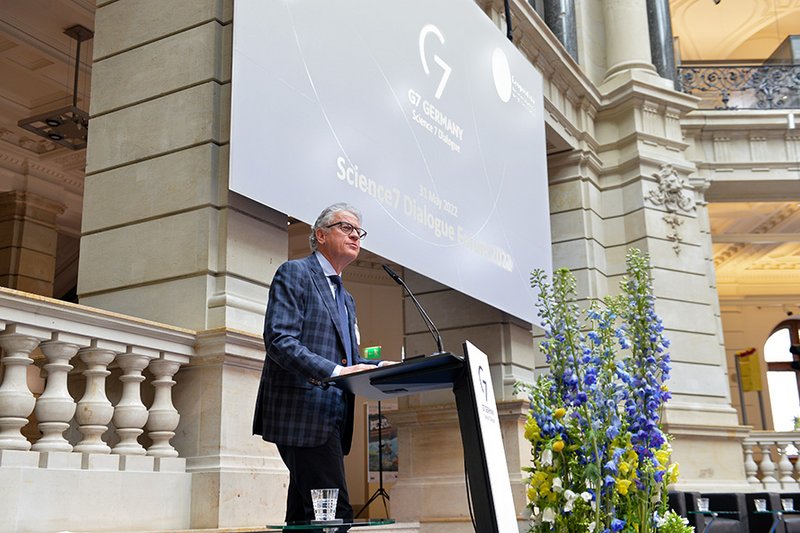
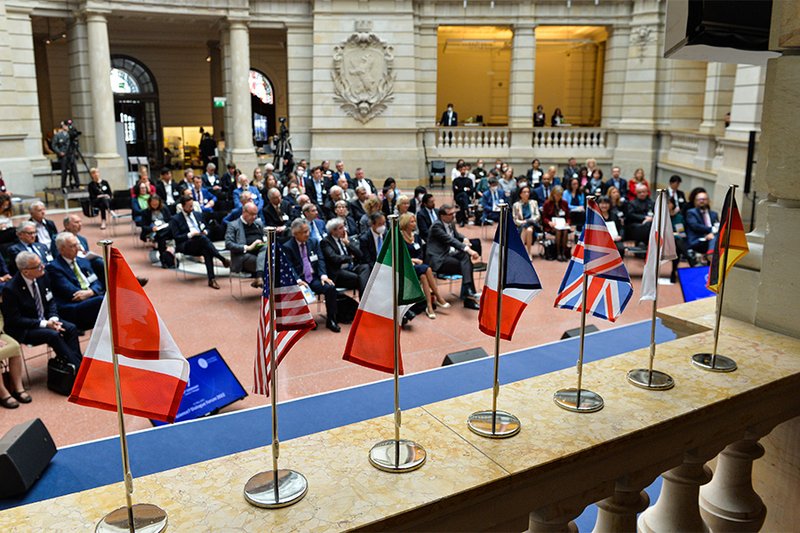
“The G7 summit must provide leadership on climate action, the energy transition, global pandemic preparedness and One Health. Our recommendations show the need and make the case for urgent international action,” explained Gerald Haug, President of the German National Academy of Sciences Leopoldina, when he submitted the four statements to the Head of the German Federal Chancellery, Wolfgang Schmidt. “The four topics are interlinked and each considers the Earth system as a whole,” he continued, highlighting the systemic approach of the statements. The joint recommendations developed by the G7 science academies under the leadership of the Leopoldina will inform the deliberations of the heads of state and government at the G7 summit, which is taking place at Schloss Elmau in Germany from Sunday, 26 June to Tuesday, 28 June.
Urgent need for coordinated measures to protect the ocean and the cryosphere
The global ocean and the ice and snow regions that make up the cryosphere are changing faster than ever before as a result of global warming. Ice loss has strongly accelerated in both Antarctica and Greenland and the Arctic permafrost is thawing. The seawater is becoming more acidic and warmer and sea levels are rising. Faced with these dramatic developments, the G7 science academies are calling for a substantive reduction in greenhouse gas emissions, global protection of marine ecosystems as well as enhanced international scientific cooperation and data sharing for an Earth observation and forecasting system based on high performance computing.
Achieving climate neutrality by accelerating decarbonisation
To achieve climate neutrality by 2050 or earlier, decarbonisation is needed in electricity generation, the heating and cooling of buildings, the mobility and transport sector as well as in industry and agriculture. To this end, the G7 science academies recommend building a carbon neutral and resilient energy system, and supporting a just energy transition through the introduction of an international trading system for renewable energy and a global CO2 pricing mechanism. The risks of climate change also need to be better communicated and carbon-neutral lifestyles promoted.
Development of antiviral drugs for increased pandemic preparedness
The COVID-19 pandemic demonstrated that the world is insufficiently prepared for pandemics and urgent action is needed to develop new antiviral drugs. The G7 science academies therefore call for long-term support for the development of specific and broad-spectrum antiviral drugs, an international coordination body for clinical studies and improved international coordination in the field of pandemic preparedness.
A One Health approach to zoonotic diseases and antimicrobial resistance
The disruption of ecosystems fosters the emergence of human pathogens from animal populations and vice versa (zoonotic diseases). Due to increasing antimicrobial resistance (AMR), the antimicrobial drugs (e.g. antibiotics) used to treat infectious diseases are losing effectiveness. To address these complex problems, the G7 science academies recommend a stronger focus on the One Health approach, which considers the health of humans, animals, plants and the wider environment as closely linked and interdependent. They also call for the use of new digital technologies for effective surveillance of zoonoses and AMR and fostering research and development focused on the One Health approach.
The science academies have been accompanying the annual G7 summits for more than fifteen years. In the run up to each summit, they address scientific agenda-related issues that require multilateral action. As the German National Academy of Sciences, the Leopoldina has been officially mandated by the German government to lead the preparation of science-based policy advice (the Science7 process) as part of the German G7 Presidency this year. The Leopoldina last had this role in 2015.