The mystery of risks - How can science help reconcile perception and assessment?

  • Symposia
  • Potsdam
Conference within the event series “Crossing Boundaries in Science” (CBiS)
  • Start date
  • End date
  • Location Potsdam

The aim of the international conference series Crossing Boundaries in Science, held by the National Academy of Sciences Leopoldina, is to act early to identify research areas whose development relies particularly heavily on interdisciplinary collaboration. The second conference in the series was held from 4 to 6 July in Potsdam under the title “The mystery of risks – How can science help reconcile perception and assessment?”. The central question was the role science plays in the evaluation of societal risks and of potential paths of action.

In the run-up to the event, the Joint Committee on the Handling of Security-Relevant Research   organised the workshop “Risk Governance and the Role of Science and Humanities,” which prepared students from Germany, Austria, Belgium, China and the United Kingdom for the conference topics. It also familiarised them with the problem of how science handles security-relevant research risks. One focus of the conference was the question of how risks and perceptions of risks are constructed. Participants also explored whether the precautionary principle restricts scientific progress. And scientists from disciplines such as sociology, economics, psychology, medicine, meteorology and biology discussed the positive and negative effects that may be associated with inaccurate risk perception.

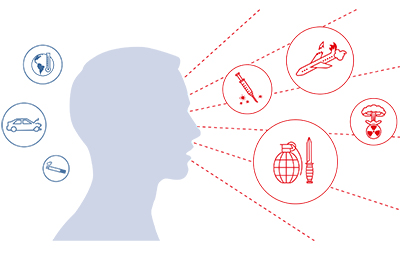
In the opening keynote speech, Prof. Dr. Ortwin Renn ML sketched out various classes of risks, which the subsequent speakers frequently returned to – natural dangers, cybersecurity and health risks. Some of the talks were dedicated to the underestimated and overestimated risks he mentioned. The speakers argued that risks are primarily a social construct rooted more in feelings than in evidence, which is why people generally see terrorism as being more dangerous than a car accident. The role of science is to recognise these perceptions while also explaining the real risk potentials in a clear and reasonable manner.

Illustration: Sisters of Design

The Leopoldina uses cookies

We use cookies on our website. Some of them are necessary (functional cookies), while others are not necessary but help us to improve our online offering and operate it economically.

You can consent to the use of non-essential cookies by clicking on the "Accept all" button or by clicking on individual settings and agreeing to them by clicking on "Accept selection".

You can access these settings at any time and deselect cookies at a later date.

Functional

These cookies are technically necessary in order to provide the following core functionalities of the website:

  • Display of the website
  • Anonymisation of IP addresses within log files
  • Status cookie consent
Comfort

In addition to necessary cookies, we also use cookies to make your use of the website more pleasant. If you accept these cookies, external media will be loaded without your further consent.

Tracking

With the help of statistics cookies, we can better customise the content and services of our website to your interests and needs. For statistics and analyses, we use the product Matomo for statistics and analyses.

External link warning

Die Nutzung dieses Teildienstes erfordert ihre Einwilligung in die Verarbeitung zusätzlicher personenbezogener Daten durch einen selbständigen Verantwortlichen: Matterport Inc., 352 E. Java Drive, Sunnyvale, CA 94089, USA. Es gelten folgende Datenschutzhinweise: https://matterport.com/de/node/44. Mit der Einwilligung durch Klick auf „Ok“ kann auch eine Übermittlung von personenbezogenen Daten in ein Land außerhalb der Europäischen Union erfolgen. Die Einwilligung ist freiwillig. Eine Ablehnung führt zu keinen Nachteilen. Eine erteilte Einwilligung kann jederzeit mit Wirkung für die Zukunft widerrufen werden.

Ich bin damit einverstanden, dass bei Nutzung dieses Teildienstes zusätzliche personenbezogene Daten verarbeitet werden. Dabei verarbeitete Datenkategorien: technische Verbindungsdaten des Serverzugriffs (IP-Adresse, Datum, Uhrzeit, abgefragte Seite, Browser-Informationen), Daten zur Erstellung von Nutzungsstatistiken und Daten über die Nutzung der Website sowie die Protokollierung von Klicks auf einzelne Elemente. Zweck der Verarbeitung: Auslieferung von Inhalten, die von Dritten bereitgestellt werden. Rechtsgrundlage für die Verarbeitung: Ihre Einwilligung nach Art. 6 (1) a DSGVO, Art. 49 DSGVO. Verantwortlicher für die Datenverarbeitung Matterport Inc., 352 E. Java Drive, Sunnyvale, CA 94089, USA. Es gilt die Datenschutzerklärung von Matterport Inc.: https://matterport.com/de/node/44.

Visit page ▸