International Recommendations

Artificial intelligence and society (2019)

Published by Académie des sciences

G7 Statement 2019

  • Defence
  • Privacy
  • Big Data
Download Publication (PDF)

Publication Details

  • Publication Date 06.05.2019
  • DOI https://doi.org/10.26164/leopoldina_04_00315
  • Count pages 5

More information

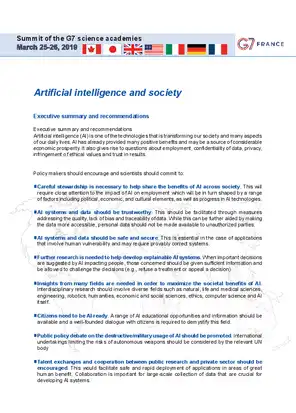
Artificial intelligence (AI) is one of the technologies that is transforming our society and many aspects of our daily lives. AI has already provided many positive benefits and may be a source of considerable economic prosperity. It also gives rise to questions about employment, confidentiality of data, privacy, infringement of ethical values and trust in results.

Policy makers should encourage and scientists should commit to:

  • Careful stewardship is necessary to help share the benefits of AI across society. This will require
    close attention to the impact of AI on employment which will be in turn shaped by a range of factors including political, economic, and cultural elements, as well as progress in AI technologies.
  • AI systems and data should be trustworthy. This should be facilitated through measures addressing the quality, lack of bias and traceability of data. While this can be further aided by making the data more accessible, personal data should not be made available to unauthorized parties.
  • AI systems and data should be safe and secure. This is essential in the case of applications that
    involve human vulnerability and may require provably correct systems.
  • Further research is needed to help develop explainable AI systems. When important decisions are
    suggested by AI impacting people, those concerned should be given sufficient information and be
    allowed to challenge the decisions (e.g., refuse a treatment or appeal a decision).
  • Insights from many fields are needed in order to maximize the societal benefits of AI. Interdisciplinary research should involve diverse fields such as natural, life and medical sciences, engineering, robotics, humanities, economic and social sciences, ethics, computer science and AI itself.
  • Citizens need to be AI-ready. A range of AI educational opportunities and information should be
    available and a well-founded dialogue with citizens is required to demystify this field.
  • Public policy debate on the destructive/military usage of AI should be promoted. International undertakings limiting the risks of autonomous weapons should be considered by the relevant UN body.
  • Talent exchanges and cooperation between public research and private sector should be encouraged.
  • This would facilitate safe and rapid deployment of applications in areas of great human benefit.
  • Collaboration is important for large-scale collection of data that are crucial for developing AI systems.

The Leopoldina uses cookies

We use cookies on our website. Some of them are necessary (functional cookies), while others are not necessary but help us to improve our online offering and operate it economically.

You can consent to the use of non-essential cookies by clicking on the "Accept all" button or by clicking on individual settings and agreeing to them by clicking on "Accept selection".

You can access these settings at any time and deselect cookies at a later date.

Functional

These cookies are technically necessary in order to provide the following core functionalities of the website:

  • Display of the website
  • Anonymisation of IP addresses within log files
  • Status cookie consent
Comfort

In addition to necessary cookies, we also use cookies to make your use of the website more pleasant. If you accept these cookies, external media will be loaded without your further consent.

Tracking

With the help of statistics cookies, we can better customise the content and services of our website to your interests and needs. For statistics and analyses, we use the product Matomo for statistics and analyses.

External link warning

Die Nutzung dieses Teildienstes erfordert ihre Einwilligung in die Verarbeitung zusätzlicher personenbezogener Daten durch einen selbständigen Verantwortlichen: Matterport Inc., 352 E. Java Drive, Sunnyvale, CA 94089, USA. Es gelten folgende Datenschutzhinweise: https://matterport.com/de/node/44. Mit der Einwilligung durch Klick auf „Ok“ kann auch eine Übermittlung von personenbezogenen Daten in ein Land außerhalb der Europäischen Union erfolgen. Die Einwilligung ist freiwillig. Eine Ablehnung führt zu keinen Nachteilen. Eine erteilte Einwilligung kann jederzeit mit Wirkung für die Zukunft widerrufen werden.

Ich bin damit einverstanden, dass bei Nutzung dieses Teildienstes zusätzliche personenbezogene Daten verarbeitet werden. Dabei verarbeitete Datenkategorien: technische Verbindungsdaten des Serverzugriffs (IP-Adresse, Datum, Uhrzeit, abgefragte Seite, Browser-Informationen), Daten zur Erstellung von Nutzungsstatistiken und Daten über die Nutzung der Website sowie die Protokollierung von Klicks auf einzelne Elemente. Zweck der Verarbeitung: Auslieferung von Inhalten, die von Dritten bereitgestellt werden. Rechtsgrundlage für die Verarbeitung: Ihre Einwilligung nach Art. 6 (1) a DSGVO, Art. 49 DSGVO. Verantwortlicher für die Datenverarbeitung Matterport Inc., 352 E. Java Drive, Sunnyvale, CA 94089, USA. Es gilt die Datenschutzerklärung von Matterport Inc.: https://matterport.com/de/node/44.

Visit page ▸