Discussion Papers

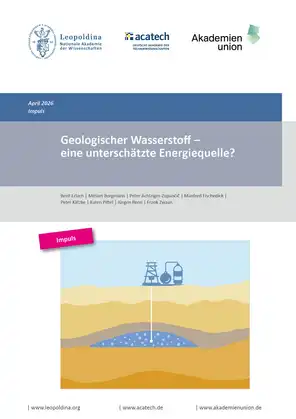
Geological Hydrogen – An Overlooked Energy Source? (2026)

Published by Erlach, Berit/ Borgmann, Miriam/ Achtziger-Zupančič, Peter/ Fischedick, Manfred/ Klitzke, Peter/ Pittel, Karen/ Renn, Jürgen/ Zwaan, Frank

Discussion Paper of the Academies’ Project “Energy Systems of the Future”

Series on “Energy Systems of the Future” (ESYS)

  • Hydrogen

Publication Details

  • Publication Date 15.04.2026
  • DOI https://doi.org/10.48669/esys_2026-1
  • Count pages 57

Geological hydrogen (molecular hydrogen formed in the Earth’s subsurface), may become a new energy source. The discussion paper by the initiative "Energy Systems of the Future (ESYS)" provides researchers, energy experts and policy-makers with a scientifically grounded assessment of this potential ressource that has so far received little systematic attention in the German energy community.

Two forms of geological hydrogen are explored in the paper: Natural hydrogen forms through naturally occurring geological processes such as reactions between certain iron-rich rocks and water. Stimulated geological hydrogen is produced by deliberately inducing reactions in the subsurface through the injection of water or catalysts. Both concepts are currently receiving strong research interest in the geosciences, but stimulated hydrogen is at a much earlier stage.

What does the discussion paper address?

  • How does geological hydrogen form, and under what conditions does it accumulate in the subsurface?
  • Do commercially exploitable deposits exist, and how can they be identified?
  • Which use cases are most promising in the short and medium term?
  • What regulatory framework is needed for exploration and extraction?
  • What research is required to make well-founded assessments of the potential?

Promising – but many open questions

Whether geological hydrogen exists n quantities sufficient for commercial extraction remains unclear. So far, there is only one documented case of sustained production – in Mali. The generation processes are understood in general, but the knowledge about migration, accumulation and consumption by microbes and chemical reactions in the subsurface is still very limited. Decentralised applications such as co-production with helium or geothermal energy are considered the most promising entry points.

Targeted public funding for research should strengthen the scientific basis for policy decisions, and mining codes should be adjusted to facilitate exploration and extraction. Geological hydrogen could complement the energy transition, but few experts see it as a real game-changer.
 

The Leopoldina uses cookies

We use cookies on our website. Some of them are necessary (functional cookies), while others are not necessary but help us to improve our online offering and operate it economically.

You can consent to the use of non-essential cookies by clicking on the "Accept all" button or by clicking on individual settings and agreeing to them by clicking on "Accept selection".

You can access these settings at any time and deselect cookies at a later date.

Functional

These cookies are technically necessary in order to provide the following core functionalities of the website:

  • Display of the website
  • Anonymisation of IP addresses within log files
  • Status cookie consent
Comfort

In addition to necessary cookies, we also use cookies to make your use of the website more pleasant. If you accept these cookies, external media will be loaded without your further consent.

Tracking

With the help of statistics cookies, we can better customise the content and services of our website to your interests and needs. For statistics and analyses, we use the product Matomo for statistics and analyses.

External link warning

Die Nutzung dieses Teildienstes erfordert ihre Einwilligung in die Verarbeitung zusätzlicher personenbezogener Daten durch einen selbständigen Verantwortlichen: Matterport Inc., 352 E. Java Drive, Sunnyvale, CA 94089, USA. Es gelten folgende Datenschutzhinweise: https://matterport.com/de/node/44. Mit der Einwilligung durch Klick auf „Ok“ kann auch eine Übermittlung von personenbezogenen Daten in ein Land außerhalb der Europäischen Union erfolgen. Die Einwilligung ist freiwillig. Eine Ablehnung führt zu keinen Nachteilen. Eine erteilte Einwilligung kann jederzeit mit Wirkung für die Zukunft widerrufen werden.

Ich bin damit einverstanden, dass bei Nutzung dieses Teildienstes zusätzliche personenbezogene Daten verarbeitet werden. Dabei verarbeitete Datenkategorien: technische Verbindungsdaten des Serverzugriffs (IP-Adresse, Datum, Uhrzeit, abgefragte Seite, Browser-Informationen), Daten zur Erstellung von Nutzungsstatistiken und Daten über die Nutzung der Website sowie die Protokollierung von Klicks auf einzelne Elemente. Zweck der Verarbeitung: Auslieferung von Inhalten, die von Dritten bereitgestellt werden. Rechtsgrundlage für die Verarbeitung: Ihre Einwilligung nach Art. 6 (1) a DSGVO, Art. 49 DSGVO. Verantwortlicher für die Datenverarbeitung Matterport Inc., 352 E. Java Drive, Sunnyvale, CA 94089, USA. Es gilt die Datenschutzerklärung von Matterport Inc.: https://matterport.com/de/node/44.

Visit page ▸