Nova Acta Leopoldina0

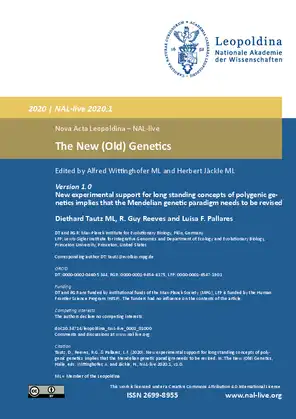
The New (Old) Genetics (2020)

Published by Alfred Wittinghofer, Herbert Jäckle

New experimental support for long standing concepts of polygenic genetics implies that the Mendelian genetic paradigm needs to be revised

Diethard Tautz ML, R. Guy Reeves and Luisa F. Pallares
Download Publication (PDF)

Publication Details

  • Publication Date 03.07.2020
  • Volume number 2020.1
  • ISSN 2699-8955
  • Count pages 16
  • Count Figures 5

When one thinks of genetics, the first thing that comes to mind is Mendel. Mendel's laws are taught at an early age in school and for many school leavers they remain the only contact with genetics. Yellow and green peas are used to show how traits are inherited, how mixing and splitting can occur. However, while such categorial thinking has fueled the development of modern molecular genetics, it does not reflect the fact that neither the common phenotypes, nor their inheritance, can be described in these terms. Instead, the rules of quantitative genetics apply to most visible manifestations of organisms.

The principles of quantitative genetics have been worked out by a contemporary of Mendel – Francis Galton. Among quantitative geneticists, statistics prevail. There are no categorical distinctions, such as the green and yellow peas, but only continuous distributions, such as body size. With the tools of genomics, it is now possible to determine for each individual gene in the genome what proportion it makes up of a continuous phenotype. Some geneticists now even assume that ultimately all genes in a genome contribute to each phenotype in varying proportions, the so-called “omnigenic model”.

While quantitative genetics teaches that there are no genetic categories, our thinking is still mainly shaped by categories. For example, we understand well how the categories “male” and “female” are determined by the distribution of the X and Y chromosomes according to Mendel's rules. But in quantitative genetics there is no longer just the category male or female, but distributions and overlaps of characters. If our schools had always taught quantitative genetics, this would have prevented many misunderstandings of genetics and inheritance.

doi.org/10.34714/leopoldina_nal-live_0001_01000

A NAL-live article open for comments and discussion. More information

This article is open for online discussion and comments. To engage, click the link on the right.

The Leopoldina uses cookies

We use cookies on our website. Some of them are necessary (functional cookies), while others are not necessary but help us to improve our online offering and operate it economically.

You can consent to the use of non-essential cookies by clicking on the "Accept all" button or by clicking on individual settings and agreeing to them by clicking on "Accept selection".

You can access these settings at any time and deselect cookies at a later date.

Functional

These cookies are technically necessary in order to provide the following core functionalities of the website:

  • Display of the website
  • Anonymisation of IP addresses within log files
  • Status cookie consent
Comfort

In addition to necessary cookies, we also use cookies to make your use of the website more pleasant. If you accept these cookies, external media will be loaded without your further consent.

Tracking

With the help of statistics cookies, we can better customise the content and services of our website to your interests and needs. For statistics and analyses, we use the product Matomo for statistics and analyses.

External link warning

Die Nutzung dieses Teildienstes erfordert ihre Einwilligung in die Verarbeitung zusätzlicher personenbezogener Daten durch einen selbständigen Verantwortlichen: Matterport Inc., 352 E. Java Drive, Sunnyvale, CA 94089, USA. Es gelten folgende Datenschutzhinweise: https://matterport.com/de/node/44. Mit der Einwilligung durch Klick auf „Ok“ kann auch eine Übermittlung von personenbezogenen Daten in ein Land außerhalb der Europäischen Union erfolgen. Die Einwilligung ist freiwillig. Eine Ablehnung führt zu keinen Nachteilen. Eine erteilte Einwilligung kann jederzeit mit Wirkung für die Zukunft widerrufen werden.

Ich bin damit einverstanden, dass bei Nutzung dieses Teildienstes zusätzliche personenbezogene Daten verarbeitet werden. Dabei verarbeitete Datenkategorien: technische Verbindungsdaten des Serverzugriffs (IP-Adresse, Datum, Uhrzeit, abgefragte Seite, Browser-Informationen), Daten zur Erstellung von Nutzungsstatistiken und Daten über die Nutzung der Website sowie die Protokollierung von Klicks auf einzelne Elemente. Zweck der Verarbeitung: Auslieferung von Inhalten, die von Dritten bereitgestellt werden. Rechtsgrundlage für die Verarbeitung: Ihre Einwilligung nach Art. 6 (1) a DSGVO, Art. 49 DSGVO. Verantwortlicher für die Datenverarbeitung Matterport Inc., 352 E. Java Drive, Sunnyvale, CA 94089, USA. Es gilt die Datenschutzerklärung von Matterport Inc.: https://matterport.com/de/node/44.

Visit page ▸