National Recommendations

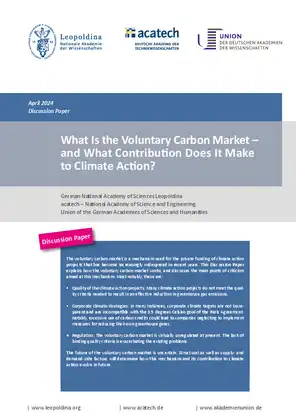
What Is the Voluntary Carbon Market – and What Contribution Does It Make to Climate Action? (2024)

Published by Borgmann, Miriam/Gierds, Jörn/Fischedick, Manfred/Henning, Hans-Martin/Matthies, Ellen/Pittel, Karen/Renn, Jürgen/Sauer, Dirk Uwe/Spiecker genannt Döhmann, Indra

Discussion Paper of the Academies’ Project “Energy Systems of the Future”

  • Carbon Management
  • Climate Protection
Download Publication (PDF)

Publication Details

  • Publication Date 29.04.2024
  • Count pages 36

The voluntary carbon market is a trading platform for what are known as “carbon credits”. The underlying promise is that climate action projects should either prevent the emission of greenhouse gases or remove CO2 from the atmosphere. Actors acquiring carbon credits – mostly companies and other private entities – can use them to offset their own greenhouse gas emissions. However, this tempting-sounding carbon offsetting concept is attracting increasing criticism and the actual protective effect for the climate appears questionable.
So is the voluntary carbon market actually a valuable tool for protecting the climate or not? And how might it change over the next few years? In this Discussion Paper, the Academies’ Project “Energy Systems of the Future” (ESYS) looks at the structure of the voluntary carbon market and how it works and highlights the challenges that emerge from this and areas where action is needed.

Key questions include:

  • How is the voluntary carbon market structured and regulated? What problems does this bring?
  • Which climate action projects generate carbon credits for the voluntary carbon market?
  • What do companies and other buyers of carbon credits use them for?
  • Why do the climate action projects and companies acquiring carbon credits sometimes attract criticism?

This publication explores how the voluntary carbon market in its current form only makes a very limited contribution to climate protection. To change that, better regulation of the market is needed, as well as mandatory and overarching quality criteria for the climate action projects and considered use of carbon credits – alongside, not in place of, initiatives to reduce greenhouse gas emissions.

The Leopoldina uses cookies

We use cookies on our website. Some of them are necessary (functional cookies), while others are not necessary but help us to improve our online offering and operate it economically.

You can consent to the use of non-essential cookies by clicking on the "Accept all" button or by clicking on individual settings and agreeing to them by clicking on "Accept selection".

You can access these settings at any time and deselect cookies at a later date.

Functional

These cookies are technically necessary in order to provide the following core functionalities of the website:

  • Display of the website
  • Anonymisation of IP addresses within log files
  • Status cookie consent
Comfort

In addition to necessary cookies, we also use cookies to make your use of the website more pleasant. If you accept these cookies, external media will be loaded without your further consent.

Tracking

With the help of statistics cookies, we can better customise the content and services of our website to your interests and needs. For statistics and analyses, we use the product Matomo for statistics and analyses.

External link warning

Die Nutzung dieses Teildienstes erfordert ihre Einwilligung in die Verarbeitung zusätzlicher personenbezogener Daten durch einen selbständigen Verantwortlichen: Matterport Inc., 352 E. Java Drive, Sunnyvale, CA 94089, USA. Es gelten folgende Datenschutzhinweise: https://matterport.com/de/node/44. Mit der Einwilligung durch Klick auf „Ok“ kann auch eine Übermittlung von personenbezogenen Daten in ein Land außerhalb der Europäischen Union erfolgen. Die Einwilligung ist freiwillig. Eine Ablehnung führt zu keinen Nachteilen. Eine erteilte Einwilligung kann jederzeit mit Wirkung für die Zukunft widerrufen werden.

Ich bin damit einverstanden, dass bei Nutzung dieses Teildienstes zusätzliche personenbezogene Daten verarbeitet werden. Dabei verarbeitete Datenkategorien: technische Verbindungsdaten des Serverzugriffs (IP-Adresse, Datum, Uhrzeit, abgefragte Seite, Browser-Informationen), Daten zur Erstellung von Nutzungsstatistiken und Daten über die Nutzung der Website sowie die Protokollierung von Klicks auf einzelne Elemente. Zweck der Verarbeitung: Auslieferung von Inhalten, die von Dritten bereitgestellt werden. Rechtsgrundlage für die Verarbeitung: Ihre Einwilligung nach Art. 6 (1) a DSGVO, Art. 49 DSGVO. Verantwortlicher für die Datenverarbeitung Matterport Inc., 352 E. Java Drive, Sunnyvale, CA 94089, USA. Es gilt die Datenschutzerklärung von Matterport Inc.: https://matterport.com/de/node/44.

Visit page ▸