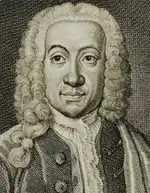
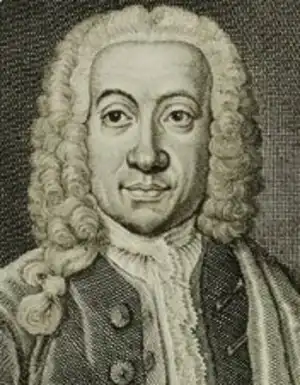
Andreas Elias Büchner (✝︎)
VI. President of the Leopoldina (1735-1769)
- Location Halle (Saale), Germany
- Election year 1726
Research
Person
The son of a hospital pastor and teacher, Andreas Elias Büchner was born on 9 April 1701 in Erfurt. He attended the “Augustinerschule” school and the Protestant “Ratsgymnasium” grammar school of his hometown.
On 6 November 1729, he married Cordula Maria Verpoorten. The couple remained childless. He died in Halle on 29 July 1769.
Career
Andreas Elias Büchner started reading medicine in Leipzig in 1716 before moving on to the university of Erfurt in 1720, and shortly thereafter to Halle. In 1722, he obtained his doctorate in medicine in Erfurt, followed by a magister degree from the faculty of philosophy in 1724.
Starting in 1726, Büchner worked as official physician appointed for the region around Rudolstadt. He became acquainted with the then President of the Leopoldina, Lucas Schroeck, through his scientific work and was invited by him into the academy on 22 August 1726. Büchner was given the byname (cognomen) Baccius I and became a civil servant as early as 1732. As Director Ephemeridum, he was responsible for publications at the academy from 1733 on.
As early as 1729, Büchner became associate professor for medicine at the university of Erfurt. In 1735, he was appointed personal physician to the emperor and received the honorary title “Edler des Heiligen Römischen Reiches Deutscher Nation” (Noblman of the Holy Roman Empire of the German Nation). Two years later, he became professor of chemistry in Erfurt before being appointed professor of medicine in Halle on 6 April 1745. He also became professor of physics at the same university, a position that was part of the faculty of philosophy at the time. In addition, a group of young natural scientists formed around him in Halle. He wrote several books on physiology, pathology, therapy and medicinal products and gave regular lectures on natural science.
Throughout this time, Andreas Elias Büchner also practiced as a physician in Halle. Owing to his great merits, he was appointed “Geheimer Medizinalrat” (private medical officer) of Prussia. Büchner served as prorector of the University of Halle three times, i.e. in the academic years of 1745/46, 1758/59 and 1767/68.
During this time, Büchner was a disciple of the Halle-based professor of medicine Friedrich Hoffmann (who was very prominent at the time and invented Hoffmann’s Drops) and his “mechanistic” understanding of medicine.
Presidency at the Leopoldina
In 1735, Andreas Elias Büchner succeeded Johann Jakob Baier to become the VI. President of the Leopoldina and gave himself the byname (cognomen) Bacchius. Initially, he moved the academy to his hometown Erfurt, where he was able to take over the old library building of the former monastery of the Augustinian Hermits from the city’s authorities. This enabled him to house the book and material collection of the Leopoldina at favourable conditions, thus turn favouring the library’s rapid growth. In addition to a significant enlargement of the library contents, the academy also has Andreas Elias Büchner to thank for the creation of library catalogues. When Büchner was appointed to the University of Halle in 1744, the academy moved with him and took roots in the city on the Saale river. The library, on the other hand, remained in the Augustinian monastery until 1805.
During his presidency, Büchner corresponded avidly with the Nuremberg-based physician and natural scientist Christoph Jacob Trew, who served as Director Ephemeridum of the Leopoldina from 1744. Their correspondence provides in-depth insights into the inner workings of the academy during those years.
It is also thanks to Büchner and his aptitude for science history that the first book on the academy’s history was written in Latin in 1755. The work, entitled “Acamdemia Sacri Romani Imperii Leopoldino-Carolinae Naturae Curiosoum Historia Conscripta Ab Eiusdem Praeside Andrea Elia Büchnero”, represented a sort of summary of the first century of the Leopoldina