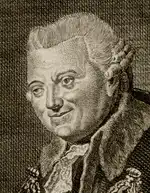
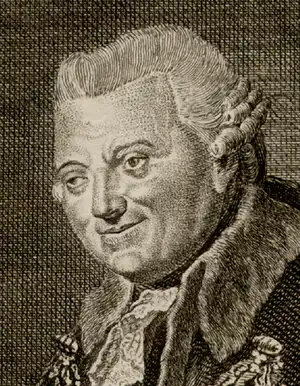
Christian Andreas von Cothenius (✝︎)
- Election year 1743
Research
Person
Christian Andreas Cothenius was born on 14 February 1708 as the youngest child of the physician Eberhard Wolfgang Coth (Cothenius) and his wife, Elisabeth, née Kehvell, in Anklam, then part of Swedish Pomerania. His father had served in a Swedish regiment before becoming city surgeon.
Christian Andreas Cothenius’ childhood was marked by war and plague, which hindered his education. He attended a school in Anklam before transferring to Szczecin and later Stralsund.
In 1735, Cothenius married Anna Dorothea Puchtert, the widow of the city physician who preceded him in Havelberg. After her death, Cothenius married Christina Caroline Sellentin in 1768. She was the widowed daughter-in-law of his former teacher from Halle, Friedrich Hoffmann. She died in 1783. He had no children from either marriage.
Christian Andreas von Cothenius died in Berlin on 5 January 1789 after a short illness. He was buried on the cemetery of the Holy Trinity Church (Dreifaltigkeitsfriedhof I) in Berlin.
He bequeathed parts of his vast inheritance to the Berlin Academy of Science and to his alma mater, the University of Halle. In his will, von Cothenius also organised the foundation of the Cothenius Medal that bears his name. To this end he left the academy 1,000 thalers. One of the first to be honoured was the physician and zoologist Ernst Haeckel in 1864, followed by the mathematician David Hilbert (1906), the pharmacist and chemist Kurt Mothes (1960), and the engineer and inventor Konrad Zuse (1985). Though the medal was initially reserved for individual scientific achievements, it has been awarded to a lifetime of superb scientific achievement since 1954.
There are streets named after Christian Andreas von Cothenius in Berlin and Havelberg.
Career
In 1728, Christian Andreas von Cothenius enrolled at the University of Halle to study medicine. One of his teachers was Friedrich Hoffmann, a renowned physician from the city of Halle, who took young Cothenius in to live with him and let him participate in his scientific work. In 1732, Cothenius earned his M.D. in Halle and later took his government licensing examination in Berlin.
After a long educational stay in Karlovy Vary Cothenius returned to Halle. He was eventually appointed to Havelberg, where he worked as a doctor and local politician for 14 years: In 1734 he was given a permanent position as city physician and Medicus Ordinarius at the Havelberg Cathedral. He became known for his attentive care for the sick and for his equal treatment of the rich and the poor.
In addition to his medical work, Cothenius took on the role of adjunct mayor of the Havelberg city council in 1736.
In 1740 he became city physician of Prignitz. In 1744 he was offered the position of court physician at the seat of government of the Duchess of Strelitz, however, this would have required the agreement of the Prussian King, Frederick II, who refused to consent. The reason he gave was that Cothenius was “so useful in the Prussian garrisons and in his own circles”.
In 1748, Cothenius was appointed court physician and city physician of Potsdam by King Frederick II. He was also assigned the districts of Zauche and Teltow, and the Great Military Orphanage.
In 1750, Cothenius became a member of the Collegium sanitatis. During the Seven Years’ War (1756 - 1763) he was also appointed general staff doctor and thus the highest ranking military doctor. One of his tasks was to provide medical care for the soldiers and veterans, which had remained woefully inadequate until then. Cothenius proceeded to establish field hospitals, which he visited on a daily basis, and he held conferences to learn about all the different symptoms. Furthermore, he put together a military pharmacy, organised the supply of dressing material and had laboratory technicians assigned to the regiments so that they could produce medicines they were lacking directly on site. He developed 104 recipes himself.
During that time, a high number of soldiers had contracted typhus. Thanks to the new strategies implemented by Cothenius, many soldiers were saved. After the war, Cothenius reported to the king that he had discharged 220,000 sick and wounded from the military hospitals.
After the peace agreement was reached, the King ordered Cothenius to come to Berlin, where he was tasked with monitoring the city’s hospitals and the Charité. Cothenius also made important contributions to practical medicine and the medical administration system. He reorganised the court pharmacy of Berlin and supported the implementation of a registration obligation for smallpox. He also provided instructions on what to do in case of a smallpox outbreak to people without access to medical care, such as those living in rural areas. His efforts in controlling epidemic diseases were groundbreaking. He also worked to fight epizootics, such as rabies, and trained country doctors.
In 1768, Cothenius became the dean of the Prussian Ober-Collegium Medicum in Berlin, which, at that time, was the highest medical authority, director of the training centre of the Collegium Medico-Chirurgicum, and member of the Collegium Sanitatis, the Berlin authority for controlling pandemic diseases.
He continued to practise medicine well into his 80s, with younger doctors assisting him as his eyesight deteriorated. By the end of his life he was completely blind.
Honours and Memberships
Christian Andreas von Cothenius received numerous awards for his work: In 1736, he was appointed royal privy councillor. He was elected a member of the German National Academy of Sciences Leopoldina in 1743. The academy later appointed him XIII Director Ephemeridum. This position made him the editor of the scientific journal published by the academy.
In 1750, he was also appointed to the Royal Academy of Sciences in Berlin. He received further awards and honours through the bestowal of the title “Imperial Counsellor and Personal Physician” of King Frederick II (1751) and through his promotion to general staff doctor (1756).