Professor Dr Christiane Nüsslein-Volhard
Nobel Prize for Physiology or Medicine 1995
- Section Genetics/Molecular Biology and Cell Biology
- Location Tübingen, Germany
- Election year 1991
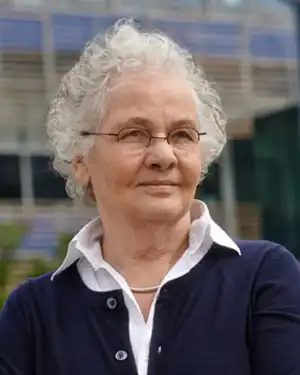
Research
Research Priorities: genetic control of pattern formation, gradient theory, Drosophila melanogaster, zebrafish Danio rerio, colour pattern formation in fishes
Christiane Nüsslein-Volhard is a developmental biologist and geneticist. Her research focuses on the genetic and molecular development analysis of animals, particularly the fly Drosophila melanogaster and the zebrafish Danio rerio. She has received numerous awards, honorary doctorates and prizes for her discovery of genes that control animal and human development and for the verification of shape-forming gradients in the fly embryo. In 1995, she was awarded the Nobel Prize in Medicine or Physiology together with Edward B. Lewis and Eric F. Wieschaus.
Together with Eric Wieschaus, Christiane Nüsslein-Volhard discovered about 120 genes in systematic studies at the EMBL in Heidelberg that have important functions in shaping the fly embryo, especially its division into segments. Identifying and describing these genes has contributed significantly to understanding general mechanisms of pattern formation during animal development. Many of the new genes also play important roles (in modified form) in vertebrate development and in carcinogenesis.
As head of research at the FML in Tübingen, Christiane Nüsslein-Volhard discovered further molecular factors already present in the egg that form the basis for the development of embryonic axes and the first subdivisions in the egg. She was the first to document the existence of gradients of shape-forming substances that activate different genes in a concentration-dependent manner and thus lead to an increase in spatial complexity during development.
Since 1992, her research group has been mainly concerned with the evolution and genetics of the zebrafish Danio rerio. Her systematic genetic studies have contributed significantly to establishing this fish as a new and powerful model system in vertebrate genetics. Recently, her research has focused on the genetic basis of forming the external shape of the adult fish, the variation of which plays a significant role in the evolution of shapes. In particular, her research group is investigating the genetic basis of stripe formation as a model for the development of colour patterns in vertebrates. Molecular interactions between the three colour cell types (black melanophores, yellow xanthophores and silver reflecting iridophores) play a decisive role.
In 2004, Christiane Nüsslein-Volhard established the CNV Foundation for the Promotion of Science and Research. The foundation's mission is to provide financial support for women with children during their doctoral studies to allow them more freedom and mobility for a career in science.
Career
- since 2014 Director Emeritus, Max Planck Institute for Developmental Biology, Tübingen, Tübingen, Germany
- since 1991 Honorary Professor, University of Tübingen, Tübingen, Germany
- 1985-2014 Scientific Member, Max Planck Society (MPG), Munich, Germany
- Director, Department of Genetics, Max Planck Institute of Developmental Biology, Tübingen, Germany
- 1981-1984 Leader, Independent Research Group, Friedrich Miescher Laboratory (FML), MPG, Tübingen, Germany
- 1978-1980 Group Leader, European Molecular Biology Laboratory (EMBL), Heidelberg, Germany
- 1977 Research Grant, German Research Foundation (DFG), Institute of Biology I (Zoology), University of Freiburg, Freiburg, Germany
- 1975-1976 Research Grant, European Molecular Biology Organisation (EMBO), Biozentrum Basel, Switzerland
- 1973 PhD in Genetics, University of Tübingen, Germany
- 1969-1974 Diploma and Doctoral Thesis, Max Planck Institute for Virus Research, Tübingen, Germany
- 1964-1969 Diploma in Biochemistry, University of Tübingen, Tübingen, Germany
- 1962-1964 Study of Biology, Chemistry, and Physics, Goethe University Frankfurt/Main, Frankfurt/Main, Germany
Functions
- 2013-2021 Chancellor, The Order Pour le Mérite, Federal Republic of Germany
- 2009-2014 Member, University Council, University of Tübingen, Germany
- 2009-2013 Vice-Chancellor, The Order Pour le Mérite, Federal Republic of Germany
- 2008 President, Society of German Natural Scientists and Physicians (GDNÄ), Germany
- 2005-2012 Member, Scientific Council, European Research Council (ERC)
- 2005-2012 Managing Director, FML, MPG, Tübingen, Germany
- since 2004 Founder, Chairperson, Christiane Nüsslein-Volhard Foundation to support Women in Science with Children (CNV), Tübingen, Germany
- 2003-2009 Secretary General, European Molecular Biology Organisation (EMBO), Heidelberg, Germany
- 2001-2007 Member, National Ethics Council, Federal Republic of Germany
- 1995-2007 Senate Member, MPG, Munich, Germany
Projects
- 2016-2022 Advanced Grant, “Danio pattern”, ERC
- 2001-2005 Project “Structural and functional analysis of the genome of the zebrafish Danio rerio, a model organism for biomedical research”, DFG, Germany
Honours and Memberships
- since 2020 Honorary Senator, MPG, Munich, Germany
- 2019 Schillerpreis der Stadt Marbach, Marbach, Germany
- 2016 Advanced Grant, ERC
- since 2010 Member, French Académie des Sciences, France
- 2007 Honorary Doctorate, Weizmann Institut, Rehovot, Israel
- 2006 Honorary Doctorate, University of Geneva, Switzerland
- 2005 Honorary Doctorate, University of Oxford, Oxford, UK
- Honorary Doctorate, University of Sheffield, Sheffield, UK
- 2005 Great Cross with Star and Sash, Federal Republic of Germany
- 2002 Honorary Doctorate, University College London, London, UK
- Honorary Doctorate, Ochanomizu University Tokyo, Tokyo, Japan
- 2001 Honorary Doctorate, The Rockefeller University, New York City , USA
- since 1997 Member, The Order Pour le Mérite for Sciences and the Arts, Federal President of Germany
- 1996 Great Cross with Star, Federal Republic of Germany
- 1995 Nobel Prize in Physiology or Medicine (shared with Eric Wieschaus and Edward Lewis), Nobel Assembly at the Karolinska Institutet, Sweden
- 1994 Cross of Merit 1st Class, Federal Republic of Germany
- 1993 Honorary Doctorate, Universität Freiburg, Freiburg, Germany
- Honorary Doctorate, Harvard University, Cambridge, USA
- 1993 Ernst Schering Prize, Ernst Schering Research Foundation, Berlin, Germany
- 1992 Louis-Jeantet Prize for Medicine, Geneva, Schweiz
- 1992 Dr. Otto Bayer Prize, Bayer AG, Leverkusen, Germany
- 1992 Mendel Medal, Genetics Society, London, UK
- 1992 Otto Warburg Medal, German Society for Biochemistry and Molecular Biology (GBM), Germany
- 1992 Louisa Gross Horwitz Prize, Columbia University Irving Medical Center (CUIMC), New York City, USA
- 1991 Honorary Doctorate, Utrecht University, Utrecht, Netherlands
- Honorary Doctorate, Princeton University, New Jersey, USA
- since 1991 Member, German National Academy of Sciences Leopoldina, Germany
- since 1990 Foreign Member, National Academy of Sciences (NAS), USA
- since 1990 Foreign Member, Royal Society, UK
- 1990 Rosenstiel Medal, Brandeis University, Waltham, USA
- 1989 Carus Medal, German National Academy of Sciences Leopoldina, Germany
- 1988 Alice and Joseph Brooks International Lecture on the Neurosciences, Harvard Medical School (HMS), Boston, USA
- 1986 Franz Vogt Prize, Justus Liebig University Gießen (JLU), Gießen, Germany
- 1986 Gottfried Wilhelm Leibniz Prize, DFG, Germany