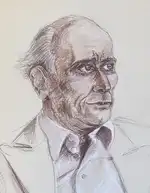
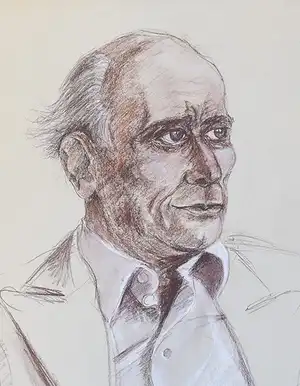
Georg Uschmann (✝︎)
- Section History of Science and Medicine
- Election year 1964
Research
biology. One of his research fields was the history of evolutionary theory, with a special focus on the
zoologist Ernst Haeckel and his students. Uschmann was also responsible for organising and making
the collections of the Ernst-Haeckel-Haus, which is part of the Friedrich Schiller University Jena,
available to the public, and for turning the house into a museum. From 1967, he served as first
director of the archive of the Leopoldina. In this capacity, he carried out in-depth research into the
history of the science academy and became editor of a series of publications entitled “Acta historica
Leopoldina” and “Representations of life by German natural scientists” (“Lebensdarstellungen
deutscher Naturforscher”).
Person
On 18 October 1913, Georg Uschmann was born in Naumburg (Saale), as the only son of Bruno Uschmann, a tailor, and his wife Margarete Anna, née Claus. In 1920, he started preparatory school for the secondary school.
Uschmann spent the first few years of his life under the impression of the recent First World War and the subsequent period of inflation. A member of his school’s rowing club, he grew up in a modest household. He would dedicate a lot of time to rowing, which he continued during his studies (physical education) at Friedrich Schiller University Jena.
On 18 March 1933, he graduated from the secondary school of ordinary level in Naumburg, and then did his voluntary labour service in Eastern Prussia. Uschmann joined the NSDAP in 1937.
On 4 March 1940, he married fellow student Käte Fränsemeier before being called up by the Wehrmacht. The couple had two daughters, Ursula (1941) and Ingeborg (1943).
From 1970 onwards, Uschmann was marked by illness. Bouts of allergies, depression and asthma curbed his creative energy. Just a month before his 73rd birthday, on 23 September 1979, Georg Uschmann died of herbes zoster in Jena. He was buried in Dessau, his daughter’s hometown.
The Georg Uschmann Award for the History of Science was founded in 1997 by scientists Ilse and Eugen Seibold from Freiburg im Breisgau. It is awarded every other year at the Leopoldina’s Annual Assembly to students who have written outstanding dissertations on a theme related to the history of science or medicine.
Career
In 1933, Georg Uschmann took up studies of philosophy at the Friedrich Schiller University Jena. He also studied history and sports (physical education) for secondary education. In the autumn of 1934, he changed his subject to biology (zoology and botany). In 1939, Uschmann earned his doctorate (dr. rer. nat) at the Friedrich Schiller University Jena, with a thesis entitled “The morphological concept of perfection in Goethe and its relation to ‘Problemgeschichte’” (“Der morphologische Vervollkommnungsbegriff bei Goethe und seine problemgeschichtlichen Zusammenhänge”), and then became an assistant at the Ernst-Haeckel-Haus in Jena.
In 1940, he was conscripted into the German Wehrmacht, where he moved up to the rank of captain. Upon his return from Soviet captivity in 1950, he resumed his work at the Ernst-Haeckel-Haus. In 1951, he was given a teaching post and became a managing senior lecturer.
Uschmann began writing a postdoctoral thesis (“Habilitationsschrift”) on the French biologist Jean-Baptiste de Lamarck and his concepts of evolutionary biology. When he realised that the political situation in East Germany would make it impossible for him to carry out research in French archives, he changed his subject to the hitherto inaccessible archival collections on the history of zoology in Jena at the Ernst-Haeckel-Haus.
During this period, the historical collections at the Ernst-Haeckel-Haus were organised and made accessible to the public. By 1953, some of the cataloguing had been completed and the indexing of historical letters and photographs had begun, laying the foundation for subsequent research on the history of biology.
In June 1959, Uschmann earned his qualification to become a professor (Habilitation) with his thesis entitled “History of zoology and zoological institutions in Jena from 1779 to 1919” (“Geschichte der Zoologie und der zoologischen Anstalten in Jena 1779 bis 1919”). He was then appointed lecturer on the history of biology and, only a few months later, on 1 November, he became director of the Ernst-Haeckel-Haus. Under his leadership, which also promoted popular scientific activities such as public lectures, slide shows and journal articles, the institution gained public recognition as part of Friedrich Schiller University Jena. A travelling exhibition about Ernst Haeckel, inaugurated by Uschmann in the Sri Lankan capital of Colombo in 1964, was testament to the Ernst-Haeckel-Haus’ cross-regional influence.
From 1962 onwards, Uschmann served as a professor of the history of natural science in Jena. On
1 September 1965, he took over the new chair for the history of natural science and was appointed professor ordinarius.
An escalating ideological dispute at the Friedrich Schiller University Jena culminating in proposals for the establishment of a chair of philosophy for atheism at the Ernst-Haeckel-Haus, prompted Uschmann to hope for a transfer to the Martin Luther University Halle-Wittenberg, where Rudolph Zaunick, a science historian who was close to Uschmann, had been given emeritus status in 1960.
Although Uschmann’s plans to transfer failed after the professorship in Halle (Saale) was abolished, Zaunick, who was also Director Ephemeridum at the Leopoldina, was able to negotiate a compromise, making it possible for Georg Uschmann to hold lectures in Halle (Saale) from 1964. Zaunick also helped Uschmann join the Leopoldina, where the latter began researching the academy’s history. After Zaunick’s death in 1967, Uschmann became his successor and began to design a layout for the archive, which had until then been housed in a rather provisional setup.
Upon completion of this reconstitution in 1967, Uschmann was appointed director of the Leopoldina’s archive, which greatly expanded his scope of duties: He became a member of the Presidium and editor of Rudolph Zaunick’s series of publications entitled “Acta historica Leopoldina” and “Representations of life by German natural scientists” (“Lebensdarstellungen deutscher Naturforscher”). Under Uschmann’s leadership, the archive was expanded and moved to a renovated building.
While Georg Uschmann continued his scientific work, political confrontations were intensifying: After 1966, East German universities were becoming increasingly isolated from Western influences, making international contacts and taking part in scientific events in Western countries more and more difficult. Despite this climate, Uschmann’s involvement with the Leopoldina enabled him to circumnavigate restrictions. He used many of his contacts from the scholarly academy to obtain international literature and meet with colleagues in Western foreign countries. Uschmann was also able to exploit many of these contacts for the benefit of the Ernst-Haeckel-Haus.
Georg Uschmann was given emeritus status in 1979.
Honours and Memberships
Georg Uschmann was frequently honoured for his scientific work, one such honour being his admission to the German National Academy of Sciences Leopoldina in 1964, and to the Académie internationale d’ Histoire des Sciences in 1971. Georg Uschmann received the Leopoldina Medal of Merit for his achievements in setting up the Leopoldina’s archive in 1978. In 1987, the Biological Association of the German Democratic Republic (Biologische Gesellschaft der DDR) posthumously made him an Honorary Member.