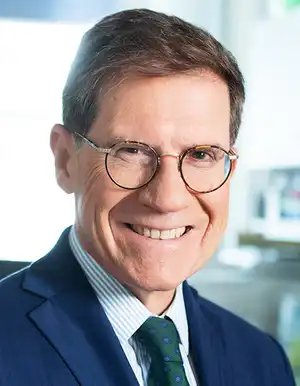
Professor Dr Giulio Superti-Furga

- Section Biochemistry and Biophysics
- Location Wien, Austria
- Election year 2008
Research
Research Priorities: Systems biology, molecular biology, proteomics, immunology, cancer research, effect of active ingredients, membrane transporters
Giulio Superti-Furga is an Italian molecular and systems biologist. His research focuses on investigating cellular responses to dysfunctions and pathogenic influences, as well as the re-establishment of cellular balance (homeostasis). Investigating the effects of drugs and viruses on the cells is a key aspect of his research. In recent years his research focus lies on membrane transporters. Drawing on basic insights, the objective of his work is to develop new treatment approaches for cancerous diseases and inflammation.
Membrane transporters which act as an interface between the cell’s interior and the outside environment are at the core of Gulio Superti-Furgas’ research. These transporters are considered key metabolism regulators. Proteases, acting as links between growth and metabolism that are relevant to treatment, are another research focus. These insights make it possible to research the molecular mechanisms of drug action in cancerous diseases and inflammation, and to develop new, improved treatment approaches.
His current research interests include the development of functional approaches in precision medicine and the role of the human membrane transporter in pathophysiology and drug development. He is committed to systems biology-based approaches in medicine and drug research and calls for a precision- and prevention-oriented medicine combining the integration of basic research, clinical expertise, and innovative diagnostics and therapeutic methods.
In his research he combines molecular-biological approaches with methods from -omics, biochemistry and bioinformatics in an interdisciplinary approach to generate a comprehensive systems-biology level understanding of the relationship between the regulation of cellular metabolism processes by membrane transporters and other homeostatic regulators. He aims to better understand the molecular foundations of drug action and to identify new treatment approaches. He and his team were able to identify new applications for existing drugs in this way.
One of Gulio Superti-Furgas’ greatest scientific achievements is the elucidation of basic regulatory mechanisms of tyrosine kinases that play a key role in human cancerous diseases. He also developed holistic approaches to researching the molecular mechanisms of drugs, discovered crucial organisational principles of the proteome and metabolome of higher organisms, and characterised the molecular components of the innate immune system. His research has significantly contributed to the systematic understanding of infections caused by pathogens and the effect mechanisms of certain drugs.
Furthermore, Superti-Furga considers the social and ethical impacts and conditions of biomedical research. As chairperson of the Steering Committee and a participating scientist in the Personal Genome Project “Genome Austria” he proactively addresses the various aspects of genome sequencing. As part of this project he also made his own genome sequence (PGA1) publicly available so as to encourage further discussion around the opportunities and challenges of genome research.
Giulio Superti-Furga is an Italian molecular and systems biologist. His research focuses on investigating cellular responses to dysfunctions and pathogenic influences, as well as the re-establishment of cellular balance (homeostasis). Investigating the effects of drugs and viruses on the cells is a key aspect of his research. In recent years his research focus lies on membrane transporters. Drawing on basic insights, the objective of his work is to develop new treatment approaches for cancerous diseases and inflammation.
Membrane transporters which act as an interface between the cell’s interior and the outside environment are at the core of Gulio Superti-Furgas’ research. These transporters are considered key metabolism regulators. Proteases, acting as links between growth and metabolism that are relevant to treatment, are another research focus. These insights make it possible to research the molecular mechanisms of drug action in cancerous diseases and inflammation, and to develop new, improved treatment approaches.
His current research interests include the development of functional approaches in precision medicine and the role of the human membrane transporter in pathophysiology and drug development. He is committed to systems biology-based approaches in medicine and drug research and calls for a precision- and prevention-oriented medicine combining the integration of basic research, clinical expertise, and innovative diagnostics and therapeutic methods.
In his research he combines molecular-biological approaches with methods from -omics, biochemistry and bioinformatics in an interdisciplinary approach to generate a comprehensive systems-biology level understanding of the relationship between the regulation of cellular metabolism processes by membrane transporters and other homeostatic regulators. He aims to better understand the molecular foundations of drug action and to identify new treatment approaches. He and his team were able to identify new applications for existing drugs in this way.
One of Gulio Superti-Furgas’ greatest scientific achievements is the elucidation of basic regulatory mechanisms of tyrosine kinases that play a key role in human cancerous diseases. He also developed holistic approaches to researching the molecular mechanisms of drugs, discovered crucial organisational principles of the proteome and metabolome of higher organisms, and characterised the molecular components of the innate immune system. His research has significantly contributed to the systematic understanding of infections caused by pathogens and the effect mechanisms of certain drugs.
Furthermore, Superti-Furga considers the social and ethical impacts and conditions of biomedical research. As chairperson of the Steering Committee and a participating scientist in the Personal Genome Project “Genome Austria” he proactively addresses the various aspects of genome sequencing. As part of this project he also made his own genome sequence (PGA1) publicly available so as to encourage further discussion around the opportunities and challenges of genome research.
Career
- since 2023 Scientific Director, Biomedical Research and Biotechnology Center (BRBC), Ri.MED Foundation, Palermo, Sicily, Italy
- since 2014 Professor of Medical Systems Biology, Medical University of Vienna, Vienna, Austria
- since 2005 Director, Research Center for Molecular Medicine (CeMM), Austrian Academy of Sciences, Vienna, Austria
- 2005-2014 Guest Professor of Molecular Pharmacology, Medical University of Vienna, Vienna, Austria
- 2000-2005 Founder and Scientific Director, Cellzome AG and Inc., Heidelberg, Germany/Cambridge, UK
- 1997-2000 Guest Professor of Molecular Biology, University of Bologna, Bologna, Italy
- 1993-2004 Staff Scientist and Team Leader, European Molecular Biology Laboratory (EMBL), Heidelberg, Germany
- 1991-1993 Postdoctoral Fellow, EMBL, Heidelberg, Germany
- 1991 Ph.D. in Molecular Biology, University of Zurich, Zurich, Switzerland
- 1987-1991 Ph.D., University of Zurich, Zurich, Switzerland, Genentech Inc., San Francisco, USA and Research Institute of Molecular Pathology (IMP), Vienna, Austria
- 1981-1986 MSc. in Molecular Biology, University of Zurich, Zurich, Switzerland
Functions
- since 2024 Chairperson, EU-LIFE alliance of leading life science research institutes in Europe
- 2017-2019 Member, Scientific Council, European Research Council (ERC)
- 2013-2015 Member, University Board, University of Vienna, Vienna, Austria
- 2015 Chairperson, Evaluation Board, Vlaams Instituut voor Biotechnologie (VIB), Ghent, the Netherlands
- 2014-2018 Chairperson, Steering Board, Personal Genome Project “Genom Austria”, CeMM, Austrian Academy of Sciences, Vienna, Austria, and Medical University of Vienna, Vienna, Austria
- since 2009 Chairperson, Award Committee, John Kendrew Young Scientist Award (JKA), EMBL, Heidelberg, Germany
- 2005-2011 Chairperson, Selection Committee, Letters Young Group Leader Prize, Federation of European Biochemical Societies (FEBS)
Projects
- 2024-2027 Project “mlDIAMANT: machine learning decodes interaction archetypes of membrane proteins to predict the effect of genetic variants”, Vienna Science and Technology Fund (WWTF), Vienna, Austrai
- 2022-2023 Academic Project Coordinator, Consortium “Resolution”, Innovative Medicine Initiative, European Commission (EC)
- 2018-2023 Academic Project Coordinator, Consortium “Resolute”, Innovative Medicine Initiative, EC
- 2016-2021 Principal Investigator, Advanced Grant “GameofGates (Solute carrier proteins as the gates managing chemical access to cells)”, European Research Council (ERC)
- 2016-2017 Proof of Concept Grant “chemos (Chemical Hematology: breaking resistance of hematological malignancies through personalized drug trials)”, ERC
- 2010-2015 Principal Investigator, Advanced Grant “i-Five”, ERC
Honours and Memberships
- 2024 Lennart Philipson Award, Alumni Association, EMBL, Heidelberg, Germany
- 2024 Wilhelm Exner Medal, Wilhelm Exner Foundation, Österreichischer Gewerbeverein, Austria
- 2024 Austrian Cross of Honour for Science and Art, First Class, Austria
- 2017 Commander (Commendatore), Order of Merit of the Republic of Italy, Italy
- since 2014 Member, Academia Europaea
- since 2012 Member, European Academy of Cancer Studies
- 2011 Austrian of the Year, Category Science
- 2011 Science Prize City of Vienna, Vienna, Austria
- 2010 Fellow, European Academy of Cancer Sciences
- since 2010 Member, Austrian Academy of Sciences, Austria
- 2009 Karl Landsteiner Prize, Austrian Society for Allergology and Immunology
- 2009 Officer (Ufficiale), Order of Merit of the Republic of Italy, Italy
- 2008 Winner in the Professor Category, Dance your PhD Contest, Science Magazine
- since 2008 Member, German National Academy of Sciences Leopoldina, Germany
- 2007-2010 Corresponding Member, Austrian Academy of Sciences (ÖAW), Austria
- since 2005 Member, European Molecular Biology Organization (EMBO)
- 2004-2010 Member, Faculty of 1000 in Biology