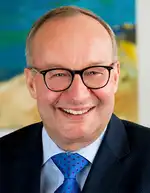
Professor Dr Hermann Einsele
- Section Internal Medicine and Dermatology
- Location Würzburg, Germany
- Election year 2024
Research
Research Priorities: Stem cell transplantation and immunotherapy for cancer, myeloma, CAR T cell therapy, bispecific antibodies
Hermann Einsele is a haemotologist and oncologist. His work focuses on cell-based immunotherapy, which is considered a breakthrough in the treatment of many diseases, especially tumour, autoimmune, infectious, and degenerative diseases. He played an important role in developing clinical standards in the treatment of blood and bone marrow cancer. In particular, his pioneering work with respect to CAR T cell therapy to treat multiple myeloma brought him world renown.
Starting with an analysis of the virus-specific immune response, Hermann Einsele and his team developed various procedures for the enrichment and selection of antigen-specific T cells – lymphocytes of the human immune system. These antigen-specific T cells were successfully used in treating viral infections in recipients of stem cell transplants, including infections with the cytomegalovirus, the Epstein-Barr virus, and adenoviruses. In additional steps he developed processes to enrich and select immune cells that are effective against fungal pathogens.
Having demonstrated the safe use of T cell therapies following stem cell transplants, Hermann Einsele has developed new strategies for T cell therapy for tumour diseases. This involves the use of T-cell-stimulating (bispecific) antibodies, first preclinically and then in clinical studies in cases of lymph node cancer and B-cell acute lymphatic leukaemia, an aggressive type of blood cancer. These studies led to the first approval for bispecific antibodies and thus to T cell therapy for tumour diseases. These bispecific antibodies were then, for the first time in the world and under the guidance of Hermann Einsele, used to treat patients with multiple myeloma, a malignant disease affecting bone marrow, which is where blood cells are made. This pioneering work marked the start of the approval process for several bispecific antibodies in treating multiple myeloma in the USA and Europe. Hermann Einsele has continued to develop new versions of bispecific antibodies with a multitargeting function. They serve as a precision tool to tackle tumour cells that are resistant to conventional immunotherapies.
Furthermore, Hermann Einsele has played a leading role in the development of CAR T cell therapy, an even more effective cellular immunotherapy. This treatment involves genetically modifying patients’ T cells in such a way that they can attack cancer cells in a targeted manner. Hermann Einsele guided the therapeutic use of CAR T cells for patients with multiple myeloma from the pilot study through to approval for general use. He also managed to develop new strategies in the design and production of CAR T cells, as well as, for the first time, to describe the resistance mechanisms of multiple myeloma against therapy using CAR T cells.
Hermann Einsele is a haemotologist and oncologist. His work focuses on cell-based immunotherapy, which is considered a breakthrough in the treatment of many diseases, especially tumour, autoimmune, infectious, and degenerative diseases. He played an important role in developing clinical standards in the treatment of blood and bone marrow cancer. In particular, his pioneering work with respect to CAR T cell therapy to treat multiple myeloma brought him world renown.
Starting with an analysis of the virus-specific immune response, Hermann Einsele and his team developed various procedures for the enrichment and selection of antigen-specific T cells – lymphocytes of the human immune system. These antigen-specific T cells were successfully used in treating viral infections in recipients of stem cell transplants, including infections with the cytomegalovirus, the Epstein-Barr virus, and adenoviruses. In additional steps he developed processes to enrich and select immune cells that are effective against fungal pathogens.
Having demonstrated the safe use of T cell therapies following stem cell transplants, Hermann Einsele has developed new strategies for T cell therapy for tumour diseases. This involves the use of T-cell-stimulating (bispecific) antibodies, first preclinically and then in clinical studies in cases of lymph node cancer and B-cell acute lymphatic leukaemia, an aggressive type of blood cancer. These studies led to the first approval for bispecific antibodies and thus to T cell therapy for tumour diseases. These bispecific antibodies were then, for the first time in the world and under the guidance of Hermann Einsele, used to treat patients with multiple myeloma, a malignant disease affecting bone marrow, which is where blood cells are made. This pioneering work marked the start of the approval process for several bispecific antibodies in treating multiple myeloma in the USA and Europe. Hermann Einsele has continued to develop new versions of bispecific antibodies with a multitargeting function. They serve as a precision tool to tackle tumour cells that are resistant to conventional immunotherapies.
Furthermore, Hermann Einsele has played a leading role in the development of CAR T cell therapy, an even more effective cellular immunotherapy. This treatment involves genetically modifying patients’ T cells in such a way that they can attack cancer cells in a targeted manner. Hermann Einsele guided the therapeutic use of CAR T cells for patients with multiple myeloma from the pilot study through to approval for general use. He also managed to develop new strategies in the design and production of CAR T cells, as well as, for the first time, to describe the resistance mechanisms of multiple myeloma against therapy using CAR T cells.
Career
- since 2004 Director, Medical Clinic and Polyclinic II, University Hospital of Würzburg, Würzburg, Germany
- 2001 Visiting Professor, City of Hope Hospital, Duarte, USA
- 1999-2004 Associate Professor, Internal Medicine II, University of Tübingen, Tübingen, Germany
- 1993-1999 Assistant Professor, Internal Medicine II, University of Tübingen, Tübingen, Germany
- 1984-1993 Research Assistant, Internal Medicine II, University of Tübingen, Tübingen, Germany
- 1996 Board Examination in Haematology and Oncology, University of Tübingen, Tübingen, Germany
- 1992 Habilitation, University of Tübingen, Tübingen, Germany
- 1991 Venia legendi for Internal Medicine, University of Tübingen, Tübingen, Germany
- 1986 MD, Institute for Experimental and Clinical Pharmacology and Toxicology, University of Tübingen, Tübingen, Germany
- 1984 Approbation as physician
- 1982-1984 Degree in Medicine, University of Tübingen, Tübingen, Germany
- 1980-1982 Degree in Medicine, University Manchester, Manchester, UK
- 1980-1982 Degree in Medicine, Guy’s Hospital London, London, UK
- 1977-1980 Degree in Medicine, University of Tübingen, Tübingen, Germany
Functions
- since 2023 Spokesperson, National Center for Tumor Diseases (NCT) Comprehensive Cancer Center Allianz WERA, Federal Ministry of Education and Research (BMBF), Germany
- 2022-2023 President, German Society for Hematology and Medical Oncology (DGHO), Germany
- since 2020 Member, Board of Directors, European Hematology Association (EHA)
- since 2020 Chairperson, Scientific Advisory Board, Wilhelm Sander Foundation, Munich, Germany
- since 2019 Member, Board of Directors, European Myeloma Network (EMN)
- since 2015 Member, Scientific Advisory Board, Faculty of Medicine, Friedrich Schiller University Jena, Jena, Germany
- 2015-2021 Vice-President, University of Würzburg, Würzburg, Germany
- since 2014 Member, Grants Committee on Clinical Studies, German Research Foundation (DFG), Germany
- 2014-2020 Grant Reviewer, Advanced Grants, European Research Council (ERC)
- 2012-2021 Member, Advisory Board, Programme “Twenty20 – Partnership for Innovation”, BMBF, Germany
- since 2011 Vice-Dean, Faculty of Medicine, University of Würzburg, Würzburg, Germany
- since 2001 Member, Board of Directors, German Society for Blood and Bone Marrow Stem Cell Transplantation, Germany
- since 1999 Chairperson, Deutsche Studiengruppe Multiples Myelom (DSMM), Germany
Projects
- 2023-2026 Principal Investigator, Grant “ELMUMY – Elucidation of risk factors and health determinants associated with progression of monoclonal gammopathies to multiple myeloma”, Horizon 2.1 “Health”, European Commission (EC)
- since 2021 Project Head, Subproject “Translational Advanced Therapy Medicinal Product (ATMP) Development Platform”, Transregio (TRR) 338, DFG, Germany
- since 2021 Applicant, Subproject “Bortezomib-induced painful neuropathy: risk factors, resilience and resolution”, Clinical Research Unit 5001 (KFO), DFG, Germany
- since 2019 Applicant, Subproject “Personalized medicine – Risk stratification and prevention of HCMV-related disease in transplant patients based on MHC-I-ligandomes”, Research Unit (FOR) 2380, DFG, Germany
- since 2018 Co-Coordinator, Grant “CARAMBA – SLAMF7-CAR T cells prepared by Sleeping Beauty gene-transfer for immunotherapy of multiple myeloma – a rare hematologic disease”, Horizon 2020, EC
- since 2017 Chairperson, Specialized Working Group “Immune Therapies for Hematologic Disorders”, European Hematology Association (EHA)
- since 2013 Co-Coordinator, TRR 124 “Pathogenic fungi and their human host – networks of interaction”, DFG, Germany
- since 2013 Project Head, Subproject “Gene-engineered CAR T-cells and macrophages to treat Aspergillus fumigatus infection”, TRR 124, DFG, Germany
- 2013-2020 Chairperson, Wilhelm Sander Therapy Unit “Multiple Myeloma”, Wilhelm Sander Foundation, Munich, Germany
- 2001-2004 Principal Investigator, Programme “Allogeneic Stem Cell Transplantation”, University of Tübingen, Tübingen, Germany
Honours and Memberships
- since 2025 Member, Bavarian Academy of Sciences and Humanities
- 2025 Honorary Doctorate, "Iuliu Hațieganu" University of Medicine and Pharmacy, Cluj-Napoca, Romania
- 2024 Ken Anderson Basic and Translational Research Award, International Myeloma Society as well as International Myeloma Foundation (IMF)
- since 2024 Member, German National Academy of Sciences Leopoldina, Germany
- 2023 Member, Academia Europaea
- 2023 Emil-von-Behring Lecture, German Society for Transfusion Medicine and Immunohematology (DGTI), Germany
- 2022 Constitution Order, Bavarian State Parliament, Bavaria, Germany
- 2022 Erasmus Hematology Award, Department Hematology ErasmusMC, Rotterdam, the Netherlands
- since 2017 Highly Cited Researcher, Category of Clinical Medicine, Clarivate Analytics, Philadelphia, USA
- since 2014 Member, Academy of Sciences and Literature Mainz, Mainz, Germany
- 2012 Nobel Lecturer Stem Cell Biology/Transplantation, Nobel Forum, Karolinska Institute, Stockholm, Sweden
- 2011 Honorary Member, Royal College of Pathology, London, UK
- 2003 Van Bekkum Award, European Group for Blood and Marrow Transplantation