Johann Lorenz Bausch (✝︎)
I. President of the Leopoldina (1652-1665)
- Location Schweinfurt, Germany
- Election year 1652
Research
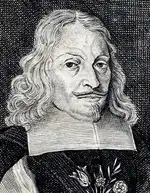
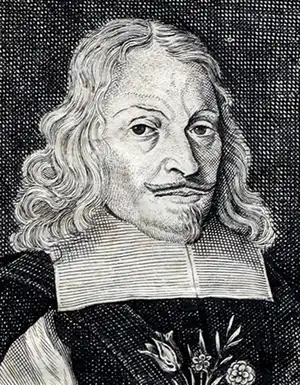
Carl Johann Lorenz Bausch was a German physician. He worked as city physician in the German city of Schweinfurt and was co-founder and president of the Academia Naturae Curiosorum. He is thus considered the first president of the German Academy of Sciences Leopoldina. He became known for expanding the extensive collection of books and writings started by his father, which is now known as the Bausch Library.
Person
Carl Johann Lorenz Bausch was born in Schweinfurt on 30 September 1605 as the first son of the town physicist Leonhard Bausch and his wife, Barbara. His brother Johann Heinrich (born 1608) later became a pharmacist and a member of the Schweinfurt city council. After attending the Latin school in Schweinfurt, Bausch transferred in 1615 to the Henneberg grammar school in the Thuringian town of Schleusingen, from which he graduated in 1621. He then received private lessons together with his brother. On 9 November 1630 Bausch married the 15-year-old Anna Margaretha Prückner. In 1631 their daughter Anna Maria was born. After the early death of the child in 1637, the couple had no further children.
Johann Lorenz Bausch died in Schweinfurt on 18 November 1665. The Leopoldina Academy Circle of Friends annually announces the Johann Lorenz Bausch Scholarship for young scholars. The Bausch Library is now housed in the Otto Schäfer Museum in Schweinfurt. There, the Bausch Tower, built from 1610 to 1618, commemorates Johann Lorenz Bausch and his father.
Career
Johann Bausch began studying medicine at the University of Jena in 1623, which he continued in Marburg in 1626 and Padua (Italy) in 1628. In addition, he travelled extensively throughout Italy between 1626 and 1628. After his return, he continued his studies at the University of Altdorf near Nuremberg, receiving his doctorate in 1630.
During the Swedish rule under King Gustav Adolph in the diocese of Würzburg, he entered the service for the Swedish government at the Julius Hospital in Würzburg from 1632 to 1634. After the defeat of the Swedes, Bausch returned to Schweinfurt, where he settled as a general practitioner in 1634. There he supported his father, at the time the Schweinfurt city physician, in fighting the plague epidemic. After his father's death, he succeeded him in office and was elected to the city council. In 1642, as city physician, he was commissioned to republish the official “Schweinfurter Apothekentax” (Schweinfurt Pharmacy Index), a catalogue of all medicines available in the city's pharmacies, which his father had previously compiled. The new version, which he thoroughly revised and expanded, appeared in its fourth edition in 1644. Bausch's intensive study of practical remedies also sharpened his awareness of their still insufficient use at that time. Bausch wanted to rectify this state of affairs and saw a way forward in the consideration of medical and pharmaceutical topics together with other scholars. This intention led decisively to the founding of the Academia Naturae Curiosorum.
Johann Bausch also made a name for himself with his extensive collection of books and writings, which his father Leonhard Bausch had already started and he expanded upon. Today, the Bausch Library is considered to be a scientific‐historical collection of the highest order.
Presidency at the Leopoldina
The founding of the Academia Naturae Curiosorum by Johann Bausch and his fellow campaigners, the physicians Johann Michael Fehr, Georg Balthasar Metzger and Georg Balthasar Wohlfahrth, was inspired by Italian models. Under Bausch's leadership, the Academy was officially founded on New Year's Day 1652 in the Free Imperial City of Schweinfurt. He himself became the first president of the Academy, which today is considered the oldest continuously existing scientific and medical academy in the world. As a member, he bore the epithet Jason I.
Johann Bausch led the society from the day it was founded until the end of his life. The Academy aimed to admit leading scholars and gain knowledge together. The motto was “Nunquam otiosus” (Never idle). The statutes drafted by Bausch named “the glory of God, the good of mankind, the further enlightenment in the field of medicine” as the association's goals. This was to be achieved, among other things, by compiling a multi-volume encyclopaedia of remedies. To this end, it was first necessary to collect the existing knowledge. In 1651, Bausch had requested in his programme that the Academy members each select an object of their choice from the mineral, plant or animal kingdoms and address it as comprehensively as possible. At the time, this demanding programme exceeded the practical possibilities of the Academy, which had just 19 members in the year of Bausch's death.
Nine years after its foundation, the first publication to appear was the “Ampelographia” by the Breslau city physician Jacob Philipp Sachs von Lewenhaimb. The work was a 670-page monograph on the vine plant. Johannes Bausch, in turn, dealt with the medicinal effects of gemstones. His work on haematites and aetites, known as blood and eagle stones, was published in the year of his death. Posthumously, three titles on other types of stones were published. Bausch's papers showed the scientifically experienced urban physicist as a scientist who was able to question existing concepts.
Soon after its foundation, the Academy sought public recognition. Due to its growing importance, Emperor Leopold I officially approved the Academy in 1672 by confirming its statutes with an imperial signum. In the course of the following years, members from other German cities were elected.