Karl Freiherr von Fritsch (✝︎)
XVI. President of the Leopoldina (1895-1906)
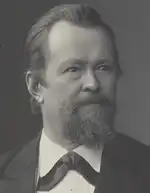
- Location Halle (Saale), Germany
- Election year 1877
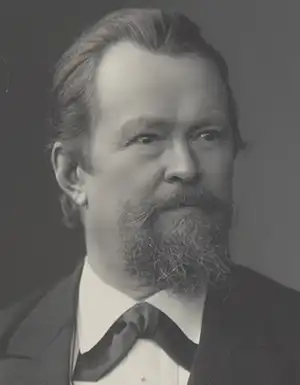
Research
Karl Georg Wilhelm Freiherr von Fritsch was a German geologist and palaeontologist whose work included research into the geology of the Canary Islands. His excursions to the Saint-Gotthard Massif in Switzerland resulted in a geological map, which is considered the prerequisite for boring through the mountain and building the Gotthard tunnel, which was opened in 1882.
For more than 30 years, von Fritsch shaped the face of geoscientific research at the Martin Luther University Halle-Wittenberg. It was under his leadership that the geoscientific collection first achieved its heyday. Freiherr von Fritsch was the 16th President of the Deutsche Akademie der Naturforscher Leopoldina (German Academy of Natural Scientists Leopoldina). During his tenure, he had a new library constructed as a permanent home for the scholarly association.
He was born to Georg August Freiherr von Fritsch, Grand Ducal Saxon Chamberlain and Head Forester, and his wife, Nanci von Rosenbach, on 11 November 1838 in Weimar. His mother having died in childbirth, Karl Freiherr von Fritsch was raised by his maternal aunt, Countess Santi.
Von Fritsch attended Friedrich Fröbel’s Play and Activity Institute in Keilhau near Rudolstadt in Thuringia, before becoming a pupil at the Weimar secondary school in 1854, from where he graduated in 1858. Inspired by a family friend, von Fritsch became enthused by geology at a young age. His “Geognostische Skizze der Umgegend von Ilmenau“ (Geognostic sketch of the Ilmenau region) was published in 1859.
In 1867 in Zurich, Karl Freiherr von Fritsch married Elisabeth Kenngott, daughter of Gustav Adolf Kenngott, a professor of mineralogy from Zurich. The couple had three sons and four daughters, and five of his children survived their father.
Karl Freiherr von Fritsch was the grandson of Karl Wilhelm Freiherr von Fritsch, a politician who owned an estate in Goddula near Merseburg, which is where Karl Freiherr von Fritsch died on 9 January 1906. His scientific estate is located in the Archive for Geography at the Leibniz Institute for Regional Geography in Leipzig. A street on the Weinberg Campus of the Martin Luther University Halle-Wittenberg has been named after him.
Career
Following family tradition, Karl Freiherr von Fritsch did a forestry apprenticeship, followed by studies at Eisenach forestry academy. In 1860, he started studying mineralogy and geology at the University of Göttingen, where he received his doctorate on 28 June 1862 with a paper entitled “Über die Mitwirkung der elektrischen Ströme bei der Bildung von Mineralien” (On the involvement of electrical currents in the formation of minerals).
He then went on a scientific excursion of the Canary Islands, before receiving his habilitation at the polytechnic institute, today’s Federal Institute of Technology Zurich. Von Fritsch undertook excursions of the Saint-Gotthard Massif, improving its geological map and paving the way for the subsequent breakthrough and the construction of the Gotthard Tunnel, which was opened in 1882.
In 1867, von Fritsch was invited to Frankfurt am Main to be a lecturer of geology by the Senckenberg Society for Nature Research.
In 1873, he moved to the Martin Luther University Halle-Wittenberg, where he elevated the existing mineral cabinet to the level of a Mineralogical Institute, whose Director he became. He was elected a professor ordinarius in 1875. It was under his leadership that the Halle geoscientific collection first achieved its heyday, considerably growing it through targeted purchases and donations. Von Fritsch also donated his valuable private collection and his library to the institute.
Inspired by Julius Kühn, an agricultural scientist, von Fritsch created a 30-metre geological profile consisting of more than 200 natural stones, providing an informative trip through the earth’s history for teaching purposes at the Martin Luther University Halle-Wittenberg.
Having found a substantial collection of fossil plants in Halle, von Fritsch focussed on phytopalaeontological studies during his time in Halle. He also collaborated with the Prussian Geological State Institute to investigate the black coal resources in the Saale valley, and explored the salt resources West of Halle on behalf of the brotherhood of salt producers of Halle. In addition to numerous individual surveys, he also published a text book on general geology in 1888, which became widely read.
In 1905, von Fritsch suffered a stroke and stepped down from his teaching obligations.
Honours and Memberships
Von Fritsch received numerous recognitions for his scientific work, among them the 4th class Order of the Red Eagle. He became a member of the Deutsche Akademie der Naturforscher Leopoldina (German Academy of Natural Scientists Leopoldina) in 1877.
Presidency at the Leopoldina
In 1895, Karl Freiherr von Fritsch, having been Hermann Knoblauch’s long-standing deputy, was elected the 16th President of the Leopoldina. Even before this appointment, he held several posts within the Academy: From 21 May 1885 until 20 May 1905, he was a civil servant, from 31 March 1888 he was a member of the Presidium, and on 17 June 1902 he became spokesperson. He held the two latter posts until his death on 9 January 1906.
During his tenure as President, von Fritsch cautiously attempted to modernise the Academy. His most notable achievement was the new library building, which was important for good reason: Under von Fritsch’s predecessor, Hermann Knoblauch, the Academy had moved its seat from Dresden to the burgeoning Central German industrial and university town of Halle in 1878. The move also meant that the Leopoldina had moved from the Kingdom of Saxony to the Province of Saxony in the Kingdom of Prussia. The library was also relocated from Dresden to Halle, however, there was no adequate building to house the collection.
The decision was taken to keep the Academy’s seat in Halle permanently. It was not until Karl Freiherr von Fritsch was appointed President that the project started taking shape, and construction of a state-of-the-art building for the library commenced, creating a new and appropriate domicile for the valuable collection on what is today August-Bebel-Straße.
Von Fritsch remained President of the Leopoldina until his death. The mathematician Albert Wangerin was elected as his successor in 1906.