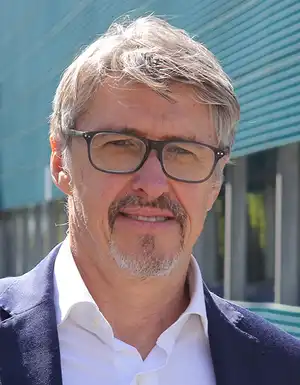
Professor Dr Marino Zerial

- Section Genetics/Molecular Biology and Cell Biology
- Location Dresden, Germany
- Election year 2024
Research
Research Priorities: Cell biology, endocytosis, intracellular trafficking, Rab GTPases, cell polarity
Marino Zerial is an Italian-German cell biologist and biochemist. He conducts research into the molecular mechanisms of endocytosis and intracellular trafficking. He has succeeded in explaining the functional mechanism of Rab GTPases. These enzymes regulate the formation and development of organelles and vesicle membrane fusion, i.e. the fusion of vesicles with endosomes. Marino Zerial’s work provides insights into the mechanisms involved in the development of liver diseases and RNA therapeutics.
Endocytosis is the uptake of material into the cell by the invagination of areas of the cell membrane. Marino Zerial’s team is investigating the underlying processes – from the molecular mechanisms to the effects on cell and tissue organisation. They are investigating the molecular mechanisms by which intracellular vesicles transport their cargo to the correct destination. Marino Zerial discovered that the enzymes Rab GTPases are important for intracellular trafficking and that Rab5 plays a crucial role in endocytosis and vesicle fusion and biogenesis.
The structure and function of liver tissue are of particular interest to the research group. They are pursuing an approach which combines biochemical and biophysical methods with modern light microscopy, cell biology and computer-aided three-dimensional tissue reconstruction. They have developed image analysis and computational pipelines to generate geometric and functional 3D models of liver tissue and bile flow. Marino Zerial has thus discovered certain structures on the apical sides of liver cells which play a role in the growth of bile ducts. In a further approach, Marino Zerial’s research group is investigating the mechanisms of RNA therapeutics (siRNA and mRNA) and RNA endocytosis.
Marino Zerial is an Italian-German cell biologist and biochemist. He conducts research into the molecular mechanisms of endocytosis and intracellular trafficking. He has succeeded in explaining the functional mechanism of Rab GTPases. These enzymes regulate the formation and development of organelles and vesicle membrane fusion, i.e. the fusion of vesicles with endosomes. Marino Zerial’s work provides insights into the mechanisms involved in the development of liver diseases and RNA therapeutics.
Endocytosis is the uptake of material into the cell by the invagination of areas of the cell membrane. Marino Zerial’s team is investigating the underlying processes – from the molecular mechanisms to the effects on cell and tissue organisation. They are investigating the molecular mechanisms by which intracellular vesicles transport their cargo to the correct destination. Marino Zerial discovered that the enzymes Rab GTPases are important for intracellular trafficking and that Rab5 plays a crucial role in endocytosis and vesicle fusion and biogenesis.
The structure and function of liver tissue are of particular interest to the research group. They are pursuing an approach which combines biochemical and biophysical methods with modern light microscopy, cell biology and computer-aided three-dimensional tissue reconstruction. They have developed image analysis and computational pipelines to generate geometric and functional 3D models of liver tissue and bile flow. Marino Zerial has thus discovered certain structures on the apical sides of liver cells which play a role in the growth of bile ducts. In a further approach, Marino Zerial’s research group is investigating the mechanisms of RNA therapeutics (siRNA and mRNA) and RNA endocytosis.
Career
- since 2023 Director and Team Leader, Human Technopole Foundation (HT), Milan, Italy
- since 2010 Professor, Dresden University of Technology, TU Dresden, Germany
- since 1998 Director and Founding Member, Max Planck Institute of Molecular Cell Biology and Genetics (MPI-CBG), Dresden, Germany
- 1991-1997 Principal Investigator, Research Group “Cell Biology and Biophysics”, European Molecular Biology Laboratory (EMBL), Heidelberg, Germany
- 1989-1991 Research Associate, EMBL, Heidelberg, Germany
- 1985-1991 Postdoctoral Fellow, EMBL, Heidelberg, Germany
- 1983-1985 Postdoctoral Fellow, Institut Jacques Monod, Université Paris Cité, Paris, France
- 1982 PhD in Biology, University of Trieste, Trieste, Italy
Functions
- since 2022 Member, Scientific Advisory Board, Cell Biology and Cancer Department, Institut Curie, Paris, France
- since 2013 Chair, Italian Scholarship Advisory Committee, Giovanni Armenise Harvard Foundation, Boston, USA
- since 2012 Reviewer, various Grant Review Panels, European Research Council (ERC)
- since 2010 Member, Editorial Board, Cellular Logistics (CL)
- since 2010 Member, Advisory Editorial Board, Molecular Systems Biology
- since 2007 Member, Italian Scholarship Advisory Committee, Giovanni Armenise Harvard Foundation, Boston, USA
- since 2005 Member, Editorial Board, Traffic
- 2003 Member, Alumni Association Board, EMBL
- since 1998 Member, Editorial Board, Journal of Cell Biology (JCB)
- since 1996 Member, European Molecular Biology Organization (EMBO), Heidelberg, Germany
Projects
- 2021-2024 Co-Coordinator, Subproject “DEEP-HCC”, Project “LiSyM-Cancer Liver Systems Medicine against Cancer”, Federal Ministry of Education and Research (BMBF), Germany
- 2020-2024 Co-Principal Investigator, Project “Self-organization and biomechanical properties of the endosomal membrane (RGP0019/2020)”, Human Frontier Science Program (HFSP), Strasbourg, France
- 2014-2022 Project Head, Subproject “Synthetic Endosomes”, Transregio (TRR) 83, German Research Foundation (DFG), Germany
Honours and Memberships
- since 2024 Member, German National Academy of Sciences Leopoldina, Germany
- since 2021 Member, American Academy of Arts and Sciences, USA
- since 2019 Member, Istituto Veneto di Scienze, Lettere ed Arti, Venice, Italy
- 2019 Fritz Lipmann Honorary Lecture, Award, German Society for Biochemistry and Molecular Biology (GBM), Germany
- 2006 Gottfried Wilhelm Leibniz Prize, DFG, Germany
- 1999 Chiara D’Onofrio Prize, Fondazione Chiara D’Onofrio, Livorno, Italy as well as Italian Society of Biophysics and Molecular Biology (SIBBM), Rome, Italy
- 1994 FEBS Anniversary Prize, GEM as well as Federation of European Biochemical Societies (FEBS), Frankfurt am Main, Germany