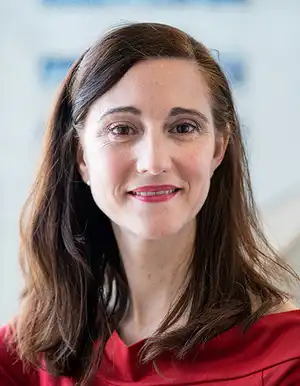
Professor Dr Meritxell Huch Ortega

- Section Genetics/Molecular Biology and Cell Biology
- Location Dresden, Germany
- Election year 2025
Research
Research Priorities: Organoids, regeneration, physiology, pathophysiology, disease mechanisms
Meritxell Huch Ortega is a pharmacist and biomedical scientist. Her research interests focus on tissue regeneration and the development of tissue-specific disease models for human organs. She elucidates the fundamental principles underlying the maintenance and repair of adult tissues as well as the mechanisms by which their dysregulation contributes to disease. She achieves this through research in 3D organoid models of the stomach, liver, and pancreas, aiming to unravel critical insights into tissue regeneration and pathology.
Regeneration is the process of restoring entire body parts or tissues to their original state. When regeneration fails, disease occurs. Unlike highly active tissues like the gut, which constantly undergo proliferation and differentiation, quiescent tissues require activation to start regeneration. The human liver and pancreas are key models for studying how cells maintain their roles and how these roles change during regeneration and disease. The liver is known for its exceptional ability to regenerate after injury, while the pancreas, despite being similar to the liver, has limited regenerative capacity. Notably, the liver can regenerate almost indefinitely after resection, but its ability is restricted after toxic injuries (e.g., from drugs or alcohol), leading to fibrosis (scarring) or, in some cases, hyperproliferation and cancer.
To explore the mechanisms behind regeneration, Meritxell Huch Ortega has developed 3D organoid models from healthy and diseased tissues of mouse and human organs, including the stomach, liver, and pancreas. In her research she combines these in vitro organoid models with in vivo systems, such as mouse models. By comparing mouse organoids with live injury-repair models, Meritxell Huch Ortega and her research group have shown that these organoids mimic many aspects of in vivo regeneration, providing valuable insights into tissue regeneration and disease mechanisms. They have transferred these models to human tissue to better model human tissue biology and study human tissue repair as well as disease. The goal is to understand in detail how human tissue regenerates and how these mechanisms are disrupted in disease.
Meritxell Huch Ortega is a pharmacist and biomedical scientist. Her research interests focus on tissue regeneration and the development of tissue-specific disease models for human organs. She elucidates the fundamental principles underlying the maintenance and repair of adult tissues as well as the mechanisms by which their dysregulation contributes to disease. She achieves this through research in 3D organoid models of the stomach, liver, and pancreas, aiming to unravel critical insights into tissue regeneration and pathology.
Regeneration is the process of restoring entire body parts or tissues to their original state. When regeneration fails, disease occurs. Unlike highly active tissues like the gut, which constantly undergo proliferation and differentiation, quiescent tissues require activation to start regeneration. The human liver and pancreas are key models for studying how cells maintain their roles and how these roles change during regeneration and disease. The liver is known for its exceptional ability to regenerate after injury, while the pancreas, despite being similar to the liver, has limited regenerative capacity. Notably, the liver can regenerate almost indefinitely after resection, but its ability is restricted after toxic injuries (e.g., from drugs or alcohol), leading to fibrosis (scarring) or, in some cases, hyperproliferation and cancer.
To explore the mechanisms behind regeneration, Meritxell Huch Ortega has developed 3D organoid models from healthy and diseased tissues of mouse and human organs, including the stomach, liver, and pancreas. In her research she combines these in vitro organoid models with in vivo systems, such as mouse models. By comparing mouse organoids with live injury-repair models, Meritxell Huch Ortega and her research group have shown that these organoids mimic many aspects of in vivo regeneration, providing valuable insights into tissue regeneration and disease mechanisms. They have transferred these models to human tissue to better model human tissue biology and study human tissue repair as well as disease. The goal is to understand in detail how human tissue regenerates and how these mechanisms are disrupted in disease.
Career
- since 2024 Honorary Professor, Dresden University, Dresden, Germany
- since 2022 Director, Max Planck Institute of Molecular Cell Biology and Genetics, Dresden, Germany
- 2019-2022 Lise Meitner Group Leader, Max Planck Institute of Molecular Cell Biology and Genetics, Dresden, Germany
- 2014-2020 Group Leader, Wellcome/Cancer Research UK Gurdon Institute, University of Cambridge, Cambridge, UK
- 2014-2020 Affiliated Group Leader, Cambridge Stem Cell Institute, University of Cambridge, Cambridge, UK
- 2014-2020 Member, Department of Physiology, Developmental Biology and Neurosciences, University of Cambridge, Cambridge, UK
- 2008-2014 Postdoctoral Fellow (Marie Curie Fellow-IEF), Hubrecht Institute for Developmental Biology and Stem Cell Research, Utrecht, The Netherlands
- 2007-2008 Postdoctoral Fellow, Centre for Genomic Regulation (CRG), Barcelona, Spain
- 2003-2007 PhD Student (Spanish Ministry of Health fellow), Centre for Genomic Regulation (CRG), Barcelona, Spain
- 2002-2003 Master of Advanced Studies, University of Barcelona, Barcelona, Spain
- 2001 BSc in Pharmaceutical Science, University of Barcelona, Barcelona, Spain
Functions
- since 2025 Member, Scientific Advisory Board, Institute of Molecular Biology of Barcelona (IBMB), Barcelona, Spanish Research Council (CSIC), Spain
- since 2025 Member, Scientific Advisory Board, ASPIRE-AECC (Neoadjuvant-adjuvant immunotherapy to improve survival in hepatocellular carcinoma), Spanish Association Against Cancer (AECC), Spain
- since 2024 Member, Scientific Advisory Board, Swiss Institute for Experimental Cancer Research (ISREC), École Polytechnique Fédérale de Lausanne (EPFL), Lausanne, Switzerland
- since 2024 Member, Steering Committee, DRESDEN-concept Genome Center (DcGC), Dresden, Germany
- since 2024 Program Dean, International Max Planck Research School (IMPRS) for Cell, Developmental and Systems Biology, Dresden, Germany
- since 2023 Member, Italian Scholarship Advisory Committee, Giovanni Armenise Harvard Foundation, Boston, USA
Projects
- since 2024 Leader, Project “BileCanMet”, ERA-NET “TRANSCAN-3”, Horizon 2020, European Union (EU)
- since 2023 Principal Investigator, Consolidator Award “Mechanisms of liver regeneration and disease across scales; from molecules to cells and tissue”, European Research Council (ERC)
- since 2023 Applicant, Subproject “Cell-microenvironment mechanical interactions in cancer from single cells to tissues”, Research Unit (FOR) 5628, German Research Foundation (DFG), Germany
- since 2023 Applicant, Research Grant “Identifying the epigenetic regulatory mechanisms that drive the response of liver ductal cells to damage”, DFG, Germany
- since 2022 Allen Distinguished Investigator, Allen Institute, Seattle, USA
- since 2021 Leader, Subproject “DEEP-HCC”, Liver Systems Medicine Cancer (LiSyM-Krebs), Federal Ministry of Education and Research (BMBF), Germany
Honours and Memberships
- since 2025 Member, German National Academy of Sciences Leopoldina, Germany
- 2024 Otto Bayer Award, Bayer Foundation, Leverkusen, Germany
- since 2023 Member, European Molecular Biology Organization (EMBO)
- 2022 Hilde Mangold Award, German Stem Cell Network (GSCN), Germany
- 2019 BINDER Innovation Prize, German Society for Cell Biology (DGZ), Germany
- 2018 Researcher of the Year, Cambridge Independent Science and Technology Awards, Cambridge, UK
- 2018 Young Investigator Award, EMBO
- 2018 Women in Cell Biology (WCIB) Early Career Medal, British Society for Cell Biology, UK
- since 2017 Member, International Society for Stem Cell Research (ISSCR)